


- •Three parent companies now own six of the ten most recognizable consumer VPN brands.
- •Independent VPN providers are shutting down due to rising bandwidth costs and DDoS exposure.
- •Most surviving independent providers have raised prices 15 to 20 percent just to stay operational.
- •White label VPN separates brand ownership from infrastructure ownership, unlike a reseller or acquisition.
- •A white label structure lets a brand avoid both consolidation risk and independent infrastructure cost.
The white label VPN industry is growing for a specific reason. The VPN industry itself is splitting into two extremes, and almost nothing is left standing in between. A small number of large owners now control most of the recognizable consumer VPN brands. At the same time, independent VPN providers are shutting down at a steady pace, unable to absorb rising infrastructure costs alone. White label VPN is the structure that lets a brand exist in the middle without owning either extreme.
The VPN Industry Is Consolidating at the Top
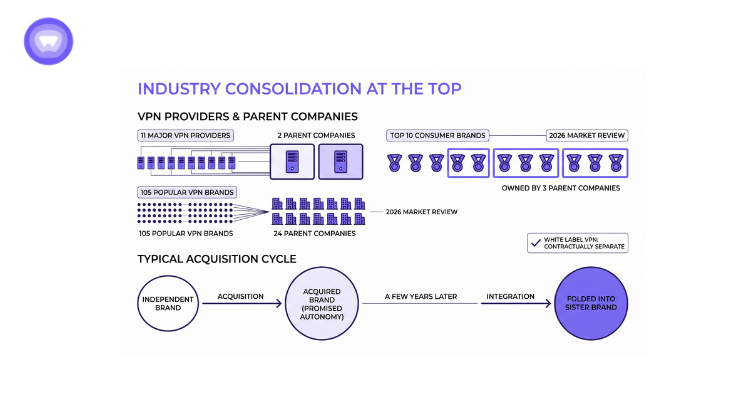
Ownership in the VPN industry has concentrated sharply since 2020. A recent server-infrastructure dataset found that just two parent companies control more than half of the server blocks among the eleven largest VPN providers. A separate industry count identified roughly 105 of the most popular VPN brands tracing back to only 24 parent companies. A 2026 market review confirms the trend has not slowed. Three parent companies now own six of the ten most recognizable consumer VPN brands.
This pattern follows a repeatable script. A large parent company acquires a smaller, independently branded VPN. It promises the brand will keep running on its own. A few years later, that brand gets folded into a larger sibling brand instead. One freemium VPN followed this exact path. It was acquired in 2021, ran as a separate brand for three years, then shut down in 2024 once its parent decided a standalone brand no longer made commercial sense. Its full user base migrated directly into a larger sister brand overnight.
This is what VPN brand acquisition looks like in practice. The customer relationship survives the acquisition. The brand identity usually does not. That is the specific risk a white label VPN structure is built to avoid, since brand ownership and infrastructure ownership stay contractually separate from day one.
Independent VPN Providers Are Disappearing at the Bottom
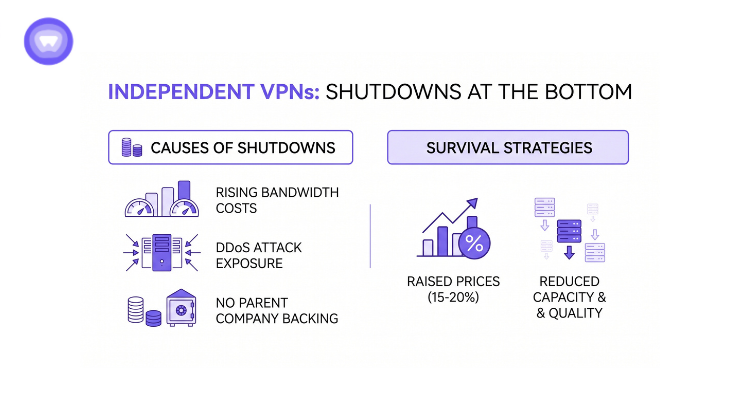
While ownership concentrates at the top, independent VPN providers are disappearing underneath it. Public shutdown reports from 2025 and 2026 point to a consistent set of causes. Rising bandwidth costs, growing exposure to distributed denial-of-service attacks, and an inability to cover infrastructure bills without a parent company’s balance sheet behind them.
Nearly every independent provider still operating has raised prices to survive, typically by 15 to 20 percent, just to keep pace with network costs. Others are quietly reducing server capacity or trimming quality instead of raising prices outright. Both responses point to the same underlying problem. Running VPN infrastructure alone has become more expensive at the exact moment competition has become more intense.
This is the second half of the barbell shaping VPN market structure today. The top of the industry is consolidating into fewer, larger owners. The bottom is shrinking as unsupported independent operators run out of runway. Very little capacity is left standing in the middle.
Where White Label Sits Among VPN Business Models
A brand entering the VPN space has three structurally different options, and they get confused constantly. A reseller sells another company’s VPN service under that company’s own terms, with a commission on each sale. The reseller owns almost nothing beyond the sales relationship. A company that builds its own VPN owns everything, including every dollar of the infrastructure cost driving the current shutdown wave. White label VPN sits in the middle of those two extremes. The partner brand owns the customer relationship, the pricing, and the app identity. A separate infrastructure partner owns the servers, protocols, and backend running underneath it.
| Model | What the Partner Owns | What the Provider Supplies | Exposure to Rising Infrastructure Cost |
| Reseller | Sales relationship only | Brand, apps, servers, backend | Very low, but no brand equity is built |
| White label VPN | Brand, pricing, customer relationship | Servers, protocols, backend maintenance | Low, cost sits with the infrastructure partner |
| Independent build | Everything | Nothing | High, this is the group currently shrinking |
This distinction explains why white label VPN industry growth is accelerating while independent VPN provider counts are shrinking. A brand no longer has to choose between full ownership and full exposure to the shutdown wave already described.
What Is Left in the Middle
A brand that wants to enter or stay in the VPN space now faces a narrower set of real options than it did five years ago. Building an independent, fully owned VPN stack means absorbing the same infrastructure costs pushing smaller providers out of business today. Getting folded into a large conglomerate through acquisition means giving up long-term brand independence. Neither option fits a company whose actual core business is security software, a telecom plan, or a SaaS product, not VPN infrastructure itself.
White label VPN is the structural answer to that gap in VPN market structure. It lets a brand keep full ownership of its customer relationship, its pricing, and its public identity, while a separate infrastructure partner absorbs the server costs, protocol maintenance, and capacity planning currently pushing independent operators out of the market. The brand takes on none of the infrastructure risk driving the shutdown wave.
What a Migration Away From an Unsustainable Model Looks Like
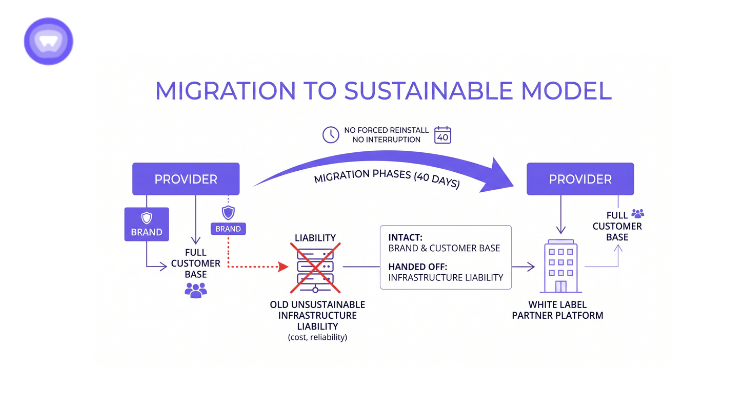
A brand that already committed to an independent VPN stack is not locked into that decision permanently. One global cybersecurity provider moved a base of three million VPN users off its own infrastructure and onto a white label partner’s platform. The migration ran in phases over 40 days, with no forced app reinstall and no visible service interruption for end users.
That migration is the practical version of the shift this article describes at the industry level. The provider kept its brand and its full customer base intact. It handed off the infrastructure layer that had become a cost and reliability liability to run alone, without disrupting the product experience its customers already trusted.
How PureWL Supports Brands Building in the Middle Tier
PureWL exists specifically for the middle tier this consolidation and shutdown wave is creating. A partner brand keeps full control of pricing, positioning, and the customer relationship, while PureWL runs the server network, protocol maintenance, and capacity planning behind it.
That structure includes a KPMG-audited no-log policy, a network of more than 6,500 servers across 88 countries, and more than 150 active partners, all figures PureVPN reports as its own operating data rather than third-party audited claims outside the no-log audit itself. Two related questions come up often once a partner brand starts weighing this shift: how the protocol layer stays current without added engineering work, and how per-seat economics compare to running infrastructure independently.
The Real Choice Underneath the Consolidation Wave
The VPN industry is not simply getting bigger. It is getting narrower at both ends, with fewer independent full-stack operators and a smaller number of owners controlling the biggest brands. The ownership question a brand answers today determines which side of that shift it ends up on. White label VPN is the one structure in the current white label VPN industry built specifically for the space in between.
A brand does not need to choose between building infrastructure it cannot sustain and losing its identity to an acquisition. Request a 20-minute infrastructure and margin review with a PureWL partner engineer to see where a VPN line fits without either risk.