


- White label VPN adoption is shifting from a paid differentiator to an assumed baseline feature across multiple industries.
- Several major consumer security suites already bundle VPN by default, resetting buyer expectations for every vendor downstream.
- MSPs, SaaS platforms, telecom carriers, and hardware makers each feel this pressure differently and on different timelines.
- Bundled security margins already run meaningfully higher than reselling individual tools, a gap that widens the longer a vendor waits.
- A real, though narrowing, differentiation window still exists for teams that move before VPN becomes fully commoditized.
White label VPN adoption is no longer a growth story about a niche add-on. It is a story about expectations shifting under every vendor’s feet at once. The global VPN market is projected to climb from $50 billion in 2023 to $137.7 billion by 2030, according to a 2024 industry analysis. That growth is not the real story. The real story is what happens to a business that treats a VPN as an optional upgrade while its competitors already ship one as a default feature. White label VPN adoption is becoming the baseline expectation across security, SaaS, telecom, and hardware. This post explains why the shift is happening, which sectors feel it fastest, and what it costs to bundle VPN last instead of early.
What “Becoming a Standard Feature” Actually Means
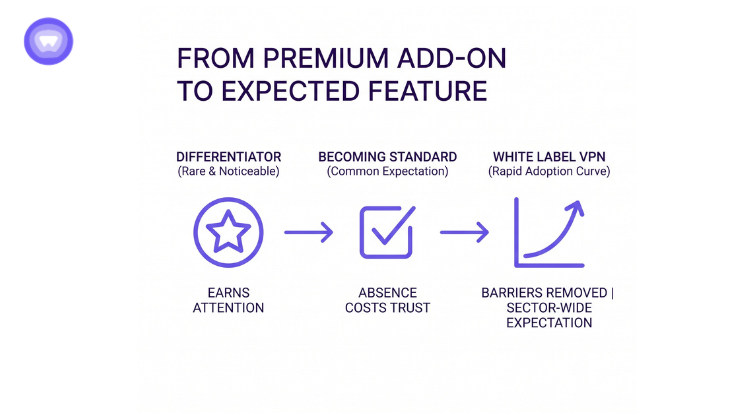
A standard feature is something buyers assume exists before they ask about it. Two-factor authentication went through this shift a decade ago. Encrypted storage went through it more recently. White label VPN adoption is following the same curve, moving from a premium extra to a checkbox buyers expect to already be checked.
This distinction matters for anyone deciding whether to bundle VPN this year or wait. A differentiator earns attention because it is rare. A standard feature earns nothing by existing, but its absence actively costs trust. Once white label VPN adoption crosses that line for a given industry, marketing a VPN as a special add-on stops working, and missing one starts working against the brand instead.
The white labeling model itself is what makes this shift possible on a fast timeline. A company does not need to build tunneling protocols or manage server infrastructure to launch what is functionally a white label VPN under its own name. That removed barrier is precisely why adoption can move from a handful of early movers to an entire sector in a short window.
The Parity Trigger: How Suite Bundling Forces Everyone’s Hand
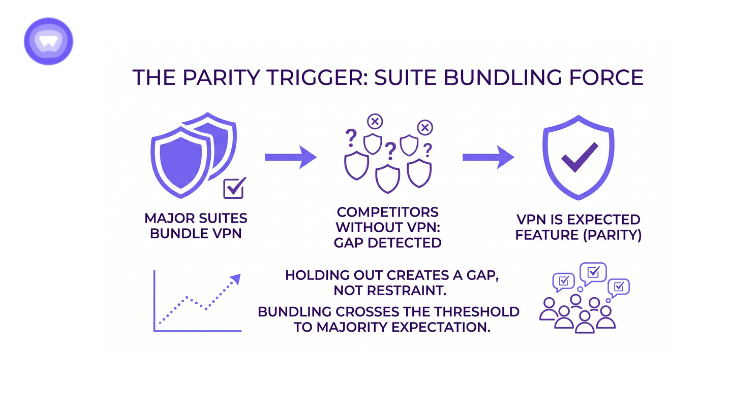
White label VPN adoption did not accelerate because more people learned what a VPN does. It accelerated because several major consumer security suites started bundling VPN access into their base subscriptions rather than selling it as a paid extra. Once that happens at scale, every other security brand competing for the same customer has to match it or explain why it does not.
The scale of that shift, including exactly how much of the antivirus-using population now expects VPN bundled in, is broken down in a companion piece on white label VPN service layers, which also maps who owns the risk once a vendor makes that move. The short version is that this is no longer a niche behavior. It is a majority expectation among users who already pay for one security product.
This is the parity trigger. It does not require every competitor to bundle VPN before pressure builds. It only requires enough visible competitors to do it that customers start treating the feature as normal. Once that threshold is crossed, holding out does not read as restraint. It reads as a gap.
Adoption by Channel: MSPs, SaaS Platforms, Telecom, and Hardware
White label VPN adoption is not hitting every industry at the same speed or for the same reason. Each channel has its own trigger, and each channel has its own proof point showing what is already happening on the ground.
| Channel | Adoption Driver | Urgency Level |
|---|---|---|
| MSPs/MSSPs | Recurring-revenue pressure from clients bundling security into one line item | High |
| SaaS Platforms | Churn tied directly to missing built-in security features | High |
| Telecom/ISP | Flat or declining ARPU pushing carriers toward value-added services | Medium |
| Hardware Makers | Buyers expecting network-level protection without a separate app | Medium |
For MSPs, the pressure is margin-driven rather than technical. CyVent’s 2025 analysis found bundled endpoint security margins run roughly 18 percentage points above reselling antivirus alone, a gap that widens further once VPN joins the same bundle.
For SaaS platforms, the pressure shows up as churn. A productivity app case study found that more than 30 percent of uninstalls cited a lack of built-in security as the reason, a figure the app’s own team could act on only after adding VPN natively.
For telecom, the trigger is ARPU stagnation rather than churn. A Gulf-region telecom aggregator documented in a built-in VPN eSIM case study reported 50 percent higher ARPU on a roaming SIM tier that bundled VPN access, a self-reported operator figure rather than an independently audited one.
For hardware makers, adoption looks different again. A router and API integration case study removed the need for a separate consumer app entirely, extending protected coverage to smart TVs and consoles without adding a new interface for the household to manage.
What It Costs to Bundle Last
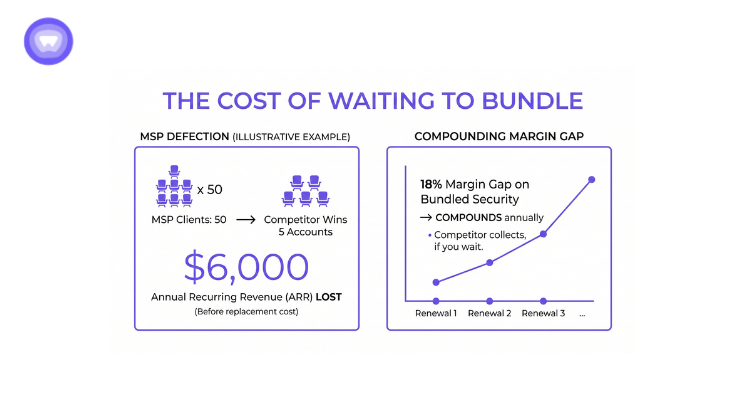
Consider a hypothetical MSP managing 50 small business clients at $10 per seat per month. If a competing MSP starts bundling VPN at no extra charge and wins even five of those accounts on that basis, the losing MSP gives up $6,000 in annual recurring revenue before accounting for the cost of acquiring replacement clients. This is an illustrative example, not a projection tied to any single company.
The margin data above points at the same pattern from a different angle. An 18 percentage point margin gap on bundled security is not a one-time number. It compounds every renewal cycle a vendor spends without the bundle in place. Waiting one full product cycle to decide does not pause that gap. It lets a competitor collect it instead.
Is There Still a Differentiation Window?
White label VPN adoption crossing a threshold in one channel does not mean the window has closed everywhere. Telecom and hardware are still earlier in the curve than MSPs and SaaS platforms, based on the adoption drivers in the table above. A telecom provider bundling VPN today is still ahead of most of its direct competitors, even though an MSP making the same move is closer to catching up than standing out.
The differentiation that remains is not about having a VPN. It is about how the VPN is delivered and verified. Buyers who now expect VPN as a baseline are starting to ask harder questions about what to actually verify in a commercial VPN provider, including audit scope, protocol transparency, and per-tenant performance guarantees. A detailed look at building trust in a white label VPN business covers this shift from feature-checklist buying to verification-based buying in more depth.
That shift creates a narrower but real opportunity. The vendors who move now can still compete on depth and verification. The vendors who wait until VPN is fully commoditized will be competing on price alone, in a category where price competition erodes margin fastest.
How PureWL Supports This Shift
Moving early on white label VPN adoption does not require a multi-year infrastructure build. PureWL provides a branded VPN partners can launch under their own name, backed by infrastructure spanning more than 6,500 servers across 88 countries, figures PureWL reports internally rather than through third-party audit.
Partners retain full control over pricing, branding, and the client relationship while PureWL handles server maintenance, protocol updates, and multi-tenant provisioning behind the scenes. For a partner deciding whether to move before or after VPN becomes fully commoditized in their channel, that removed build burden is often the deciding factor.
Conclusion
The question in front of most vendors is no longer whether to add VPN. White label VPN adoption already answered that question for the channels moving fastest. The real question is how soon a given business needs to move before the decision gets made for them by a competitor’s announcement instead. Request a 20-minute walkthrough to see where your channel sits on that timeline.