


- Business Model First: Define your business model before comparing providers. Whether the VPN sells standalone, bundles with an existing product, or runs through resellers changes which provider features actually matter.
- Operational Depth Over Marketing: Look past marketing claims into operational depth. Platform branding, owned infrastructure, backend tooling, transparent pricing, and real support all separate providers that scale from ones that only look strong in a demo.
- Exit Terms Matter: Exit terms matter as much as day one features. Data export rights, contract lock in periods, and app store ownership determine how costly it is to leave a provider later, a factor most buyers overlook until it is too late.
- Market Stakes Are Rising: The market context raises the stakes. Rapid VPN market growth and rising enterprise adoption mean picking a provider that cannot scale becomes more costly every year.
- Proof Over Theory: Real deployment proof beats theoretical features. A documented case study of VPN bundled with existing services showed measurable gains in client growth, retention, and revenue, though results map most directly to similar business models.
Most buying guides for VPN resale treat the decision like a checklist of app features. That misses the real risk. The providers that fail partners are not the ones with weaker encryption. They are the ones whose backend, pricing, and support quietly become a liability six months after launch. To choose white label VPN provider correctly, look past the demo and into how the business runs behind it.
Start With Your Business Model Before You Compare Providers
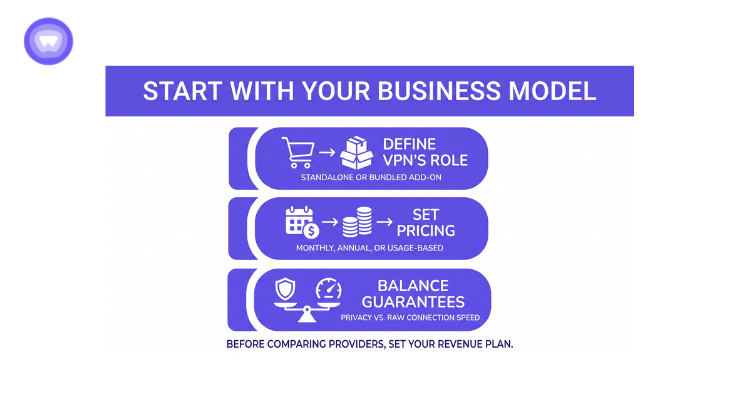
Before any vendor comparison, define how the VPN fits your revenue plan. A branded VPN can work as a standalone subscription, a bundled add-on to an existing product, or a reseller-distributed offer. Each path pulls different requirements out of a provider.
Three questions settle this early:
- Will the service sell directly, or ride alongside a product you already offer?
- Does pricing run monthly, annual, or usage-based?
- Does your audience care more about privacy guarantees or raw connection speed?
Once these answers exist, the process to choose white label VPN provider turns into a simple filter, not a guess. Businesses that skip this step often pick a strong provider that still does not fit their sales plan.
What Actually Matters When You Choose White Label VPN Provider
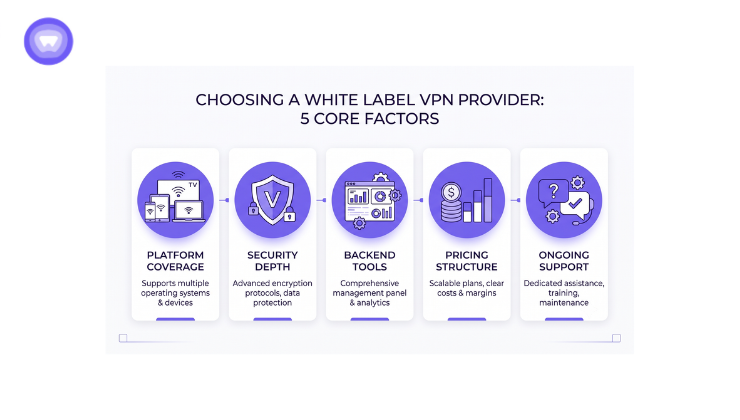
Every provider claims full customization and enterprise-grade infrastructure. The differences show up in how completely each one delivers on that claim at scale, not in the marketing copy. Five factors carry most of the real risk.
Platform Coverage and Brand Ownership
A white label app has to read as a first-party product, not a reskinned utility. That means full Android and iOS coverage, store-ready builds, and no visible trace of the original VPN vendor.
Partial branding is a common trap. Some providers only reskin the interface while keeping shared code or shared app-store listings across multiple clients. That setup limits how the product can grow and who controls the listing.
Infrastructure and Security Depth
Server count and protocol support decide whether the product holds up once real users show up. Look for a large, geographically distributed server network. Confirm support for OpenVPN, IKEv2, and WireGuard, plus a documented no-log policy rather than a marketing claim.
Providers without owned infrastructure often resell capacity from someone else. That adds a layer of risk you cannot inspect directly. Performance and privacy claims then depend on a vendor you never see. This is exactly where buyers who choose white label VPN provider on price alone tend to get burned later.
Backend Tools and Integration Support
The admin console is where day-to-day operations either run smoothly or become a support burden. A serious provider gives partners a centralized dashboard for user management, billing, and server assignment. APIs and SDKs support deeper integration into an existing app or platform.
Usage analytics matter here too. Without visibility into adoption and churn, forecasting turns into guesswork.
Pricing Structure and Margin Protection
When you choose white label VPN provider, pricing clarity determines whether margins hold up as the user base grows. Flexible, transparent pricing that scales with usage protects that margin. Hidden infrastructure fees or per-feature surcharges erode it quietly.
Free or heavily discounted tiers usually come with a catch: restricted branding, capped users, or no path to monetization. They work for testing, not for a commercial launch.
Onboarding and Long-Term Support
A fast launch means little if support disappears once the contract is signed. Dedicated onboarding, integration guidance, and ongoing technical support reduce time to market and prevent avoidable downtime later.
What Happens When You Need to Leave
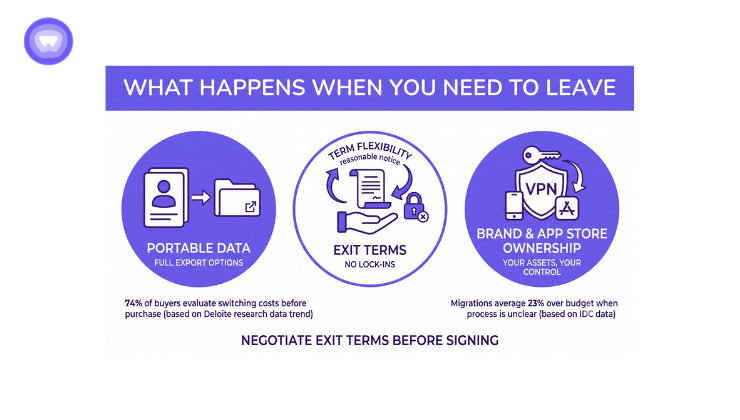
Every guide on this topic stops at day-one features. None of them cover what happens years later, when a business outgrows a provider or needs to switch. That gap is a real blind spot. Exit terms shape total cost as much as the launch price does.
Three questions belong in every contract review, not just the sales call:
- Can you export full user records, billing history, and device data in a portable format?
- Does the contract lock you into a minimum term, or allow exit with reasonable notice?
- Who owns the app store listing and brand assets if you switch providers?
The EU Data Act’s core switching and portability provisions took effect on September 12, 2025. They do not name VPN resale contracts directly, but they signal where buyer expectations are heading across digital services. Negotiating exit terms after signing is no longer a safe default.
More buyers are asking these questions before signing anything. Deloitte’s Tech Trends research found that 74% of software buyers now evaluate switching costs before a purchase. That is up from 47% in 2018, based on industry research. That shift applies directly to VPN resale contracts. Data ownership and app store control rarely get discussed until a partner tries to leave.
The financial risk is real too. IDC research shows 38% of platform migrations exceed their original budget. The average overrun lands at 23% above plan, according to cloud migration data. A white label VPN migration carries the same exposure. Rebuilding user accounts, re-authenticating devices, and re-establishing trust with an installed base takes real engineering time.
Clear export tools, a documented offboarding process, and no forced minimum term remove most of that risk. The problem never gets the chance to start.
What the Numbers Say About Getting This Decision Right
The stakes behind the decision to choose white label VPN provider are larger than most buyers assume. The global VPN market is projected to grow from $88.96 billion in 2025 to $534.22 billion by 2034. The estimate comes from one market analysis. That growth means more competition for privacy-conscious users, raising the cost of picking a provider that cannot scale.
Enterprise demand is already substantial. Over 78% of organizations with more than 500 employees already run VPN solutions to secure internal communication and cloud access. That figure comes from recent industry data. A narrower VPN software segment is expanding just as fast. It is projected to grow from $2.45 billion in 2024 to $9.41 billion by 2033, a 16.2% annual growth rate.
None of this guarantees success for any single reseller. It does mean scaled providers separate quickly from the rest. Shallow reseller access dressed up as a full white label program falls behind fast.
Proof From a Live Partner Deployment
Numbers on a market report are useful context. A real deployment tells you more about what happens after signup. This proof point speaks directly to MSPs, since bundling was the actual mechanism behind the results. One managed service provider bundled antivirus protection with a branded VPN inside its security suite, rather than selling both separately.
The result comes from a documented partner case study. Within two months, enterprise clients grew 20%, operational costs fell 32%, client retention rose 15%, and revenue increased 25%. These figures come from the partner’s own reporting, not an independent audit. A SaaS platform or device maker selling VPN as a standalone feature should expect different specific numbers. The underlying principle still holds: a well-integrated backend consistently outperforms a bolted-on add-on, regardless of the exact business model.
Quick Reference: Criteria at a Glance
Use this table as a working scorecard whenever you sit down to choose white label VPN provider against a shortlist.
| Criterion | What Good Looks Like | Red Flag |
| Branding | Full native apps, no vendor trace, store-ready | Shared app framework across multiple clients |
| Infrastructure | Large owned server network, audited no-log policy | Resold capacity from an undisclosed third party |
| Backend | Centralized dashboard, APIs, usage analytics | Manual user management with no reporting |
| Pricing | Transparent, scales with usage, no hidden fees | Free tier with branding or user caps |
| Support | Dedicated onboarding plus ongoing technical help | Support that ends after the initial setup call |
| Exit Terms | Full data export, no forced minimum term | No documented offboarding or export process |
Where PureWL Fits Into This Decision
PureWL White Label VPN Solution was built around these six criteria rather than around a single flagship feature. Partners get fully branded apps across Android, iOS, Windows, and macOS. A server network spans more than 6,500 locations worldwide. A centralized console covers billing, user management, and analytics in one place.
Pricing stays partner-driven, without the hidden infrastructure charges that erode margins as a client base grows. Onboarding includes direct integration support, so the setup does not fall entirely on a team still learning the platform. Full data export and a documented offboarding path come standard, with no forced minimum contract term.
Making the Final Call
Choosing a provider stops being a gamble once six things are clear on paper. Those six: business model, infrastructure depth, backend tooling, pricing structure, support commitment, and exit terms. The goal at this stage is confident selection, not endless comparison. Regulatory deadlines like the EU Data Act’s September 2025 switching provisions are normalizing exit rights fast. Most VPN contracts have not caught up yet.
That gap closes for buyers who ask early, not for ones who wait. When you choose white label VPN provider, weigh the operational fit over the marketing page. That operational fit determines whether the launch still works a year from now.