


- Ownership, not encryption, is the real difference. A white label VPN and a regular VPN typically run the same protocols. What changes is who owns the brand, the billing, and the customer data.
- Referring users to a regular VPN creates a compliance gap. That provider becomes an uncontracted data processor under GDPR, with no data processing agreement in place.
- Embedding keeps support and app store review inside one system. A referred VPN means a second app install and a support conversation you cannot fully control.
- The revenue math favors embedding at scale. A one time affiliate commission stays flat, while a per seat white label markup compounds with every renewal.
- Waiting to switch costs more than deciding early. Migrating an existing user base later means new onboarding, new billing hooks, and a support transition most teams could have avoided.
Two products share the word VPN and almost nothing else. The White Label VPN vs VPN confusion is common. One is a retail app, the kind a person downloads from a store. They pay five dollars a month and never think about it again. The other is infrastructure a product team wires into a roadmap, a billing system, and a support queue.
This is not a comparison of open source builds, reseller programs, or building a VPN from scratch. It is the narrower, more common question product teams actually face. Point users to an existing consumer VPN app, or embed one under your own brand instead. Confusing the two costs product teams real time during vendor selection. This applies whether the product is a SaaS platform or a connected device.
The white label VPN vs VPN question sounds like a branding detail. It is actually a decision about who owns the customer, the data policy, and the margin.
Two Products, One Overused Word
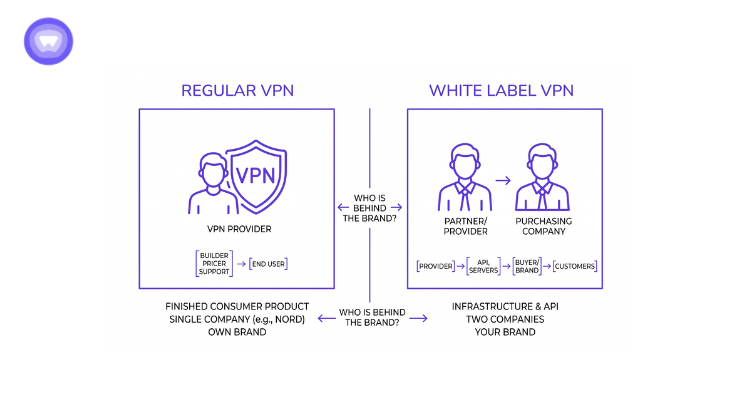
Marketing pages use “VPN” to describe both categories. Buyers naturally assume the difference is cosmetic. It is not. The cost of that confusion shows up fast. In one internal case study, over 30 percent of app uninstalls were tied to a lack of built-in security. That is not a missing feature elsewhere in the product. A regular VPN is a finished consumer product. One company builds it, prices it, and supports it for its own end users.
A white label VPN is different. It is a set of servers, protocols, and APIs that a second company packages under its own brand. That second company then sells it to its own customers. The white label VPN vs VPN comparison starts at this level. It is about who the product legally and operationally belongs to, not how the encryption works.
What a Regular VPN Is Built to Do
A regular VPN, such as a retail app from a known privacy brand, serves one company’s own subscriber base. Its logging policy belongs to that vendor. Its server list belongs to that vendor. Its app store listing belongs to that vendor too. A product team can recommend it. They can link to it or bundle a discount code for it. None of the underlying infrastructure ever becomes their own. None of the pricing or customer data does either. The relationship stays one layer removed from the product it is meant to protect.
What a White Label VPN Actually Gives You
A white label VPN flips that arrangement around. The infrastructure, protocols, and server network stay with the provider. The brand, pricing, billing, and customer relationship transfer to the partner instead. Practically, that means:
- Your logo, app name, and support contact appear everywhere the user looks.
- You set the price, the plan tiers, and the renewal terms.
- You own the resulting customer data and the support tickets tied to it.
- You can bundle the VPN into an existing subscription, not a separate checkout.
That last point matters more than it looks. A referral link sends a paying user somewhere else. A white label VPN keeps that user, and that revenue, inside your own account system. This is the practical core of the white label VPN vs VPN decision.
White Label VPN vs VPN: Side-by-Side Comparison
Every row in the table becomes a recurring cost or a recurring margin. It stops being a one-time decision once a product scales past a handful of users. That is where the white label VPN vs VPN gap widens fastest.
| Factor | Regular VPN (referred) | White Label VPN (embedded) |
| Brand shown to user | Third-party VPN brand | Your own brand |
| Who sets pricing | Third-party vendor | You |
| Who owns customer data | Third-party vendor | You |
| Support channel | Third-party vendor | Your own team |
| Revenue model | One-time affiliate commission | Recurring per-seat margin |
| App store listing impact | Separate app, separate review | Part of your existing app |
| Data processing agreement | Rarely available to you | Signed directly with you |
Who Owns the Customer Relationship
Ownership shows up in small operational details long before it shows up on a balance sheet.
App Store Review Treats Embedded and Referred VPNs Differently
Apple and Google both scrutinize apps that send users to install a second, unrelated app. An embedded white label VPN ships inside your existing binary. It goes through one review cycle under your existing developer account. A referral to a separate VPN app means a second install. It means a second permissions prompt too. Your product team also inherits a support conversation it cannot fully control. That second app updates on its own schedule, not yours.
Branding Consistency Affects Retention, Not Just Looks
Security-conscious users judge trust by consistency. A user told to “download this other VPN app for full protection” reads that as an admission. Your product is telling them it cannot secure itself. A user who sees your own brand handling the encryption reads that as a built-in feature. It does not read as an outsourced patch.
The Compliance Gap Nobody Mentions
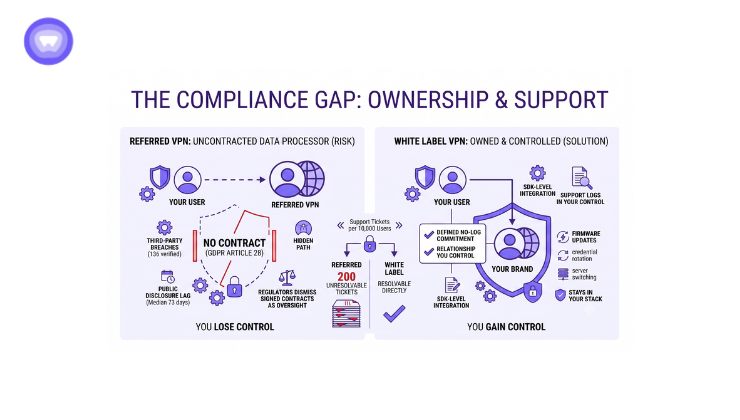
Ownership and support are not the only stakes. Referring users to a regular VPN quietly changes who is legally responsible for their data.
A Referred VPN Provider Becomes an Uncontracted Data Processor
A product team that recommends a third-party consumer VPN creates a gap. That provider starts handling traffic tied to your users. No data processing agreement exists between you and them. Under GDPR Article 28, a written agreement must exist before a processor ever touches that data, not after. A 2026 enforcement review found 136 verified third-party breach events in 2025 alone. The median public disclosure lag was 73 days. Regulators are no longer accepting a signed contract as proof of oversight. A white label arrangement replaces the gap entirely. It comes with a defined no-log commitment and a relationship you actually control.
For Connected Devices, the Same Gap Sits at the Firmware Layer
A product team shipping a connected device faces a sharper version of the same problem. A device that recommends a separate VPN app means the user configures it manually, outside your firmware. Support tickets about connectivity land on your team regardless of which company built the VPN. An SDK-level white label integration puts the VPN inside the device’s own configuration flow instead. Your support documentation can then reference one system, not two. Firmware updates, credential rotation, and server switching all stay inside one stack you control. None of it depends on a separate vendor’s release schedule.
Support Tickets Reveal the Real Cost of Recommending One
Verizon’s 2025 Data Breach Investigations Report is covered in recent VPN research. It ties perimeter devices and VPN endpoints to a 34 percent jump in exploitation activity. The same coverage puts edge-device breach growth at roughly eightfold in a single year. Another source separately reports that paid VPN adoption among US users climbed to 52 percent in 2025.
Every one of those paying users expects a fast, documented answer when a connection issue comes up. A referred VPN cannot give your support team that documentation. A white label VPN can, because the logs and escalation path sit inside your own vendor relationship. Decide who controls that traffic before your next release, not after a breach forces the question.
Picture this as a simple, illustrative example, not a sourced figure. A product team supporting 10,000 users on a referred VPN sees a modest 2 percent monthly contact rate. That alone creates 200 support tickets the team cannot resolve directly, since the logs sit with someone else.
The Real Cost Comparison
Run the math on a second illustrative example. A product team with 5,000 paying seats refers users to a consumer VPN through an affiliate link. That link pays a flat 20 dollar commission per signup. If 8 percent convert, that is 400 signups and 8,000 dollars, once. The same team embeds a white label VPN at a 4 dollar per seat markup across those same 5,000 seats. That is 20,000 dollars every month, not once. It compounds as the user base grows too.
The market underneath that math keeps expanding. The global VPN market was valued near 89 billion dollars in 2025. It is projected to exceed 534 billion dollars by 2034, according to market forecast data. A referral commission captures none of that growth curve. A white label margin captures a slice of it on every renewal. Product teams comparing white label VPN vs VPN vendors on price alone tend to miss this effect. A one-time commission and a recurring markup look similar only in the first month.
When a Regular VPN Recommendation Still Works
A referral is not always the wrong call. It fits teams still validating demand for security features. It fits teams with no support capacity to absorb a new product line. It also fits products where security is a minor feature, not a core promise. The decision changes once retention data starts showing a pattern.
The uninstall pattern cited earlier, over 30 percent tied to missing built-in security, makes the point plainly. That is where a referral link stops being a convenience. It starts being a retention leak instead. Once that pattern shows up in retention data, the white label VPN vs VPN debate is effectively already decided.
Switching Later Costs More Than Deciding Now
Some teams start with a referral link, planning to switch to a white label VPN once volume justifies it. That switch is rarely instant. Moving an existing user base from a referred VPN to an embedded one means new onboarding flows. It also means new billing hooks and a support transition period. Two systems briefly overlap during that window. None of that is difficult on its own. It is simply easier to plan for early. Retrofitting later, once thousands of users already expect the old flow, costs far more. Teams that map out the white label VPN vs VPN decision early tend to avoid a second migration project entirely.
Questions Worth Asking Before You Pick Either Model
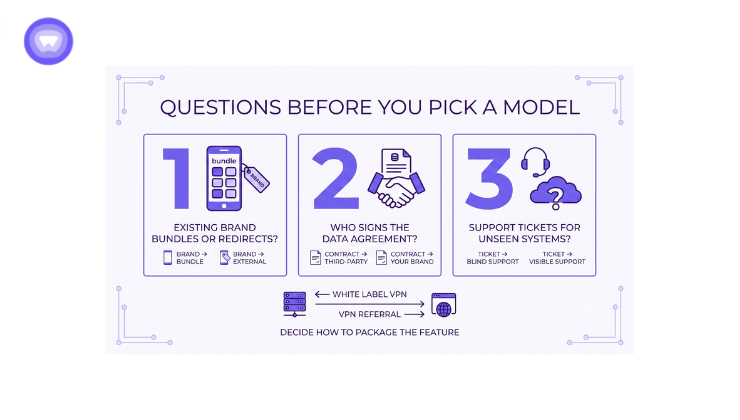
- Does your app store listing already bundle other security features under your own brand, or route users elsewhere for them?
- Who signs the data processing agreement if a user’s traffic runs through a third-party VPN you only linked to?
- Does your support team currently field tickets about a VPN it has no visibility into?
These questions rarely appear in generic VPN comparison content. Most of it is written for individual buyers, not for product teams. Product teams are the ones actually deciding how to package a feature. They need a white label VPN vs VPN answer that goes past app store reviews and surface-level branding.
What Embedding Looks Like in Practice
One router manufacturer worked with PureWL to remove the separate VPN app from its setup flow entirely. That fix is documented in a network security case built on this exact problem. Users no longer needed to install or configure a second app to get protected. The integration also extended coverage to devices that cannot run a native VPN client at all. That included smart TVs and game consoles, closing a gap a referral link could never reach.
PureWL White Label VPN Solution Handles the Infrastructure Side of That Decision: White Label VPN vs VPN
PureWL White Label VPN Solution runs the network, protocol, and API layer behind a white label VPN. A product team never has to build server infrastructure to offer one. The platform is SOC 2 Type II certified. Its no-log policy is independently verified by KPMG. It connects through APIs and SDKs, not a bolted-on separate app.
Teams that bundle a VPN under their own brand, rather than referring one out, see a clear pattern. This comes from PureWL’s own partner data, not an outside audit. Bundled users show roughly 50 percent lower churn. That figure sits on top of 17 years of infrastructure experience. More than 150 active partners already run on the same network. The provisioning, billing hooks, and support documentation exist for teams making this exact switch. They are not built for teams starting from a blank server rack.
The Decision Comes Down to Ownership
A regular VPN is a product you point users toward. A white label VPN is a product you own, price, and support as if you built it yourself. The white label VPN vs VPN choice is not about which one encrypts traffic better. Both typically run the same underlying protocols. It is about who keeps the customer relationship once that user renews.
It is also about who keeps the compliance paper trail and the recurring margin. See what embedding a white label VPN would take in your own product.