


- Infrastructure Fit Over Feature Count. A white label VPN provider that cannot connect to your identity, billing, and security systems creates real costs after launch: duplicate logins, unpaid seats, and monitoring blind spots. The right integration model depends on what you already run, not on which provider has the longest feature list.
- Identity and SSO Integration Is Where Most Deployments Stall. Only 35 percent of corporate apps are fully onboarded to single sign-on today. A white label VPN should authenticate through your existing SSO and issue short-lived session tokens, not force a second login for every user.
- Billing Must Stay the Single Source of Truth. Provisioning and deprovisioning should run on webhooks tied to your subscription platform. Without this link, customers who cancel a plan can keep VPN access, a gap that compounds fast for MSPs managing many client tenants.
- Network Security and Compliance Fit Are Evaluation Criteria, Not Afterthoughts. Confirm protocol support, kill switch behavior, and logging format against your existing stack before committing. Pull the provider’s SOC 2 and GDPR documentation during the same evaluation call, since procurement delays cause more integration stalls than engineering does.
- Vet Integration Readiness Before Signing. Ask whether the provider exposes a documented API, supports your SSO flow, and offers a sandbox for testing. A provider that answers with specifics is built for integration into existing infrastructure; one that cannot is built for a standalone deployment instead.
Choose a white label VPN provider that cannot connect to your identity, billing, and security systems. The cost shows up after launch. Duplicate logins pile up. Unpaid seats stay active. Blind spots open in your monitoring stack. Your team ends up funding a migration project nobody planned for.
MSPs and MSSPs feel this risk first, since they run this stack across many client tenants at once. For an MSP managing 200 client tenants, one missed cancellation webhook can leave dozens of seats active by mistake. That forces manual reconciliation across billing and support every cycle.
A white label VPN can avoid all of this. It connects to your existing identity system, billing system, and network security stack through API and SDK connections. You do not need to rebuild what you already run. Most integration friction comes from picking the wrong connection model, not from the VPN technology itself. White label VPN business integration works when the provider exposes the right endpoints. Your team then maps those endpoints to systems already in place.
What Integrating a White Label VPN Into Existing Infrastructure Actually Means
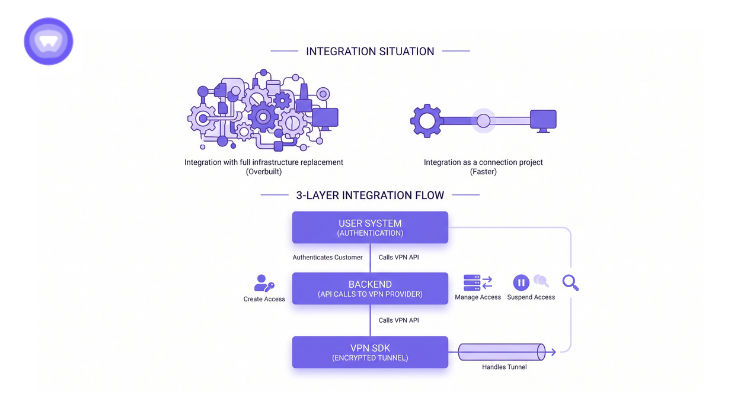
White label VPN business integration is not the same as building a VPN from scratch. You are not standing up gateways, tunneling code, or encryption libraries. You are connecting your existing product to a provider’s network. The provider handles the network layer. Your back end keeps ownership of the customer relationship.
A typical integration sits across three layers. Your user system authenticates the customer first. Your backend then calls the VPN provider’s API to create, suspend, or manage that access. The VPN SDK on the customer’s device handles the encrypted tunnel itself. None of these layers force you to replace your existing user database, billing platform, or support desk.
This distinction matters for planning. Teams that treat integration as a full infrastructure replacement tend to overbuild it. Teams that treat it as a connection project move faster and spend less. For an MSP running this across client tenants, that difference compounds every renewal cycle.
Identity and SSO Integration
Most enterprise buyers already run an identity provider such as Azure AD or Okta. A white label VPN should plug into that system. It should not force a second login for every user.
The practical flow is simple. Your existing SSO authenticates the user first. Your backend then requests a short-lived VPN session token from the provider’s API. The VPN SDK receives that token and opens the tunnel. The customer never creates a separate VPN password.
This gap shows up more than most teams expect. A 2026 MintMCP review found only 35 percent of corporate apps are fully onboarded to single sign-on. A VPN feature that skips SSO adds to that backlog. Identity fit is where white label VPN business integration most often stalls. Zero Trust adoption is moving fast enough that identity gaps stand out even more. A 2025 SSOJet identity report found 72 percent of global enterprises had adopted or were actively implementing Zero Trust. That figure was 60 percent in 2024. Confirm SSO compatibility before your next security review or renewal cycle. A VPN that cannot issue identity-linked tokens becomes another unmanaged exception in your Zero Trust rollout.
Token-based session handling also keeps access rules under your control. Your backend can enforce device limits, region restrictions, and plan-based entitlements. It can do this before the SDK ever opens a connection.
Billing and CRM System Integration
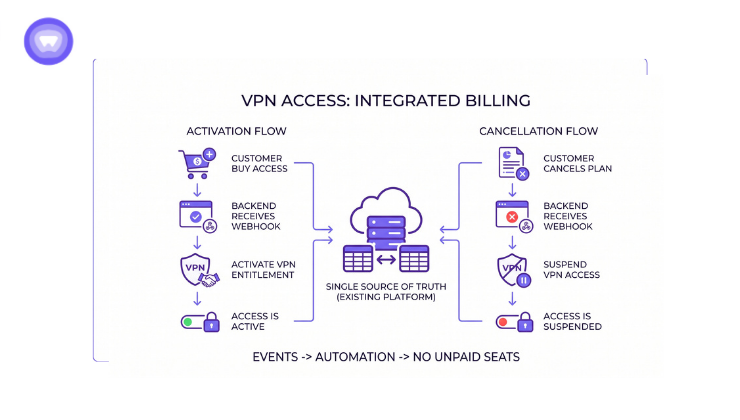
Your existing subscription platform should stay the single source of truth. A white label VPN should never create a second, competing customer database.
The standard pattern runs on webhooks. A customer buys a plan that includes VPN access. Your payment processor confirms the charge. Your backend receives that confirmation and activates the VPN entitlement through the provider’s API. Cancellation runs the same path in reverse. A canceled subscription triggers a webhook. Your backend then suspends VPN access on its own.
This ties setup to billing events instead of a manual step someone has to remember. It also blocks a common failure. Customers cancel a plan but keep VPN access, because the two systems never talked to each other. For an MSP running dozens of client tenants, that gap is what turns into the unpaid-seat problem described earlier. Billing fit is a core part of any white label VPN business integration plan.
Network Security Stack Compatibility
A white label VPN needs to sit inside the security controls you already run. It should not act as an unmonitored gateway sitting next to them. This is where the infrastructure question matters most for network and security teams.
Three compatibility points come up in almost every deployment. First, confirm protocol support. The provider should support the tunneling protocols your firewall rules and endpoint policies already expect. Second, check kill switch and DNS leak protection at the client level. A dropped VPN connection should not silently expose traffic your controls were built to catch. Third, check the logging format. Your SIEM or monitoring stack should read VPN events on its own. It should not need a custom parser for every field.
Enterprises are not adding VPN in isolation. MuleSoft’s 2025 Connectivity Benchmark Report found organizations run an average of roughly 897 connected applications. Only about 28 percent of them are actually integrated with each other. A disconnected VPN adds one more silo to that pile. It creates exactly the blind spot your network security stack exists to prevent.
Compliance and Procurement Workflow Fit
Most enterprise integrations stall at procurement, not engineering. A security team reviewing a new VPN vendor asks for the same evidence it asks any processor. That means a SOC 2 report, a GDPR data processing position, and a documented patch cadence.
A white label VPN business integration should not require your team to build that evidence from scratch. The provider’s own compliance posture becomes part of your vendor risk assessment, not a separate project. Ask for the audit report and the patch cadence during the same evaluation call. Do this while you confirm API access, rather than treating compliance as a later step.
This is also where procurement timelines get shortened or extended. A provider with a documented SOC 2 Type II report moves through vendor review faster. A provider offering only a general security claim does not. Build this check into the same evaluation window as the technical integration work, not after it.
Choosing an Integration Model: API, SDK, or Hosted
The right integration model depends on how much of your existing infrastructure you want to touch. It does not depend on which model has the most features. A provider’s SDK and API documentation is the fastest way to see which model fits. Check it before you commit to one.
| Model | What It Touches | Best Fit | Trade-Off |
| API-Only | Backend calls the provider’s API directly; you build your own client experience | Teams with existing SSO, billing, and a mature backend that want full UI control | Highest development effort, but no third-party UI to maintain |
| SDK-Embedded | Provider’s SDK handles the tunnel inside your existing app | Product teams adding VPN as a feature inside an app that already exists | Faster launch, but tied to the SDK’s update cycle across platforms |
| Hosted/Branded App | Provider delivers a standalone branded app; you focus on billing and support | Businesses without an existing app or backend team to extend | Least infrastructure work, but limited control over the client experience |
Teams with a mature backend and an existing identity system usually get the most value from the API-only model. It keeps every integration point inside infrastructure they already control. Teams without that backend capacity reach the market faster with the hosted model. That speed comes at the cost of deeper customization later.
Common Integration Failure Points and How to Avoid Them
Most integration problems trace back to three recurring gaps.
Authentication mismatches happen when a team wires the VPN API into a legacy login system. This skips the SSO layer everything else already uses. It creates a second identity source that drifts out of sync within months.
Protocol conflicts happen when a chosen VPN protocol collides with existing firewall or endpoint policy. Confirm protocol compatibility during the evaluation call. Do not wait until the first pilot user reports a blocked connection.
Siloed logging happens when VPN session data lands in the provider’s dashboard only. That data stays invisible to the security team’s existing monitoring stack. Ask for a logging export or webhook option before committing to a provider. VPN events should sit inside the same visibility your team already has for every other system.
Poor data integration carries a real cost across the broader enterprise. Gartner’s research places the cost of disconnected data at roughly 12.9 million dollars a year per enterprise. VPN integration is a small piece of that picture. It still adds to the same total when treated as a standalone system instead of a connected one.
Skipped compliance review happens when engineering starts building before procurement confirms the provider’s audit posture. This forces a late-stage pause. Security ends up reviewing a SOC 2 report that could have been requested on day one. Pull the compliance documents during the same call where you confirm API access. Do not wait until the integration sprint is already scheduled.
Migrating From an Existing VPN Vendor
White label VPN business integration looks different when you are replacing a vendor. Replacing an existing VPN vendor is a different project than adding VPN for the first time. The identity, billing, and network integrations already exist. The task is redirecting them to a new provider without a service gap.
Run both providers in parallel during a defined cutover window. Point new signups at the new provider’s API. Keep existing users on the legacy connection until their renewal date. Migrate identity token issuance first. A broken SSO handoff affects every integration point downstream. Confirm the new provider can read your existing logging and monitoring format. Do this before decommissioning the old one, so the security team does not lose visibility mid-migration.
Timeline and IT Effort: What to Expect
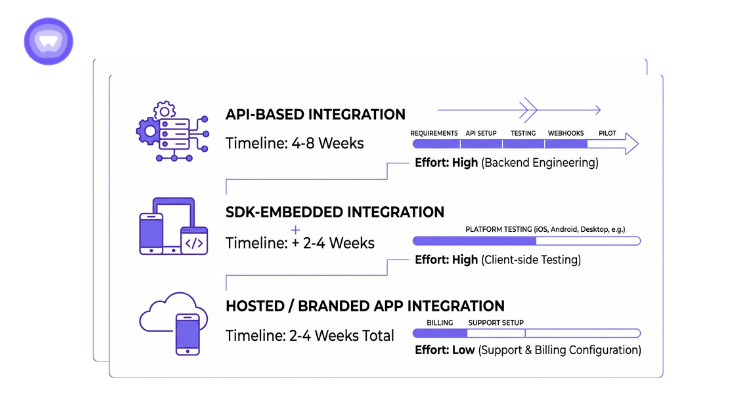
A mid-size organization with existing SSO can typically finish an API-based integration in four to eight weeks. This assumes a documented billing webhook system is already in place. That timeline covers requirements gathering, API credential setup, identity token testing, and billing webhook wiring. It ends with a staged rollout to a pilot group. Most white label VPN business integration projects follow this same shape.
SDK-embedded integrations usually add two to four weeks on top of that. Client-side testing across platforms takes longer than backend API work alone. Hosted or branded app integrations move faster on the technical side. They often take two to four weeks total. Most of the remaining work is billing and support setup, not engineering.
IT department involvement is required in every model. The scope of that involvement changes. API integration needs backend engineering time. A hosted model mainly needs support and billing configuration instead.
Evaluating a Provider’s Integration Readiness Before You Commit
A successful white label VPN business integration starts before the contract is signed. Treat this as an extension of a standard vendor vetting call. Ask these questions before signing, not after the first integration sprint stalls.
- Does the provider expose a documented API for user setup, session management, and billing access rights, or only a dashboard?
- Can the provider issue short-lived session tokens compatible with your existing SSO flow?
- Does the provider support a webhook or export format your SIEM or monitoring stack can read without custom parsing?
- What protocols does the provider support, and do they match your firewall and endpoint policy?
- Is there a sandbox environment for testing before a production rollout?
- What is the provider’s documented timeline from signed agreement to a working pilot?
A provider that answers with specifics, not a general feature list, is built for integration into existing infrastructure. A provider that cannot answer these questions is built for a standalone deployment instead.
Where PureWL Fits
PureWL’s VPN Solution exposes API and SDK access built for this kind of integration. It is not a standalone app users must adopt separately. Identity token issuance connects with existing SSO providers. Billing entitlements sync through webhook-based setup. Session logging exports in formats built for an existing security stack to read.
The underlying infrastructure carries a SOC 2 Type II audit. KPMG verified that audit independently. The security review that comes before any enterprise deal gets a documented answer. It does not have to rest on a claim taken on faith. Submit the short form below for a working demonstration of these exact connections. It maps directly to an MSP’s client-tenant stack.
Final Thoughts
White label VPN business integration succeeds or fails on infrastructure fit, not feature count. The provider with the longest list of protocols still creates rework. That happens if its API cannot talk to your identity system or billing platform. Map your SSO provider, your billing webhook flow, and your logging format first. Submit the short form to see a working PureWL VPN integration for your SSO, billing webhook, and logging stack. Identify the right deployment model before your next integration sprint.