


Key Takeaways
- The unit decides the bill. Active users, created accounts, devices, and gigabytes each produce a different invoice for the same customers.
- Use the 40% rule. Divide the per-account rate by the per-active rate. Below that activity level, per active user costs less.
- Margin leaks in the mismatch. Selling unlimited devices while paying per device is the most common trap.
- Ask how the minimum works. A stacked minimum added $12,000 a year in the illustrative example, for identical usage.
- Get the edges in writing. Settle the active-user trigger, price escalators, and tier steps before you sign.
Quick Answer: White label VPN pricing follows six common models. These are a flat platform fee, per active user, per provisioned account, per device, bandwidth, and revenue share. Many current offers pair a monthly minimum with a per-user rate. The cheapest model depends on how many of your users connect each month.
Most product teams compare white label VPN pricing by looking at one number, the rate per user. That number rarely decides the monthly bill. The unit behind it does. A provider can bill on active users, created accounts, devices, or gigabytes. The same customer base produces a different invoice under each one.
The gap gets expensive fast. Zylo reports that organizations leave 46% of licenses unused on average. Pay per created account, and that idle share still lands on your invoice. In addition, a Zylo survey of 218 IT leaders found 78% received unexpected charges tied to consumption pricing. Another 77% faced costs that surfaced only after signing.
This guide explains each white label VPN pricing model, who it fits, and where it breaks. It also covers the step most guides skip. That step is matching the unit you pay on to the unit you sell on.
Why the Billing Unit Decides Your Margin
Usage-based billing is now the default across software, not an edge case. Metronome’s 2025 survey of 100 software companies found 85% had adopted usage-based pricing. VPN providers follow the same pattern. As a result, almost every white label VPN pricing quote now carries a usage component.
That shift moves risk onto the buyer. A flat license fee is easy to forecast. A usage fee depends on behavior you do not fully control. For example, some users install your app, connect twice, and never return. Under one model they cost nothing after the first month. Under another, they keep billing until you delete them.
So the first question is not the rate per user. Instead, it is the definition of a user and the window used to count one.
The Six Core White Label VPN Pricing Models
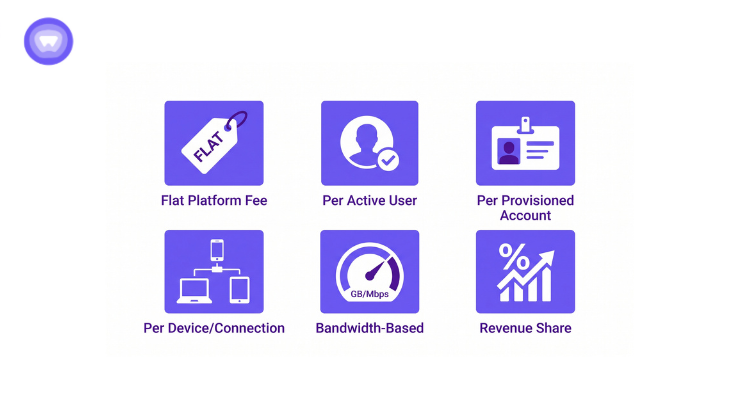
Providers mix and rename these models, but six building blocks sit under almost every price sheet. Each one bills on a different unit. As a result, each one shifts a different risk onto the product team.
Flat Platform Fee
A flat platform fee charges one fixed amount per month or year. It often covers apps, branding, server access, and a set user ceiling. Budgeting stays simple, since the invoice does not move with usage.
The catch sits at the ceiling. Cross it, and the next tier can raise the bill in one step. Flat fees fit early launches with a known user count. However, they fit poorly when growth is fast or uneven.
Per Active User
Per active user pricing bills only for accounts that connect during the billing period. An account that never opens the app does not count. This model tracks real usage closely, so it suits products where many users stay idle.
The definition carries the weight here. One VPN connection in 30 days may count as active. Other contracts count any login or API call, even a background token refresh. Get the exact trigger in writing before you model costs.
Per Provisioned Account
Per provisioned account pricing, often called per-seat pricing, bills for every account created. Active or idle, each account counts. Every user created through the provisioning call adds to the invoice from that moment.
This model is easy to audit, since the count matches your own user table. On the other hand, it charges you for idle users. That is where the 46% unused figure hits hardest. Provisioned pricing works when nearly every account connects each month, such as a managed rollout across a client’s staff.
Per Device or Per Connection
Per device pricing counts each phone, laptop, or router running the VPN. Per connection pricing counts live tunnels at the same time instead. Both scale with how many devices a user owns, not how many users you have.
Households and travelers often run several devices each. A user on three devices can triple the cost of one seat. This per-device pricing trap shows up when your own retail plan promises unlimited devices.
Bandwidth-Based Pricing
Bandwidth pricing bills on the gigabytes that move through the network. Light users cost little, while streaming and large downloads cost far more. It pairs well with free tiers that cap data, because the cap also caps your cost.
One VPN brand used a bandwidth-based freemium model to give free users a data limit. Paying users then upgraded for higher limits. Without a cap, though, a few heavy users can drive most of the bill. Background app traffic also counts as usage.
Revenue Share
Revenue share replaces a unit fee with a percentage of what you collect from end users. The provider earns more only when you do. For this reason, early launches like it, since no fixed cost arrives before revenue does.
The trade-off appears at scale. A fixed percentage keeps rising with your price, even when the provider’s cost does not. It also gives the provider a reason to ask for your billing data. Many partners move off revenue share once volume becomes stable.
Hybrid: Minimum Commitment Plus Usage
Many current offers combine a monthly minimum with a per-user rate. The minimum covers the provider’s fixed cost. Meanwhile, the usage rate scales with your base.
One detail changes the math completely. In some contracts, the minimum is a floor that usage draws down. In others, the minimum is a platform fee that usage stacks on top of. The math section below shows how far apart those two readings land.
White Label VPN Pricing Models Compared
Each model bills on a different unit, so each one fails in a different way. Use the table below to match your product’s usage pattern to the model that fits it.
| Model | Billed On | Cost Predictability | Best Fit | Watch For |
| Flat platform fee | Fixed monthly or annual amount | High until the tier ceiling | Early launch with known volume | Step jumps at each tier |
| Per active user | Accounts that connect in the period | Medium | Free or low-engagement features | A loose definition of active |
| Per provisioned account | Every account created | High | Managed rollouts with full adoption | Paying for idle accounts |
| Per device or connection | Devices or live tunnels | Low | Single-device products | Unlimited-device retail plans |
| Bandwidth | Gigabytes transferred | Low without caps | Data-capped free tiers | Heavy users and background traffic |
| Revenue share | Percentage of end-user revenue | Tracks your revenue | Pre-revenue launches | Cost rising faster than value |
| Hybrid minimum plus usage | Floor or fee plus per-user rate | Medium | Most scaled programs | Floor versus stacked minimum |
The Unit Mismatch Test
Every white label VPN deal has two price sheets. One is what the provider charges you. The other is what you charge your own customers. Margin leaks when the two sheets count different things.
Most pricing guides cover only the first sheet. Yet the mismatch between both sheets is where unplanned costs come from. Run each pairing below against your own plan before you sign.
| How You Sell | How You Pay | What Goes Wrong |
| Unlimited devices per subscription | Per device | Each extra device raises cost while revenue stays flat |
| VPN free inside a paid product seat | Per provisioned account | Every seat bills, even users who never open the VPN |
| Free tier with no data cap | Per active user | Free users bill at the same rate as paying users |
| Monthly plans with easy cancellation | Annual minimum commitment | Users churn, but the minimum stays |
| Fixed-price annual plan | Bandwidth | Heavy users cost more each month at the same revenue |
A match does not need to be perfect. It needs to move in the same direction. In short, when your revenue rises with a unit, your cost should rise with that same unit.
Illustrative Math: Same Users, Five Different Bills
The numbers below are illustrative, not quoted rates from any provider. They show how the unit, not the rate, decides the invoice. Start with one product team and one customer base:
- 10,000 created accounts
- 3,000 accounts connect in a given month, a 30% activity rate
- Active users run 2.5 devices each, so 7,500 devices
- Rates of $2.00 per active user, $0.80 per account, or $1.00 per device
- A $1,000 monthly minimum for the hybrid rows
Now double activity to 60% and keep everything else the same.
| Model | Bill at 30% Active | Bill at 60% Active |
| Per active user at $2.00 | $6,000 | $12,000 |
| Per provisioned account at $0.80 | $8,000 | $8,000 |
| Per device at $1.00 | $7,500 | $15,000 |
| $1,000 minimum drawn down by usage | $6,000 | $12,000 |
| $1,000 fee stacked on usage | $7,000 | $13,000 |
At 30% activity, per active user is the cheapest option. At 60%, per provisioned account wins by $4,000 a month. The crossover sits at 40% activity. At that point, $2.00 per active user equals $0.80 across every account.
That gives a simple rule. Divide the per-account rate by the per-active rate. If your monthly activity sits below that figure, per active user costs less. If it sits above, provisioned pricing costs less.
The minimum question matters too. Here, a stacked fee adds $1,000 a month for the same usage. Over a year, that is $12,000 the drawn-down reading never charges.
Matching White Label VPN Pricing to How Your Product Ships
The right white label VPN pricing model depends less on company size. It depends more on how users reach the VPN. Four delivery patterns cover most product teams.
Free Feature Inside a Paid Product
When the VPN ships free inside a paid plan, usage is uneven. Many users never open it. Per active user pricing fits this pattern best. Provisioned pricing, by contrast, bills for every seat you sell.
Paid Add-On Tier
When users opt in and pay for the VPN, activity runs high. Both per active user and provisioned pricing can work here. Compare them at your real activity rate, using the rule above.
Freemium Standalone App
A freemium app needs free users to cost little. Bandwidth pricing with a hard free-tier cap keeps that cost bounded. Active-user pricing also works, as long as the free tier limits data or session time.
Bundle or Activation Add-On
Some products provision the VPN automatically at sign-up or activation. One eSIM partner added VPN at eSIM activation and sold it as a recurring add-on. Automatic provisioning inflates the created-account count fast. Therefore, per active user pricing protects margin far better than per-account billing in this pattern.
Contract Terms That Change What a Model Costs
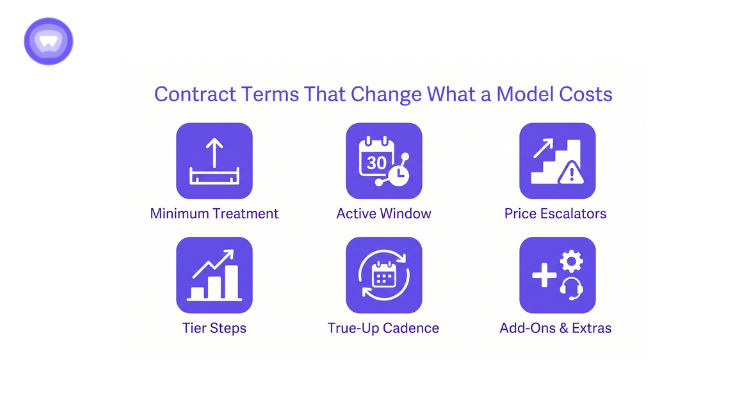
The model sets the shape of the bill. The contract sets its edges. Five terms move the real cost more than the headline rate does.
- Minimum treatment: a floor that usage draws down, or a fee that usage stacks on top of
- Active window: one VPN connection in 30 days, any login, or any API call
- Price escalators: what triggers an increase, and how much notice you receive
- Tier steps: whether a higher tier reprices every user or only users above the threshold
- True-up cadence: monthly, quarterly, or annual reconciliation of actual counts
Components outside the core model need the same attention. Dedicated IPs, extra platforms, and priority support are often billed as add-ons. As a result, a low base rate with costly extras can exceed a higher all-in rate. The vetting call is the right place to settle all of this. These pricing lock questions cover escalators and notice periods in more depth.
What the Right Model Unlocked for One Bundle Partner
A pricing model matters most when it lets a product team launch an offer it could not afford before. A published bundle case study shows this in practice. It describes a software company that sells 40+ iOS apps under one subscription.
The company added a branded VPN app to that bundle, with a free tier and a premium upgrade. The free tier had to stay cheap enough to offer widely. Meanwhile, the premium tier had to convert. After launch, the company reported a 2x rise in subscription sales. Conversion rates rose 40%, and acquisition costs fell 56%.
These are the partner’s own reported results, not independent audits. Still, they show what becomes possible when the wholesale model supports the retail offer.
How PureWL Prices Its White Label VPN
PureWL publishes its white label rates instead of hiding them behind a sales call. The SDK and API plan carries a $250 monthly minimum plus $1.99 per active user. The Business-Ready VPN Service carries a $1,000 monthly minimum plus the same $1.99 per active user. A custom plan covers enterprise builds and large user bases.
Both listed plans bill on active users, not created accounts. That suits products where many accounts stay idle. The VPN Solution plan also includes branded app templates, backend infrastructure, app store setup, and a billing area. PureWL runs 6,500+ servers across 88+ countries, based on its own reported figures. Ask your account manager how the minimum applies against usage in your agreement.
Choosing a White Label VPN Pricing Model
White label VPN pricing is a choice of unit before it is a choice of rate. First, pull your own activity rate, device count, and data usage. Then price each model against those numbers, not against a provider’s sample. Finally, settle the minimum, the active definition, and the escalators in writing.
Request a 20-minute pricing-model review built on your own activation data.
Frequently Asked Questions
How do white label VPN providers charge partners?
Providers bill on six units: flat fee, active users, provisioned accounts, devices, bandwidth, or revenue share.
Is per active user cheaper than per seat pricing?
Per active user costs less whenever monthly activity sits below the per-seat rate divided by the per-active rate.
What counts as an active user in white label VPN pricing?
The contract sets the trigger, such as one VPN connection per billing period, so define it in writing.
Is a monthly minimum commitment credited against usage?
No. Some contracts draw usage down against the minimum, while others stack usage fees on top of it.
Which white label VPN pricing model suits a freemium app?
Bandwidth or capped active-user pricing suits freemium, because a data cap limits what each free user costs.
Is revenue share a good white label VPN pricing model?
Revenue share suits pre-revenue launches but grows costly at scale, since the provider’s cut rises with your price.
Why does per-device pricing cost more for household plans?
Each household runs several devices, so a per-device bill multiplies while the subscription price stays fixed.