

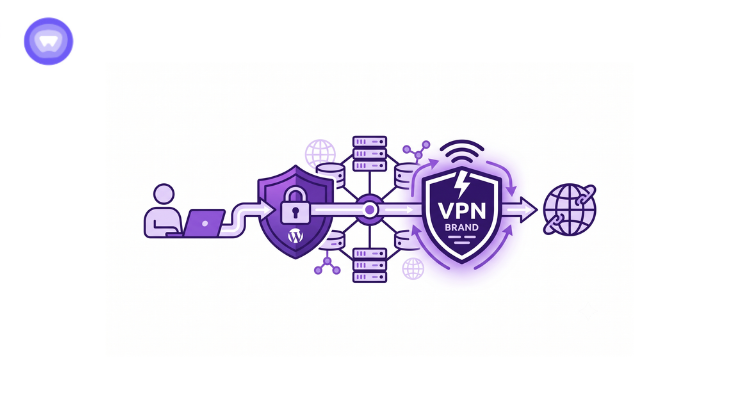
- Pipeline Over Branding: Every reseller guide explains white label VPN as a branding exercise, but the real decisions happen in the provisioning pipeline: account creation, server assignment, protocol selection, and billing sync.
- Cost of Delay: Failing to answer technical diligence questions has a real cost: 54% of vendors lose enterprise deals over unfinished security reviews, and review alone adds two to six weeks to sales cycles.
- Sync Design Cost: Backend sync design has a direct dollar cost. A polling based backend can generate 20 to 30 avoidable support tickets a month per client, worth $360 to $1,050 at standard SaaS support rates, while a webhook based backend removes most of that cost.
- Offboarding Matters: Offboarding matters as much as onboarding. Proper session revocation and clearly defined data retention windows protect an MSP from liability and audit exposure after a user cancels.
- Model Choice: Provisioning model choice (embedded SDK vs. full white label app vs. affiliate) trades launch speed against brand control and app store ownership, so the right model depends on whether an MSP wants speed or a standalone brand.
Ask ten reseller guides to explain how white label vpn works, and all ten stop at branding. They cover logos, app icons, and pricing screens. None open the provisioning pipeline that decides whether a branded app actually reaches an app store on schedule.
That gap costs businesses real launch time. The mechanics behind account creation, server assignment, and billing sync matter more than the color scheme everyone talks about.
This piece skips the logo talk. It walks through the technical sequence instead. What happens the moment a partner signs a contract. How a user account gets created. How servers get assigned. How partner billing systems stay in sync with a provider’s backend.
For businesses weighing a VPN upsell, this is the part that decides margin and risk. It also decides how fast a client starts paying.
What Not Knowing This Pipeline Actually Costs
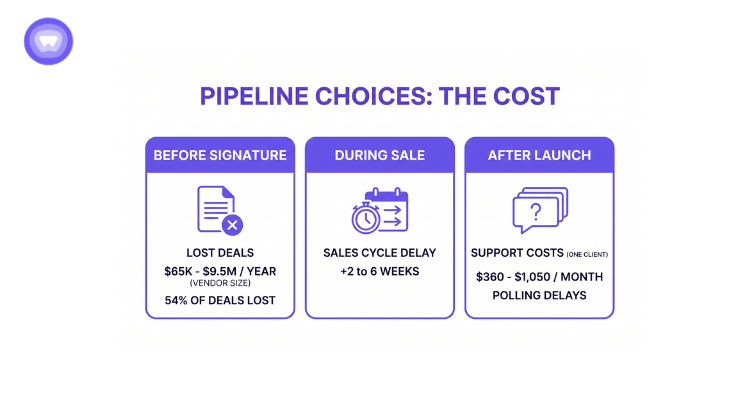
Whistic’s 2025 research found that 54% of vendors lose an enterprise deal over an unfinished security review. The annual cost of those losses runs from $65,000 for smaller vendors to $9.5 million for larger ones. A separate 2026 sales-cycle benchmark found security review alone adds two to six weeks to most enterprise sales cycles. For an MSP reselling a white label VPN, those review questions target this exact pipeline, not the branding.
The same exposure shows up after launch, not just before signature. On a polling-based backend with a 15-minute delay, stale account status alone can generate 20 to 30 tickets a month. This volume is illustrative, based on typical support-load patterns, not a universal figure. Applying SaaS support benchmarks of $18 to $35 per ticket turns that volume into $360 to $1,050 a month, for one client alone. A webhook-based backend removes that cost almost entirely. Status changes reach the partner instantly instead of on a delay.
Three numbers, then: a deal-loss rate near the sale, a sales-cycle tax during it, a support bill after it. All three trace back to the same pipeline choices this piece walks through next.
How White Label VPN Works Before Branding Ever Happens
A white label VPN is a full VPN platform an MSP or partner can rebrand and resell under its own name. The provider owns servers, tunnel protocols, and app code. The partner owns pricing, support, and the client relationship. Most explanations stop here. They treat a white label deal as a licensing arrangement, not a live system with moving technical parts.
Underneath that licensing arrangement sits a pipeline of API calls, server assignments, and data syncs. Skipping that layer means an MSP cannot answer basic diligence questions from a client’s security team.
Provisioning Request
A partner’s request to add a user typically triggers an API call to the provider’s backend. This call carries an identifier, a plan tier, and a branding token. Modern VPN infrastructure often follows the same secret-key-and-access-token authentication pattern used across SaaS platforms generally. The backend validates the request. It then creates a session tied to that partner’s namespace, not to the provider’s own consumer app.
A weak namespace boundary carries real cost. If one partner’s data leaks into another client’s dashboard, that surfaces during the same security review costing vendors deals. An MSP evaluating a provider should ask how that boundary gets enforced before signing, not after a client asks.
Branding Application
Once the account exists, the branding layer applies the partner’s logo, color palette, and app name to that session. On the embedded SDK model, this branding lives inside a shell app the partner already owns. On the full white label build model, branding gets baked into a standalone app. The partner submits that app to app stores under its own developer account. That distinction affects app store review timelines and which party app stores hold accountable for policy violations.
Branding usually extends past the app icon, into splash screens, support links, and password-reset domains. Providers that expose these as dashboard fields let an MSP update them without a ticket. Providers that hardcode them force a manual request for every small brand change, which slows routine marketing work.
Server and Protocol Assignment
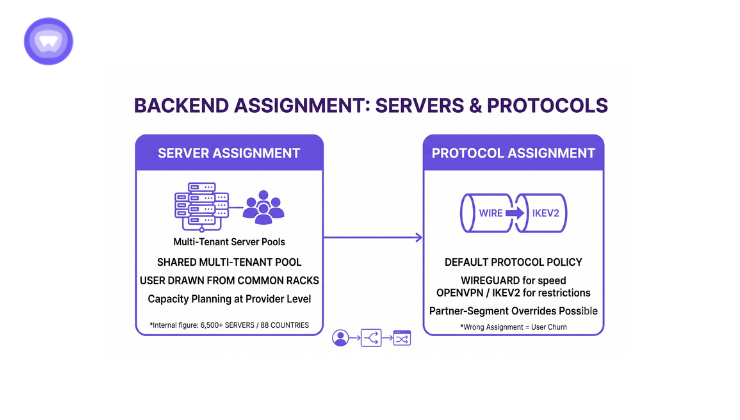
Once branding and identity resolve, the backend decides which servers and protocols route the new user. This step is invisible in almost every reseller guide, yet it directly shapes speed, uptime, and client complaints. This is the layer of how white label vpn works that decides whether a global rollout stays reliable.
Multi-Tenant Server Pools
Most white label VPN providers run a shared, multi-tenant server pool across regions. A partner’s users draw from the same physical servers as every other partner’s users, filtered only by session metadata. PureWL’s own deployment spans 6,500+ servers across 88 countries, an internal figure rather than a third-party audited count. That scale lets a reseller offer global coverage without leasing a single server. Capacity planning happens at the provider level, not the partner level.
Choosing the Tunnel Protocol
Protocol assignment usually defaults to WireGuard for speed, with OpenVPN or IKEv2 available for users on restrictive networks. A partner rarely picks this manually per user. The backend applies a default policy. Partners can override it for specific client segments, such as remote finance teams needing higher throughput. Getting this wrong for a client segment shows up as churn, not a support ticket.
Keeping Partner and User Data in Sync
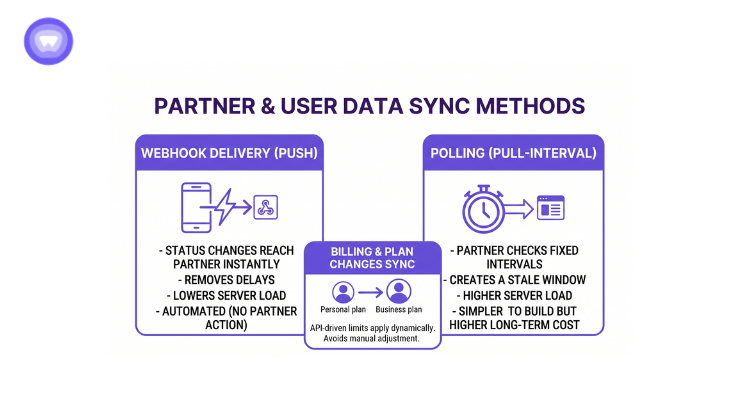
A provisioned account only stays useful if its status stays accurate. Suspended users, upgraded plans, and canceled subscriptions all need to reach the VPN backend in near real time. This sync layer is where reseller guides go quiet and where actual reliability gets decided.
Webhook Delivery vs Polling
Two patterns dominate here. A webhook model pushes status changes to the partner’s system the moment they happen. A polling model has the partner’s system check the provider on a fixed interval, such as every few minutes. Webhook delivery cuts latency and server load. Polling is simpler to build but leaves a window where a canceled user still holds an active session. MSPs evaluating how white label vpn works should ask providers directly which model their platform uses.
Billing and Plan Changes
Plan changes follow the same sync problem. A user upgrading from a personal plan to a business tier needs new bandwidth limits. Those caps should apply without a support ticket. Providers with a mature user management API handle this as a single call. Providers without one force partners to adjust each account manually. That stops scaling past a few hundred users and pushes ticket cost back up.
What Happens When a Partner Offboards a User
Onboarding gets most of the attention in reseller guides. Offboarding gets almost none, even though a mishandled cancellation creates real liability for an MSP.
Session Revocation
When a partner cancels a user, the backend must revoke every active session on that account. Blocking new logins is not enough. A user logged in on a phone and a laptop can keep tunneling traffic past the cancellation date. That gap is a contract violation an MSP has to explain to its own client, not a minor technical detail.
Data Retention Windows
Cancellation also raises a retention question. Connection logs, billing records, and support transcripts need a defined retention window. That window should match the partner’s compliance obligations, not a generic provider default. An MSP serving fintech or healthcare clients should confirm this window before signing. A mismatch becomes the MSP’s problem during an audit, not the provider’s.
Why the Pipeline Decides Your Margin, Not Just Your Launch Date
None of this is academic. The pipeline choice determines how many support tickets a partner’s team fields each month, at the per-ticket cost cited earlier. That cost eats directly into reseller margin. The margin math behind how white label vpn works becomes visible at this sync layer. It shows up well after the branding is signed off.
Switching providers after choosing the slower model carries its own cost. A full user migration and a new app store submission bring real risk of drop-off during the cutover.
The market backing this decision keeps expanding. Privacy management software is projected to grow from roughly $2.7 billion to $15.2 billion by 2028, and VPN bundling sits inside that growth curve.
A real MSP case study shows the scale of that effect. This MSP added a bundled antivirus and VPN suite for its clients. Within two months: 20% client growth, a 32% cost cut, 15% higher retention, and 25% revenue growth.
The Compliance Layer Buyers Never See
Security teams evaluating a reseller’s VPN offer ask about logging, encryption, and breach history before signing off. Most white label guides skip this section, leaving MSPs unprepared for that conversation. Compliance is the last piece of how white label vpn works that most partners overlook until a client asks directly.
An independently audited no-log policy carries more weight than a claim on a landing page. So does clarity on which party, provider or partner, holds legal responsibility if a breach occurs. This is not a hypothetical concern. IBM’s most recent breach research found the average breach detection lag still runs 194 days globally. That is long enough for exposed credentials to circulate widely before anyone notices.
An MSP unable to answer these questions during a client’s security review loses the deal regardless of price. That is not rare. It is the same 54% failure rate cited earlier, playing out right as a reseller deal is supposed to close.
Provisioning Models Compared
Each row trades speed against control. An MSP chasing a fast launch may accept an embedded SDK. An MSP building a standalone security brand needs the full white label path. That path takes longer to clear app store review.
| Model | Branding Control | App Store Ownership | Backend Visibility | Typical Launch Time |
| Embedded SDK | Full UI branding inside the partner’s existing app | Partner’s existing listing | Low, provider manages backend fully | 1 to 3 weeks |
| Full White Label App | Full UI and standalone app identity | Partner’s own developer account | Moderate, partner sees usage dashboards | 4 to 8 weeks |
| Affiliate or Referral | Minimal, provider’s brand stays visible | Provider’s listing | None | Days, but no ownership |
Where PureWL Fits Into This Pipeline
PureWL White label VPN Solution runs the provisioning, server assignment, and sync layers above as one managed backend. Partners integrate once and inherit updates automatically. The platform’s no-log policy carries a verified audit. Its infrastructure spans over 150 partners worldwide, built across 17 years in privacy infrastructure.
For an MSP asking how white label vpn works for its own client base, PureWL removes the manual sync problem. Its user management API and webhook delivery model handle that layer directly. Partners get one integration point instead of a patchwork of support workarounds.
Closing Thoughts
How white label vpn works comes down to a pipeline most guides never open: provisioning, branding, server assignment, and sync. Skipping that pipeline during due diligence means inheriting someone else’s technical debt on day one.
MSPs that ask about webhook delivery, audit status, and app store ownership before signing avoid that support load. They avoid the migration risk too.