

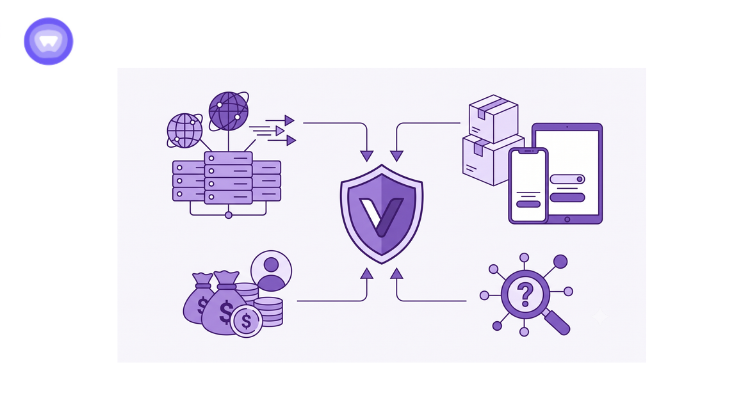
- Included and billed as extra are not the same thing. Apps, encryption, and a branding layer form the base package, while kill switch, split tunneling, and dedicated IPs are often priced on top.
- Some obligations never sit inside any white label VPN contract. Regulatory compliance, CRM integration, and app store account ownership stay with the buyer, regardless of provider.
- The delivery layer changes what counts as included. App-only branding, SDK embedding, and SIM or eSIM level activation each carry a different inclusion scope.
- A written inclusion schedule should govern the contract, not the marketing page. Confirming protocols, support tiers, and integration scope in writing prevents costly surprises after signing.
- ARPU gains depend on matching inclusion terms to the actual bundle. A base app tier priced differently from a SIM level rollout will not produce the same margin outcome.
White label VPN solutions rarely arrive as one clean package. Providers list encryption, branded apps, and server access as included. Then they split kill switches, dedicated IPs, and premium support into separate line items. For telecom operators and ISPs, that gap changes the entire ARPU calculation before launch even begins.
A provider quoting a flat per-subscriber fee can look identical to a competitor. That competitor may quote the same fee plus per-feature charges. The difference only shows up once the invoice arrives. Global VPN market value reached an estimated $48.5 billion in 2025. It is projected to climb toward $156 billion by 2035. Operators entering this category expect VAS margin to track that growth curve. Margin depends entirely on which components carry extra fees and which sit inside the base contract.
Analysts tie value added services directly to average revenue per user. GSMA Intelligence found operators offering VAS saw ARPU gains of up to 30 percent. The gain came from stronger retention and engagement, not new subscriber growth. According to PwC, telecom ARPU is projected to stay flat or decline across several major markets through 2029. That pressure raises the stakes on every white label VPN solutions line item an operator adds. A miscalculated add-on fee can erase the ARPU gain the bundle was supposed to deliver.
This piece breaks down what most white label VPN solutions include in a base package. It covers what typically gets billed as an extra, and what sits outside every contract, regardless of provider. It also covers a detail specific to telecom and ISP buyers. The technical delivery layer, app, SDK, or SIM profile, changes what counts as included.
What a White Label VPN Solution Includes by Default
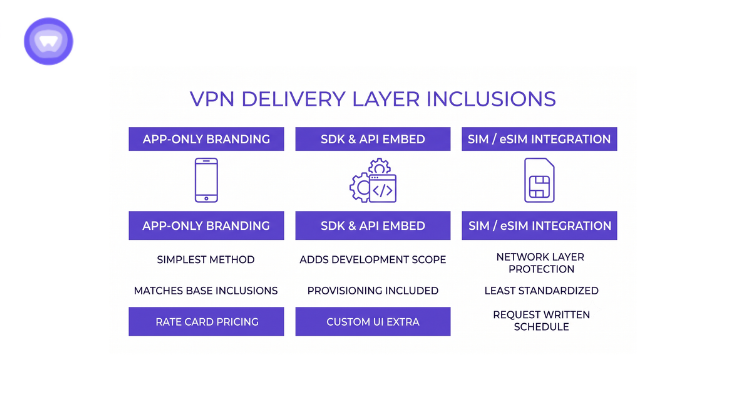
Most white label VPN solutions ship with a consistent core, regardless of vendor. This baseline rarely changes across providers because it forms the minimum viable product every reseller expects on day one.
- Branded apps for the major platforms: Windows, macOS, iOS, and Android
- A shared server network spanning multiple countries
- Standard encryption protocols, typically AES-256 alongside WireGuard or IKEv2
- A branding layer for logos, color schemes, and app store listings
- A basic account or subscription management dashboard
These five components form the floor, not the ceiling. Every provider markets its offering around this list. That is why competing quotes often look interchangeable at first glance. The actual scope can differ sharply once negotiations start.
Features Often Marketed as Included but Billed as Extras
The base list above is where most vendor comparisons stop. It is also where budgeting mistakes start. Several features get described as standard in marketing copy. They then appear as separate line items once the contract is drafted.
Security and Privacy Extras
Kill switch, split tunneling, and obfuscation protocols for restricted regions frequently carry setup or per-feature fees. One reseller-facing VPN provider states this openly in its own pricing page. It lists additional charges next to auto-reconnect, split tunneling, and censorship-resistant protocols. Dedicated IP addresses are almost never part of the base tier. Enterprise clients who require a fixed exit point usually need this feature. Buyers should treat it as a negotiable line, not an assumption.
Support and Account Management Tiers
Round-the-clock technical support is commonly framed as an upgrade above standard business-hours coverage. It usually carries an added fee. Dedicated account managers, priority escalation paths, and custom SLA terms also sit above the base package. Most vendor pricing structures treat these as a separate tier. A telecom operator budgeting for enterprise clients needs each of these priced in writing. Waiting until the first support ticket to learn the actual coverage tier is a costly way to find out.
What Falls Outside Every White Label VPN Solution
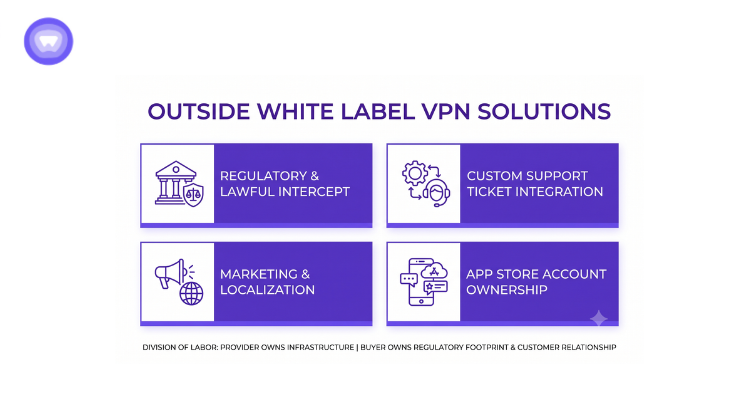
Some obligations never appear inside a white label VPN contract, no matter which provider is chosen. Buyers who assume otherwise end up building these pieces late and over budget.
- Regulatory obligations tied to the buyer’s own operating license, including lawful intercept and data retention rules where they apply
- Integration of support tickets into the buyer’s existing CRM or helpdesk system
- Marketing, localization, and app store copywriting beyond basic branding assets
- Ownership of the app store developer account and its review history
None of these gaps reflect a weak provider. They reflect a division of labor that every reseller agreement follows. The provider owns infrastructure and protocol maintenance. The buyer owns everything tied to its own regulatory footprint and customer relationship. Confusing the two during procurement is one of the most common and most expensive planning mistakes telecom buyers make.
Why Inclusion Terms Vary So Much Between Providers
Buyers often assume pricing differences come down to margin alone. In practice, the cost structure behind each component explains most of the variation.
Bandwidth and per-tenant server capacity carry a real infrastructure cost for the provider. Kill switch and split tunneling are cheap to enable but expensive to support at scale. They generate a disproportionate share of technical tickets. Premium protocols built for censorship-resistant regions require ongoing engineering work, since network-level blocking keeps evolving. Providers that fold all of this into one flat fee are pricing for the average customer. They are not pricing for the specific one negotiating the contract.
This matters for telecom buyers because average-customer pricing rarely fits an operator’s actual usage pattern. A carrier bundling VPN into a high-volume consumer plan has a different cost profile. An MSP reselling to a handful of enterprise accounts looks nothing like that profile. Asking a provider to explain why a feature is billed separately often reveals room to negotiate. This works better than accepting the line item at face value.
How the Delivery Layer Changes What Is Included
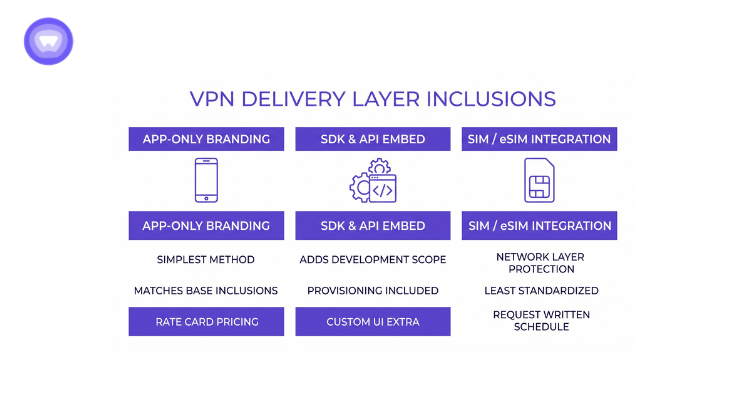
Telecom and ISP buyers face a variable that most generic VPN buying guides skip entirely. The technical layer at which the VPN gets embedded changes what counts as included, sometimes significantly.
App-Only Branding
The simplest delivery method rebrands an existing app shell. Inclusion here matches the base list above almost exactly. No deeper integration work is required, so pricing tends to stay close to the provider’s published rate card.
SDK and API Embed
Embedding VPN functionality inside an operator’s own app through an SDK adds development scope. This scope sits outside the base package in most agreements. Account provisioning endpoints and session management calls are usually included. Custom UI work inside the operator’s own app is not, and should be scoped as a separate line.
SIM and eSIM Level Integration
Building VPN activation into the SIM or eSIM profile itself is the least standardized inclusion across providers. This method turns protection on at the network layer, rather than inside a separate app. Few vendors document this tier clearly on a public pricing page. Operators pursuing this route should request a written inclusion schedule before signing anything. Verbal assurances rarely hold up once integration work begins.
Reading the Inclusion Schedule Before You Sign
A written inclusion schedule should govern the contract, not a marketing feature list. Marketing pages are built to make every tier look complete. The signed schedule is the only document that actually defines scope.
Before signing, telecom and ISP buyers should confirm the following in writing.
- Which protocols and encryption standards are included at the base tier
- Whether kill switch, split tunneling, and dedicated IP are included or billed per feature
- What support tier applies by default, and the cost to upgrade it
- Whether SDK or SIM-level integration work is scoped separately from the base license
- Who owns compliance obligations tied to the operator’s own telecom license
Procurement teams that request this schedule early, before the sales call ends, gain a real advantage. Providers unwilling to itemize pricing at this level are sending a signal. The final invoice will likely look different from the initial quote.
This step matters more for white label VPN solutions than for most software purchases. A missed line item in a typical SaaS contract usually means a support ticket. A missed line item in a telecom VAS bundle can mean re-pricing an entire subscriber tier after launch. That fix costs far more than catching it on paper.
White Label VPN Solutions: Included vs Add-On at a Glance
The table below summarizes every component covered above in one view. Use it as a quick reference during vendor calls.
| Component | Typically Included | Often Billed Separately |
| Branded apps (iOS, Android, desktop) | Yes | Custom UI beyond templates |
| Core encryption (AES-256, WireGuard) | Yes | Obfuscation protocols |
| Kill switch | Sometimes | Common as a paid add-on |
| Split tunneling | Sometimes | Common as a paid add-on |
| Dedicated IP addresses | Rarely | Standard as an add-on |
| Business-hours support | Yes | 24/7 coverage, dedicated manager |
| SDK/API access | Basic endpoints | Custom integration work |
| SIM/eSIM-level activation | Rarely | Usually a separate project |
| Compliance with buyer’s own license | No | Always the buyer’s responsibility |
Where This Plays Out in Telecom Bundling
A Gulf-region telecom aggregator used a white label platform to add VPN to its roaming SIM product. The bundle targeted enterprise users specifically. The operator reported 50 percent higher ARPU on the bundled tier compared to the base plan. This figure comes from the operator’s own reported results. It has not been independently audited by a third party.
The result still illustrates the core point of this piece. The ARPU gain only holds if the inclusion terms match what the operator actually budgeted for. A base app tier priced for a different delivery method will not produce the same outcome at the SIM level.
How PureWL Structures Inclusion
PureWL publishes its inclusion terms by component, not as a single bundled price. Partners can see which protocols, support tiers, and integration options sit inside the base license before signing anything. Encryption, the branded app shell, and standard business-hours support are part of every partner agreement. SDK access, dedicated IPs, and SIM-level embedding are scoped separately, based on the delivery method a partner actually needs.
This structure matters most for telecom and ISP partners weighing VAS economics against a shrinking connectivity margin. Knowing the exact inclusion terms before launch keeps the ARPU math intact. It prevents the kind of unplanned add-on fees that quietly erode margin after go-live. Fixing scope after a bundle is already live is far harder than fixing it on paper.
Final Thoughts
White label VPN solutions differ less on core features than on what counts as included versus billed as an extra. The base package, apps, encryption, and a branding layer, looks similar across providers on paper. What actually separates a predictable margin from a shrinking one is the written inclusion schedule behind that package. Telecom and ISP buyers who request that schedule before signing avoid most budget surprises. Confirming how the specific delivery layer changes inclusion closes the remaining gap. Request a written inclusion breakdown before comparing any two white label VPN solutions on price alone. Follow it with a 20-minute scoping call to confirm the delivery layer.