


- Global VPN access depends on three linked layers, legal status by country, data residency at the routing layer, and real time server assignment, not just a large server count.
- VPN legality splits into three regimes worldwide, full access, licensed or government approved access, and outright restriction, with countries like China, Russia, Pakistan, and Myanmar each handling it differently.
- Routing personal data through a non adequate country during transit can create a GDPR transfer obligation, even when the final destination itself is adequate.
- Data localization rules are expanding fast, with over 331 regulations now in place across 155 countries as of December 2024.
- Latency depends on real time, latency aware server assignment rather than a static country list, and restrictive markets often require obfuscated protocols to stay usable.
A server list with ninety countries on it proves nothing about whether a connection is legal, compliant, or fast in half of those countries. Most product teams evaluating a white label VPN global rollout treat “global” as a server count. That framing misses the three factors that actually decide whether a connection reaches the user, stays legal, and loads fast.
White label VPN global infrastructure includes far more than a wide server map. It includes a legal layer that changes by jurisdiction, a data residency layer that governs where traffic is allowed to exit, and a technical layer that decides whether a connection is fast enough to use. Skip any one of these and a global rollout stops working the moment it reaches a restricted market or a regulated data flow.
The gap shows up early. Over 331 data localization rules now sit across 155 countries, and that number keeps growing every year. A product team that ships a white label VPN global feature without mapping these rules against its own user base risks a blocked market or a compliance review months after launch, not before it.
This piece breaks global access into the three layers that determine whether it actually works, not just whether it sounds complete on a features page.
What “Global” Actually Means in a White Label VPN Deployment
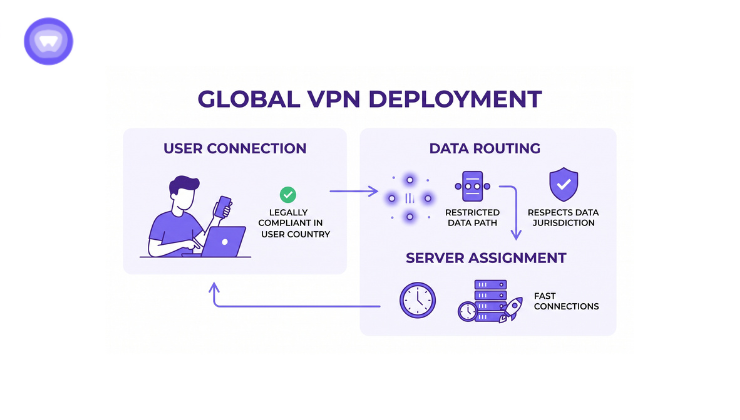
A global VPN deployment has to do three things at once. It has to stay legal in the country where the user connects. It has to route data in a way that respects where that data is allowed to travel. It has to assign servers fast enough that the connection does not feel like a downgrade.
Most providers solve the third problem well and leave the first two to the reseller. That split creates real risk for any product team building a white label VPN global user base without legal or compliance specialists on staff.
Why This Split Matters for Product Teams
A SaaS platform advertising VPN protection to users in twenty countries makes an implicit legal claim in each one. Few product teams check that claim country by country before launch.
- A feature that works everywhere on paper can fail selectively once regional law gets involved.
- Support tickets tied to blocked or slow connections often trace back to a legal or routing gap, not a server outage.
- Fixing this after launch costs more than mapping it during provider evaluation.
Legal Status Changes What Access Means by Country
VPN legality is not one category. It splits into three regimes: full access, licensed or government-approved access, and outright restriction.
China and Iran fall into the licensed category. Only government-approved VPN providers may operate, and unapproved traffic gets actively detected and blocked. Russia blocks specific providers rather than issuing a blanket ban, so server-level reputation matters as much as protocol choice.
Myanmar tightened its position further. Its 2025 Cybersecurity Law introduced criminal penalties for operating an unauthorized VPN service, with prison terms and fines reaching several thousand dollars.
None of this shows up in a server count. A white label VPN global rollout that treats every country the same will eventually route a user through a legal regime it was never built to handle.
What This Means for a Product Team Shipping Internationally
A product team does not need legal counsel in ninety countries. It needs a provider that tracks these regimes and adjusts server assignment and protocol choice, rather than treating every region as identical.
- Ask whether the provider maintains a current view of licensed versus restricted versus open markets.
- Ask how server assignment changes in a licensed-access market compared to an open one.
- Confirm whether obfuscated protocols are available where standard VPN traffic gets detected and blocked.
Data Residency Turns Server Selection Into a Compliance Decision
Server location is not only a performance lever. For any product handling EU user data, it is also a compliance decision.
Under GDPR, personal data may move freely to countries holding an adequacy decision from the European Commission. As of 2025, fifteen countries hold that status, including the UK, Japan, and Switzerland. Routing to anywhere outside that list requires Standard Contractual Clauses and a documented transfer impact assessment.
The detail most reseller guides skip: routing personal data through a non-adequate country during transmission can create a transfer obligation, even when the final destination is adequate. A VPN exit server sitting in the wrong jurisdiction for part of a session can trigger the same transfer duties as a permanent move.
Why an Adequate Destination Is Not Automatically a Safe Route
This distinction matters for any white label VPN global deployment serving EU users. Server selection logic has to account for the transit path, not only the endpoint.
- A German user routed through a non-adequate exit node before reaching a US application server creates a transfer question worth documenting.
- Reseller contracts should specify which exit regions handle EU-originating traffic by default.
- A provider that cannot answer this in writing is not ready for regulated markets.
Data Localization Rules Are Multiplying Faster Than Most Roadmaps Account For
Residency is not only a European concern. China’s Cybersecurity Law requires certain categories of data to stay within its borders. India applies similar local-processing requirements to specific sectors, including payments data. A white label VPN global rollout aimed at either market needs a residency answer before launch, not a retrofit after a regulator asks for one.
Latency and Server Assignment Are Still an Engineering Problem
Legal and residency questions decide whether a connection is allowed. Server assignment decides whether it is usable.
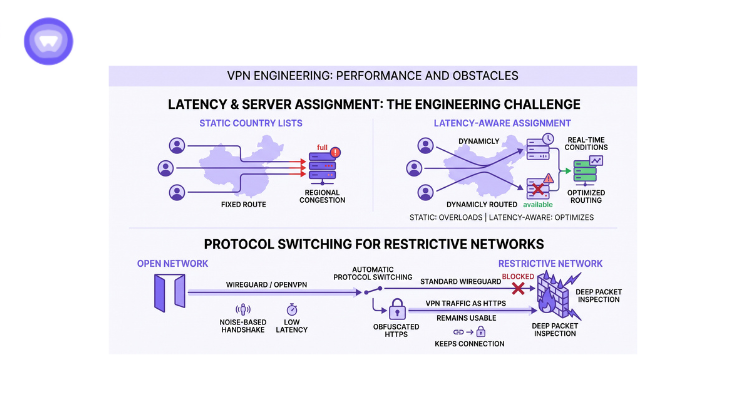
Static country lists assign users to the nearest labeled region, regardless of actual network conditions at connection time. Latency-aware assignment checks real-time load and round-trip time across nearby server clusters, then routes the session to whichever server assignment actually performs best at that moment.
Nearest-Server Logic vs Static Country Lists
- Static assignment sends every user in a country to the same server pool, even during regional congestion.
- Latency-aware assignment reroutes new sessions around a congested node without the user noticing.
- The difference shows up hardest during regional traffic spikes, not average daily use.
Protocol Switching for Restrictive Networks
WireGuard’s Noise-based handshake and ChaCha20-Poly1305 cipher work well on open networks and deliver low-latency connections in most regions. In markets that actively detect and block VPN traffic, standard WireGuard or OpenVPN signatures get flagged by deep packet inspection. An obfuscated tunnel that disguises VPN traffic as regular HTTPS traffic keeps the connection usable where the standard protocol layer gets blocked outright.
A white label VPN global deployment needs both paths available, and needs to switch between them automatically based on where the connection originates.
Comparing Regions at a Glance
Legal status, compliance obligations, and server strategy shift by region, so the same rollout logic never applies twice.
| Region | VPN Legal Status | Compliance Requirement | Server Strategy |
| European Union | Fully legal | Adequacy check or SCC for exit routing | EU-based exit servers for EU-originating traffic |
| United States | Fully legal | State-level privacy law variance | Latency-aware, regional clusters |
| China | Licensed access only | Government-approved provider status | Obfuscated protocol, licensed infrastructure |
| Russia | Legal, provider-dependent | Provider-level blocking risk | Reputation-monitored server pool |
| Gulf States (UAE, Oman) | Licensed corporate use | Corporate registration in some cases | Business-tier server assignment |
| Pakistan | Registration-based | Government VPN registration | Standard access with registration awareness |
| Myanmar | Criminal penalties for unlicensed use | High legal exposure | Restricted deployment, obfuscation required |
Proof: What a Global Rollout Looks Like in Practice
Theory aside, global rollouts fail most often during migration, not at steady state. A cybersecurity provider moving three million users across a global infrastructure needed a way to shift server assignment and session state without a service interruption large enough for users to notice.
The migration ran in phases across a 40-day window, moving users region by region rather than in a single cutover. That phased approach is the same mechanism a white label VPN global deployment needs when onboarding a new international market: move a region, monitor latency and legal-flag rates, then expand.
How PureWL Supports White Label VPN Global Access
PureWL runs a white label VPN global network spanning 6,500+ servers across 88+ countries, independently audited by KPMG for its no-log compliance, an internal infrastructure figure rather than a third-party market count. Server assignment factors in legal status by region, so a partner’s rollout does not default to the same routing logic in a licensed-access market as it does in an open one.
Partners get access to the underlying white label VPN platform along with documentation on exit-region selection for EU-originating traffic, so compliance decisions do not have to be made blind. Protocol switching between standard and obfuscated tunnels happens automatically based on connection origin, which keeps a global rollout usable in restrictive markets without a separate build.
Global Access Is a Compliance and Engineering Problem, Not a Feature Checkbox
A server count tells a partner nothing about whether their users can actually connect, legally and reliably, from the country they are in. The teams that get this right treat white label VPN global coverage as three linked decisions: legal status by region, data residency at the routing layer, and server assignment that adapts in real time.
Skipping any one of these turns a global launch into a series of regional surprises. Mapping all three before launch turns it into infrastructure a product team can actually stand behind.