
Key Takeaways
- VPNGN publishes a full price card, starting at a $250 monthly commitment.
- Its reseller route runs your brand inside VPNGN’s own app store entries.
- PureWL, Windscribe, WLVPN, and Pango are the four main white-label alternatives.
- Listing ownership decides how hard a future migration will be.
- Ask every provider about residential IP sourcing, audit scope, and SLA credits in writing.
Quick answer: The main VPNGN alternatives are PureWL, Windscribe White Label, WLVPN, and the Pango Partner SDK. They differ in who owns the app store listing, how pricing scales, and what audit evidence is published. Product teams that want to own the listing and the subscriber base should favor an SDK or custom-app route.
Most teams start searching for VPNGN alternatives after the second invoice, not the first. The trigger is usually cost per renewal, a data overage line, or a listing they do not control. As a result, each of those costs grows quietly with the user base.
The stakes are also higher than a pricing gap. Verizon’s 2025 Data Breach Investigations Report found that breaches involving a third party doubled to 30%. A white-label VPN provider is exactly that type of third party. For product teams, the vendor decision is now a security decision too.
This guide compares VPNGN against four white-label VPN platforms using public pricing, published infrastructure claims, and app store rules. It also covers the migration mechanics that decide how hard leaving will be.
What VPNGN Offers Product Teams Today
VPNGN is the platform behind VPNWholesaler.com, a New Jersey company founded in 2018. Today, its public pages describe four ways to launch a VPN feature. Understanding those four routes first makes the VPNGN alternatives easier to judge.
The Four VPNGN Routes and Their Public Prices
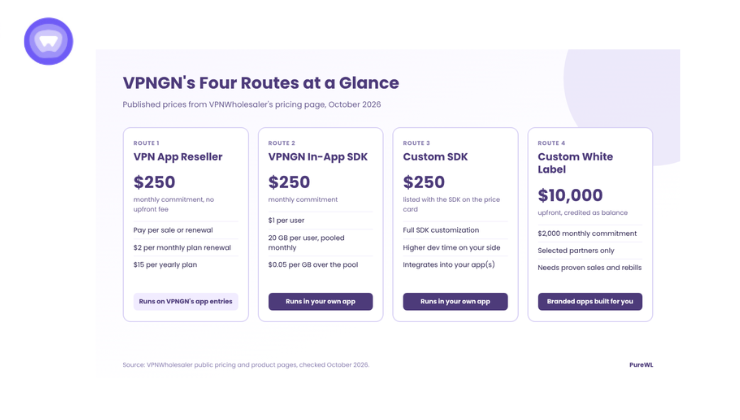
VPNWholesaler publishes its full price card, which no other platform in this comparison does. As of October 2026, the pricing page lists these routes:
- VPN App Reseller: a $250 monthly commitment with no upfront fee. You pay per sale or renewal, from $1 for a weekly plan to $15 for a yearly plan.
- VPNGN In-App SDK: a $250 monthly commitment. Each user costs $1 and adds 20 GB to a shared monthly data pool.
- Data overage: traffic beyond the pool is billed at $0.05 per GB, counting inbound and outbound.
- Custom White Label: a $10,000 upfront payment, credited as account balance, plus a $2,000 monthly commitment.
In addition, the reseller plans include unlimited data and unlimited household devices under a fair usage policy. Free trials of up to seven days are not charged. Also, non-paying users can run on non-premium servers at $0.03 per GB.
What the Public Pages Do Not Answer
On the other hand, several due diligence points stay open on the marketing site. The pages describe AES-256-GCM encryption, a kill switch, and DNS and IPv6 leak protection. However, they do not name the tunneling protocols or publish a server count.
The homepage also promises “thousands of residential IP addresses” for unblocking. That claim deserves a direct sourcing question, covered later in this guide. Finally, the site lists cloud logos for its infrastructure, including AWS, Azure, and DigitalOcean. Ask which locations run on rented cloud capacity and which run on dedicated hardware.
Still, the uptime commitment is specific, which helps. VPNWholesaler states 99.9% uptime in North America and Western Europe. Every other location carries a 99% target.
Why Teams Look for VPNGN Alternatives
The reasons cluster around five structural limits rather than service quality. Moreover, each limit shows up at a different growth stage.
Listing Ownership on the Reseller Route
The reseller route runs your brand through VPNGN’s own app store entries. VPNWholesaler itself describes the SDK as the option for teams that want their own app instead. That distinction matters later, because the listing owner controls the subscriber relationship.
Apple only lets organization-enrolled developers publish VPN apps. Therefore, a team that later wants its own listing must clear that enrollment step first. Planning for it at launch avoids a rushed cutover.
Per-Sale Pricing at Scale
Per-sale pricing is friendly at low volume. As a result, it suits teams testing demand. At higher volume, though, every renewal carries a fixed wholesale cost. Teams with long subscription terms feel this least, while monthly-plan businesses feel it most.
The Custom White Label Gate
The fully branded route is open only to selected partners. VPNWholesaler requires proven daily sales and rebills before it builds custom apps. In addition, the $10,000 upfront payment sets a high bar for early-stage teams.
Data Pool Overage on the SDK
The SDK pool works well for light users. Heavy streaming users, by contrast, can push a product past its pooled allowance. Since overage bills both directions of traffic, video-heavy audiences raise costs fastest.
Directory Listings That Mislead Buyers
Beyond pricing, software directories add confusion to the search itself. Capterra files VPNGN under app building software, with zero user reviews as of October 2026. Its suggested VPNGN alternatives are no-code app builders, not white-label VPN platforms. Buyers therefore need a VPN-specific comparison instead.
VPNGN Alternatives Compared Side by Side
For accuracy, the table below uses each provider’s own public pages, checked in October 2026. Where a provider does not publish a figure, the cell says so rather than guessing.
| Factor | VPNGN | PureWL | Windscribe White Label | WLVPN | Pango Partner SDK |
| Delivery models | Reseller, in-app SDK, custom SDK, custom white label | SDK, REST APIs, custom branded apps | Reselling codes, API access, full white glove build | Turnkey apps, API | SDK for mobile, desktop, and routers |
| Native SDK | Yes | Yes (Windows, Mac, Android, iOS) | No, API only | Not confirmed on cited sources | Yes |
| Public pricing | Yes, full price card | Not published | Partial (about 50% reseller discount) | Not published | Not published |
| Entry cost | $250 monthly commitment | Not published | Per-user, month to month | Not published | Not published |
| Named protocols | Not named publicly | WireGuard, OpenVPN, IKEv2 | WireGuard, OpenVPN, IKEv2 | Not named on cited sources | Hydra, OpenVPN, WireGuard |
| Published network size | Not published | 6,500+ servers, 88+ countries | 69+ countries, 135+ cities | 64 countries observed by a third party | 830 bare-metal servers |
| Published audit evidence | None referenced on marketing pages | Big Four audited no-log policy | Independent audit plus court-tested no-logs | Not referenced on cited sources | Not referenced on cited sources |
| Listing owner on fastest route | VPNGN | Partner | Windscribe (reselling) | Partner | Partner |
In short, the biggest split is not features. It is who holds the listing and the billing relationship on the route you actually pick.
The Four VPNGN Alternatives in Detail
Each provider below suits a different product team, so match the fit before the price. The summaries stick to what each company states publicly.
PureWL
PureWL offers native SDKs for Windows, Mac, Android, and iOS, backed by REST APIs and an API playground. Teams can integrate through its SDK documentation or commission custom branded apps. Additionally, the network spans 6,500+ servers across 88+ countries, and KPMG audits the no-log policy.
Protocol choice covers WireGuard, OpenVPN, and IKEv2, with central protocol patching handled by the provider. However, pricing is not published on the site, so request a written per-user rate before comparing. This route fits teams that want to own the listing from day one.
Windscribe White Label
Windscribe runs three partnership models. Reselling uses partner discount codes at about 50% off retail and launches in 48 to 72 hours. Windscribe recommends an existing base of 50,000+ customers for that route.
API access gives full design control on a per-user, month-to-month basis. Windscribe states a build time of one to six months. Meanwhile, the white glove option has Windscribe build the branded apps in one to three months. Development costs are priced separately. Notably, Windscribe states it does not offer an SDK.
WLVPN
WLVPN belongs to the NetProtect group, the same corporate family behind IPVanish and StrongVPN. In an i2Coalition member interview, the team described turnkey apps, an API for usage tracking, and provider-hosted servers.
Network intelligence firm Netify currently observes WLVPN across 64 countries and 94 cities. Because pricing is not published, expect a sales-led quote.
Pango Partner SDK
Pango offers SDKs for Android, Apple platforms, Windows, and routers. Its proprietary Hydra protocol sits alongside OpenVPN and WireGuard. Pango lists 830 bare-metal servers and 125 virtual locations across six continents.
For proof, Pango also publishes a case study of a cybersecurity provider moving about one million users onto its SDK. Again, pricing is not public. Teams comfortable with a proprietary protocol and an SDK-first build will find the strongest fit here.
Illustrative Cost Math at 2,000 Paying Users
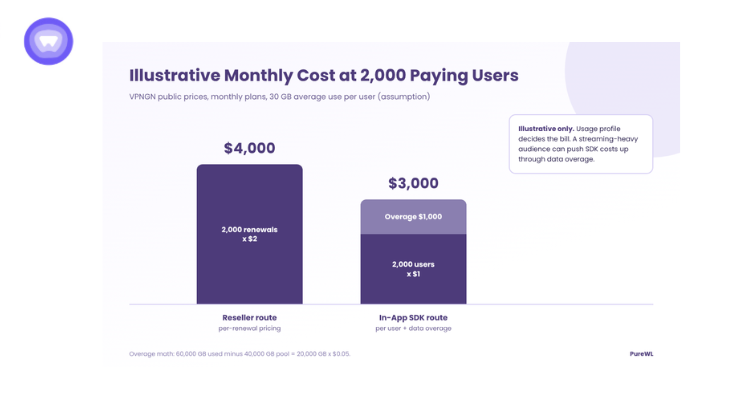
Public pricing lets buyers model VPNGN alternatives against real numbers. The example below is illustrative and uses round figures. It assumes 2,000 paying users on monthly plans.
On the reseller route, 2,000 monthly renewals at $2 each cost $4,000 per month. That clears the $250 commitment many times over, so the floor never binds. Each renewal keeps the same wholesale cost regardless of scale.
On the in-app SDK, 2,000 users cost $2,000 and create a 40,000 GB pool. Next, assume each user moves 30 GB per month. Total traffic reaches 60,000 GB, leaving 20,000 GB of overage. At $0.05 per GB, that adds $1,000, for a monthly total near $3,000.
The lesson is not that one route is wrong. Instead, usage profile decides the bill. A streaming-heavy audience can erase the SDK’s per-user savings. Run your own traffic data through every quote, including the margin math on renewals.
Questions to Ask Before Choosing VPNGN Alternatives
Every provider on this list should answer the same questions in writing. Use them as a shared scorecard alongside these vetting questions for contract terms.
How Are Residential IPs Sourced
Residential IPs help with streaming access, but sourcing matters. In January 2026, Google disrupted IPIDEA, one of the largest residential proxy networks. That network enrolled consumer devices through SDKs embedded in third-party apps. Ask any provider advertising residential IPs how those addresses are obtained and consented.
Which Protocols Ship and Who Patches Them
Above all, protocol names matter because patch duty follows them. Verizon’s 2025 report found edge devices and VPNs made up 22% of exploitation targets, up from 3% a year earlier. Ask each provider which protocols ship in the SDK and how fast patches reach partner builds. A provider that will not name its protocols cannot commit to a patch window either.
Which Infrastructure Did the Audit Cover
A no-log audit only covers the systems in scope. Ask whether the white-label infrastructure was included, not just the parent consumer brand. After that, ask for the report date and the auditor’s name.
Who Owns the Listing and the Subscriber Data
In practice, ownership decides how hard it is to leave. Confirm who publishes the app, who holds the subscriber records, and how data exports work. These exit terms belong in the contract, not in a sales email.
What Do SLA Credits Actually Pay
An uptime percentage without a credit schedule protects no one. Ask how outages are measured, which regions count, and what credit applies. Also ask how fast the provider revokes sessions when a subscriber cancels.
How a Migration Off VPNGN Works
Migration difficulty depends almost entirely on who owns the app listing. There are two common starting points.
If You Already Own the App Listing
Teams on the in-app SDK already publish their own app. Switching providers then means replacing the SDK and pointing provisioning at a new backend. As a result, subscribers keep the same app, reviews, and billing history.
If the app also moves between developer accounts, Apple’s app transfer process keeps reviews and ratings intact. Subscription apps need an app-specific shared secret before the transfer starts.
If Users Sit Inside the Provider’s Listing
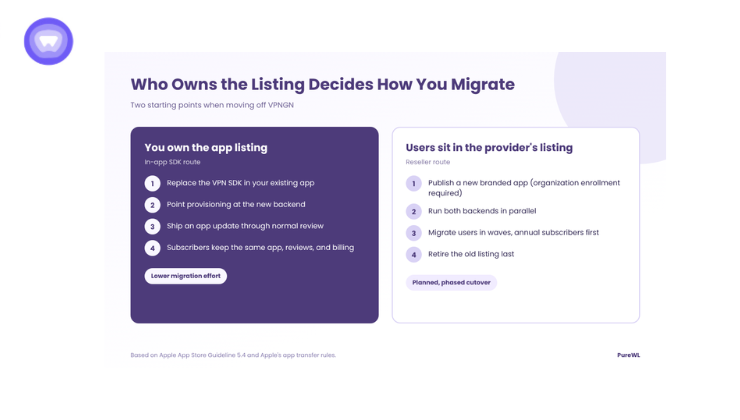
Reseller-route users live inside the provider’s own app entries. Therefore, moving them requires a new branded app and a planned cutover. In practice, teams run both services in parallel and migrate users in waves.
A practical cutover follows four steps:
- Publish the new app first: clear organization enrollment and store review before any user moves.
- Run both backends in parallel: keep the old service live until the final wave completes.
- Migrate in waves: start with annual subscribers, since they have the longest remaining term.
- Retire the old listing last: close it only after support tickets about the move fall off.
A phased approach limits churn during that window. For example, PureWL documented a phased migration of 3 million users over 40 days, with no major service disruptions reported. These figures come from PureWL’s own published case study, not an independent audit.
Which Alternative Fits Which Product Team
The right choice follows the team’s resources and growth stage. Use this shortlist as a starting filter:
- Testing demand with an existing audience: reselling routes from VPNGN or Windscribe launch fastest.
- Shipping VPN inside an existing app: an embedded VPN SDK from PureWL, Pango, or VPNGN keeps the listing yours.
- Strong engineering team, custom UX: Windscribe API access or PureWL REST APIs give full design control.
- No developers, full branded suite: PureWL custom apps, Windscribe white glove, or WLVPN turnkey apps.
For a deeper look at running costs after launch, see this operational comparison of white-label VPN platforms.
How PureWL Supports Teams Moving From VPNGN
PureWL gives product teams native SDKs for Windows, Mac, Android, and iOS, plus REST APIs for provisioning. Meanwhile, the listing, billing, and subscriber relationship stay with the partner. Behind that sits a network of 6,500+ servers across 88+ countries, with a KPMG-audited no-log policy.
PureWL has already moved 3 million users in a phased migration, as the case study above shows. Ask for a written per-user quote and audit scope before you compare it with other VPNGN alternatives.
Conclusion
The best VPNGN alternatives are not the ones with the longest feature lists. They are the ones that leave your team owning the listing, the data, and the exit. Price your real traffic profile, demand audit scope in writing, and plan the migration path before signing.
Request API sandbox access for a 20-minute integration walkthrough.
Frequently Asked Questions
What are the best VPNGN alternatives?
PureWL, Windscribe White Label, WLVPN, and the Pango Partner SDK are the four main white-label VPN alternatives to VPNGN.
How much does VPNGN cost?
VPNGN starts at a $250 monthly commitment, with $1 per SDK user or $2 per monthly reseller renewal.
Does Windscribe offer a white-label VPN SDK?
No. Windscribe offers reselling codes, API access, and a full white glove build, but states it has no SDK.
Can I move my users off VPNGN without losing them?
Yes. SDK users keep their app during a backend swap, while reseller users need a phased cutover.
Which VPNGN alternative publishes a third-party no-log audit?
PureWL cites a KPMG-audited no-log policy, and Windscribe cites an independent audit plus a court case.