

- Encryption is now a requirement, not a differentiator: Enterprise buyers ask how a product is encrypted by default, not whether it has VPN. Products without transport-layer encryption get flagged in compliance review and lose deals before negotiation starts.
- Building VPN infrastructure in-house rarely pays off: In-house builds take 18 to 24 months and cost 500K dollars or more. A white-label approach cuts implementation to 4 to 12 weeks and cost by roughly 80 percent.
- Embedded VPN drives revenue through three levers: It raises average contract value by removing a sales blocker, cuts churn since bundled users churn 50 percent less, and creates upsell room through premium routing and compliance tiers.
- Real deployments prove the model: An MSP bundling white-label VPN with antivirus saw 20 percent growth in enterprise clientele, 15 percent higher retention, 32 percent lower operational costs, and 25 percent revenue growth within two months.
- Partner selection determines success: Look for SOC 2 Type II certification, full rebranding control, structured audit logs, fast integration timelines, and documented failover before committing to a white-label VPN provider.
Enterprise buyers no longer separate security into layers. They want it baked in. That shift changed how SaaS vendors win deals. An embedded VPN white label has become table stakes for retention, not a luxury add-on.
Your product data passes through customer networks every day. Without built-in encryption at the transport layer, that data sits exposed. Competitors who embed privacy earn higher annual contract values (ACVs) and lower churn. Those who don’t are bleeding customers to platforms that do.
This guide walks through why embedded VPN white label adoption is accelerating, how it works operationally, what your customers actually demand, and how to implement it without rebuilding your infrastructure.
The Enterprise Shift: Built-In Security Beats Bolt-On
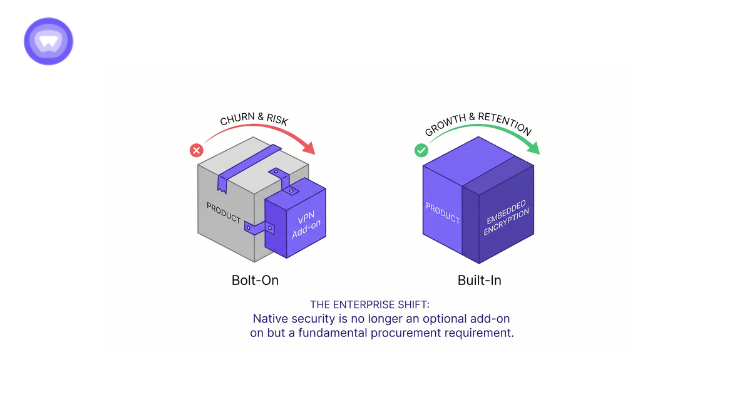
SaaS buyers stopped treating VPN as a separate purchase five years ago. Now they expect it native to any product touching regulated data.
Data breaches take an average of 181 days to identify and longer to contain. During that window, exposed API traffic and session data sit accessible. Enterprise procurement teams factor this directly into vendor decisions. If your product lacks transport-layer encryption, compliance teams flag it immediately.
The trend accelerated after 2024. Companies managing customer payment information, employee identities and authentication flows, healthcare or financial records, IoT device firmware updates, and geographic data or location services now require encrypted tunnels as a precondition for procurement. An embedded VPN white label shifts this from a “nice to have” into a product requirement. Your customers stop negotiating its value because it becomes invisible. It becomes a core capability they expect without choosing it.
The business impact is measurable. One MSP partner bundling white-label VPN with antivirus saw 20% growth in enterprise clientele and 15% increase in client retention. Another productivity SaaS reduced churn by 18% after adding built-in encryption.
Enterprise procurement language shifted from “Does your product have VPN?” to “How is your product encrypted by default?” That question changed how vendors compete.
What Embedded Actually Means: Beyond Marketing Speak
Most VPN discussions conflate “built-in,” “integrated,” and “native.” These terms mean different things operationally.
An embedded VPN white label means your product’s traffic routes through a secure tunnel automatically. Users never launch a separate client or switch tabs. The VPN infrastructure runs as an extension of your product layer, not as a separate service users toggle on. Customers see your branding, your control panel, and your audit logs. They have zero visibility into the underlying infrastructure. Encryption happens without configuration friction. It works out of the box.
The distinction matters because it determines whether customers can actually use your product at enterprise scale.
A productivity SaaS added native encryption by routing all API calls through a dedicated tunnel. Customers didn’t need to install anything. Traffic from their office, from remote workers, and from their APIs all got encrypted automatically. There were no SDK modifications, no conditional logic, and no user confusion. The result: 18% lower churn and measurably higher Net Promoter Score in the security category.
Contrast that with bolt-on VPN. Users have to install a separate client, remember to connect it before using the product, troubleshoot connection drops, and manage two separate interfaces. By the time customers struggle through step two, adoption starts failing. Sales loses the differentiation. Support gets flooded with connection issues.
Embedded is superior operationally. Customers don’t experience VPN at all. They experience your product, more secure.
The Implementation Question Your Team Is Actually Asking
Most SaaS founders ask one core question: Can we white-label a VPN without building one from scratch?
The answer determines ROI.
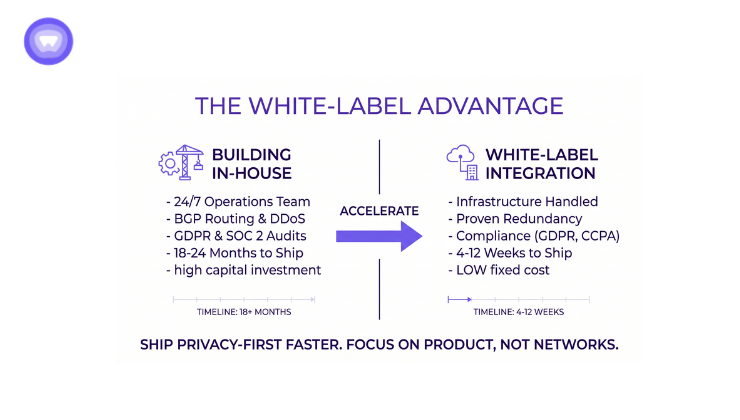
Building VPN infrastructure in-house requires redundant server infrastructure across multiple geographies, BGP routing configuration and DDoS mitigation, compliance frameworks for SOC 2 and GDPR, zero-knowledge architecture to verify your infrastructure cannot access customer data, and 24/7 network operations centers. That footprint takes 18-24 months and 500K dollars or more in initial capital to do right. Most SaaS teams lack the expertise, the capital, and the customer demand to justify it.
A white-label approach inverts the problem. You integrate a VPN infrastructure that already passes audits, already handles compliance for GDPR, CCPA, and HIPAA, already routes traffic globally with redundancy built in, lets you brand it as your own so customers never see the vendor, and scales without hiring a network operations team.
Your team focuses on product integration like API calls, logging, and dashboard embedding instead of infrastructure. Implementation time drops to 4-12 weeks. Cost drops by 80 percent.
The trade-off is clear. You depend on a partner for uptime and performance.
But here’s what changes the economics. Your customers see this as table stakes, not differentiation. They don’t pay extra for it. They just expect it. If you’re outsourcing to a reputable, compliant partner, your cost is fixed. Your competitive advantage isn’t the VPN itself. It’s that you shipped privacy-first faster than competitors.
How Your Customers Will Use It (And How to Avoid Breaking Their Workflows)
Embedded VPN white label only wins if it doesn’t create friction. Customers deploy it in three primary patterns.
Pattern 1: Transparent Encryption for API Consumers
A fintech platform embeds VPN to encrypt all API traffic between customer systems and backend infrastructure. The implementation works as follows:
- The customer’s server makes an API call and the call gets encrypted automatically
- No client software is needed, and no SDK modifications are required
- The fintech looks more secure to enterprise buyers, and the customer’s compliance team stops asking about transport encryption
- Your API gateway checks if the request comes through your VPN tunnel. If it does, you trust the origin. If it doesn’t, you enforce stricter rate limits or block it entirely
- Customers switch to your VPN because it solves their regulatory requirements and your account security
Pattern 2: Secure SaaS Dashboards for Distributed Teams
A productivity SaaS embeds VPN so employees accessing the product from any location get encrypted connections. Here’s how it plays out:
- Sales teams in the field, customer success reps at home, and engineers at coffee shops all have traffic tunneled
- The company’s IT doesn’t have to manage user VPN configurations. Your product handles it
- Customers activate a single-sign-on integration with your embedded VPN
- When an employee logs in, they’re automatically routed through the tunnel
- Logs show which team member accessed what resource, when, and from where, making audit compliance automatic
Pattern 3: IoT Device Privacy for Hardware Manufacturers
A router manufacturer embeds white-label VPN so firmware updates, telemetry, and configuration traffic all encrypt automatically. The pattern breaks down as:
- End-users benefit because their data is protected
- Manufacturers can charge for privacy tiers like free encrypted connection or premium multiregional routing without building infrastructure
- Firmware integrates VPN tunnel creation at boot
- The device connects to the manufacturer’s branded VPN service before accepting updates or sending telemetry
- The manufacturer’s brand appears in device logs and settings, but they outsourced network operations entirely
Each pattern requires different integration points. None requires customers to change their workflows. They just get more security automatically.
The Economics: Why White-Label VPN Drives Revenue
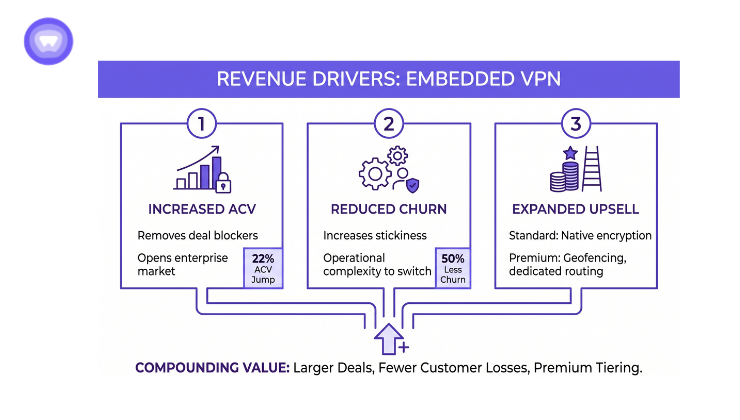
Embedded VPN white label affects three revenue drivers directly.
Average Contract Value (ACV) is the first lever. Enterprise procurement committees now list encrypted data transport as a requirement. It’s not a differentiator. It’s a blocker. A SaaS platform without built-in encryption loses deals to competitors who have it. There’s no negotiation and no workaround. The deal dies. By embedding white-label VPN, you clear that hurdle for 100 percent of new enterprise opportunities. You’re not upselling privacy. You’re removing an objection.
One SaaS vendor selling to financial services firms saw ACV jump 22 percent after embedding encryption. A managed service provider bundling white-label VPN with antivirus security demonstrated equivalent lift at scale. Their enterprise clientele grew by 20%, enabling tier-one account sales that had previously been blocked by compliance-readiness gaps.
Churn reduction is the second lever. Once customers connect their critical workflows to encrypted channels, switching becomes operationally painful. They’ve configured single-sign-on around it, baked it into their security policies, and explained it to their compliance team. That stickiness is worth real money. According to PureWL partner data, bundled users churn 50 percent less than single-product customers. Specific case data shows similar dynamics: a fintech platform using embedded VPN as a retention tool saw churn drop measurably in year one.
Upsell surface is the third lever. Once privacy is embedded, you can layer premium tiers on top without refactoring. Standard tier offers encrypted connection to your product’s core infrastructure. Premium tier encrypts via specific geographic nodes, keeping data in-region. Enterprise tier provides dedicated routing, compliance audit trails, and integrations with their SIEM tools. You’re not selling incremental VPN. You’re selling premium versions of something they already have.
The three levers compound. You win larger deals, lose fewer customers, and upsell existing ones. That’s why competitors are moving fast on embedded VPN white label.
Technical Hurdles That Matter (And How to Avoid Them)
Most SaaS teams underestimate the complexity of embedding VPN properly.
Hurdle 1: Integration Point Uncertainty
Your question is where does VPN live in the stack. Here’s how to approach it:
- The wrong answer is to wrap everything in a tunnel. That creates latency, breaks some third-party integrations, and confuses support teams
- The right answer is to encrypt at the boundary layer where customer data enters your system
- Encrypt API gateways, SSO flows, file upload endpoints, and customer data streaming. Everything else stays fast
- Identify which data types are regulated and encrypt those
- Leave internal service-to-service traffic unencrypted for speed. This is not a security hole. It’s engineering pragmatism
Hurdle 2: Logging and Compliance Requirements
You need audit trails that hold up under scrutiny. The requirements include:
- Showing which user accessed which resource
- Showing when the tunnel was active
- Showing geographic origin of the connection and duration of the session
- If logs show no compliance-ready audit trail, customers still fail their own compliance audits
- Ensure your VPN partner provides structured logging APIs so your product can pull logs, format them for your dashboard, and make them queryable by customers
Hurdle 3: Performance and Latency
Poorly done encryption can add 50-200ms to every request, a real problem for real-time applications. Best practice looks like this:
- Use VPN for data in motion with encrypted tunnel
- Keep internal compute unencrypted for speed
- Latency adds 10-30ms if you use geographically close nodes, which is acceptable
- Test with real workloads before shipping
- A white-label partner should provide performance guarantees in their SLA
Hurdle 4: Compliance Verification
You need third-party verification, since SOC 2 Type II audit is table stakes and GDPR and HIPAA readiness documentation matters if you sell to healthcare or financial services. A reputable white-label VPN partner should provide:
- Audit reports showing their infrastructure is secure
- Compliance certifications for SOC 2, GDPR, and HIPAA
- Written confirmation that they do not access or log customer data
- Disaster recovery and backup procedures
Don’t embed unaudited infrastructure. That’s a liability.
Comparison Table: Build vs. Buy vs. White-Label Embed
For most SaaS teams, white-label embedded VPN delivers the best ROI. You get the compliance stamp, the geographic redundancy, and the customer retention boost without the operational overhead.
| Metric | Build In-House | Traditional VPN Partner | White-Label Embedded |
| Initial Setup Cost | 500K to 2M dollars | 10K to 50K dollars setup and license | 20K to 80K dollars integration |
| Time to Market | 18 to 24 months | 2 to 4 weeks | 4 to 12 weeks |
| Ongoing Infrastructure Cost | 50K to 200K per year | 1K to 10K per year per user or data | Fixed per-tier pricing 500 to 5K monthly |
| Compliance Audits Annual | 20K to 100K dollars | Included in partner’s SLA | Included in partner’s SLA |
| Team Headcount Operations | 3 to 5 full-time | 0 vendor-managed | 0 to 1 part-time integration only |
| Ability to Rebrand | 100 percent control | Limited or none | 100 percent white-label control |
| Geographic Redundancy | Your responsibility | Built-in | Built-in |
| Customer Churn Impact | Not applicable | Depends on product | 50 percent lower than control group |
Real Economics: How MSPs and SaaS Teams Calculate ROI
An MSP serving small and medium businesses faced a challenge. Antivirus alone didn’t differentiate them anymore. Every managed service provider offered it.
They embedded a white-label VPN into their managed security platform. No separate client. No user configuration. Just automatic encryption for all traffic from managed devices.
One managed service provider bundling white-label VPN with antivirus security achieved significant year-one results. Enterprise clientele grew by 20 percent because larger accounts wanted built-in privacy. Client retention improved by 15 percent as fewer customers migrated to competitors. Operational costs fell by 32 percent with no customer support overhead for VPN configuration. Revenue grew by 25 percent in two months from upsells to the existing customer base. These outcomes are documented in a verified case study.
The math is simple. Adding white-label VPN cost 15K dollars upfront and 2K dollars monthly. The retention improvement alone at 180K dollars annually paid for it 10 times over.
For SaaS vendors, the calculation is similar. Embedded VPN removes a blocker for enterprise sales, closes larger deals faster, reduces churn because customers are stickier when privacy is native, and creates a premium tier upsell for geographic routing and compliance certifications.
The typical payback period is 4-8 months.
How to Evaluate a White-Label VPN Partner
Not all white-label VPN providers are equivalent. Your choice determines whether embedded VPN drives revenue or becomes a support burden. Ask these five critical questions before committing:
- Do they provide complete audit trails in a format your customers need? A bad answer is “We log all connections.” A good answer is “We provide structured JSON logs via API, queryable by user, timestamp, geography, and data category.”
- Can you fully rebrand it as your own? A bad answer is “We support some customization.” A good answer is “Customers see only your branding. We provide white-label dashboards, API endpoints under your domain, and audit reports with your company logo.”
- What’s their compliance posture? A bad answer is “We’re GDPR compliant.” A good answer is “SOC 2 Type II certified with KPMG verification, GDPR and HIPAA ready, third-party no-log audits available, and disaster recovery tested quarterly.”
- How fast can they integrate? A bad answer is “4-6 months.” A good answer is “4-12 weeks depending on your architecture. We provide API documentation, SDKs for your tech stack, and a dedicated integration engineer.”
- What happens if they go down? A bad answer is “We have 99.9 percent uptime.” A good answer is “Dedicated failover infrastructure, redundancy across multiple regions, automatic fallback so customers can access your product with degraded security but full functionality, and root cause analysis within 2 hours of any outage.”
Choose a partner with a track record with your ICP. If you’re SaaS, ask for references from other SaaS vendors. If you’re IoT, ask for hardware manufacturers they’ve already embedded into.
Implementation Roadmap: Realistic Timeline
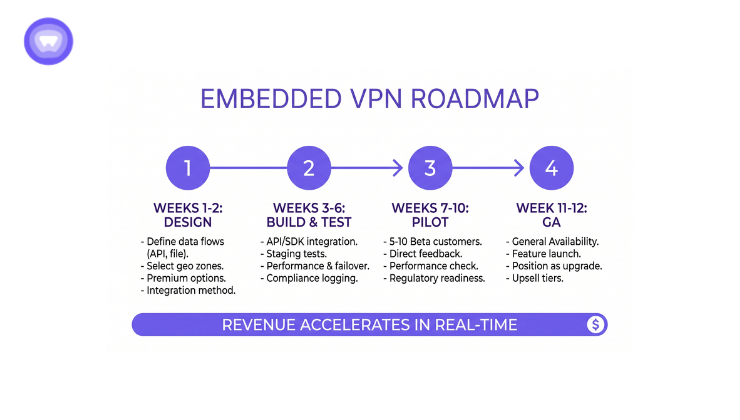
Week 1-2 covers discovery and architecture review. You and your partner define which data flows get encrypted like API traffic, SSO, file uploads, and webhooks. You determine which geographies matter for data residency and compliance zones. You decide whether you need premium tiers for multiregional routing and compliance logging. You select your integration method from API-based, SDK, or reverse proxy.
Week 3-6 is development and testing. Your engineers integrate the VPN and test in staging with real traffic patterns. Verify that latency impact is acceptable, audit logs are formatted correctly, customer dashboard embedding works, and failover scenarios don’t break your product.
Week 7-10 is beta customer rollout. Pilot with 5-10 existing customers. Gather feedback on performance and whether encryption is noticeable, usability and whether the feature is obvious, and compliance readiness to see if audit logs meet regulatory requirements.
Week 11-12 is general availability. Announce embedded VPN white label to your customer base. Position it as a security upgrade, compliance enabler, and retention tool. Tier it with standard included and premium encryption routing as upsell.
The entire process happens in real time. You’re generating revenue on week one. You’re just not promoting it widely until week 12.
The Market Reality: Privacy as Table Stakes
Embedded VPN white label is no longer optional for enterprise SaaS. It’s becoming the minimum security expectation.
Enterprise procurement teams now ask if data is encrypted in transit, if they can audit who accessed their data and when, if the encryption vendor is independent and audited, and if it works without disrupting their workflows. If you answer yes to all four, you win deals faster. If you answer no to any, you get flagged in compliance review and lose.
Competitors embedding white-label VPN are eating market share from those who aren’t. It’s not because encryption itself is rare. It’s because built-in encryption removes friction.
SaaS customers no longer install separate clients or make conscious security choices. They expect security to work automatically, completely, and invisibly. Embedded VPN white label is how modern products meet that expectation.
Building Your Embedded VPN Strategy
The fastest path to implementation is not building VPN in-house. It’s identifying a white-label provider that matches your compliance requirements for SOC 2, GDPR, HIPAA, and industry-specific certifications. The provider should offer complete API-driven integration so it feels native to your product. It needs to scale with your customer base without surprise costs. It must offer full rebranding with your brand, your dashboard, and your support.
Start by mapping your enterprise customer requirements. Do they need encryption? Do they need audit trails? Do they need geographic redundancy? That determines which white-label tier you need and which provider makes sense.
PureWL provides white-label VPN infrastructure purpose-built for SaaS and IoT vendors. More than 150 partners worldwide have embedded their VPN solution to encrypt customer data without rebuilding infrastructure. For SaaS teams, PureWL handles the compliance stack including SOC 2 Type II certification, GDPR readiness, and API audit logging so your team focuses on product integration. For IoT manufacturers, they provide device-level encryption APIs that require no customer configuration. The implementation spans 4-12 weeks depending on your architecture. Customers see your branding entirely. Your support team inherits zero VPN-related tickets.
Final Thoughts
If enterprise procurement is blocking your deals for lack of encryption, or if churn is rising because competitors offer built-in privacy, white-label embedded VPN moves the needle. You remove a blocker, retain customers longer, and upsell privacy tiers without hiring a network team.
The question is not whether you need embedded VPN. Enterprise customers have already decided that. The question is how fast you can implement it and capture the revenue upside.