

Key Takeaways
- A white label VPN deployment usually takes 2 to 8 weeks, while the branded build takes days.
- Store accounts, VPN store review, and internal vendor approval set the real launch date.
- Apple and Google tie VPN apps to organization accounts, so request a D-U-N-S number on day one.
- An embedded SDK skips new store listings and often launches in 2 to 4 weeks.
- Run every gate in parallel from signature, not in sequence after it.
Quick Answer: A white label VPN deployment usually goes live in two to eight weeks. The provider builds the branded app in days. Store accounts, VPN store review, and internal vendor approval set the real launch date.
Ask a provider how long a white label VPN deployment takes, and the answer usually lands in days. Most provider pages quote a build window of one to three weeks. That number is accurate. However, it measures the wrong clock.
The provider controls the branded build. Your product team controls everything around it. That includes store accounts, legal review, billing hooks, and release planning. Those tasks decide when paying users actually connect.
This guide separates the two clocks. First, it maps each deployment model to a realistic timeline. Then it shows which gates to open on day one, so the launch date stops slipping.
What a Slow White Label VPN Deployment Costs
Every week of delay has a price. The feature gap stays open while users compare options. Meanwhile, internal approval work expands to fill the calendar.
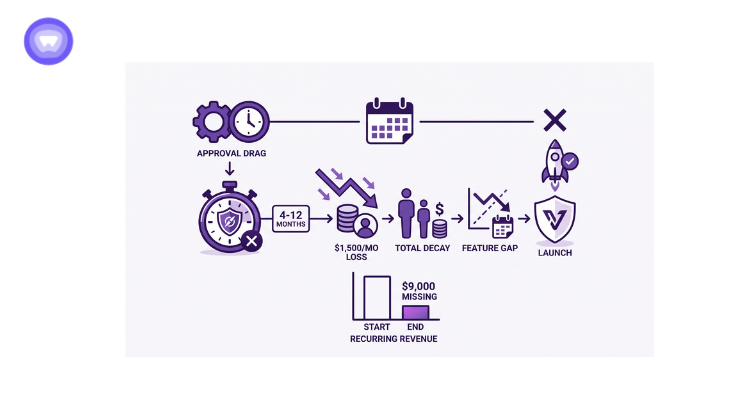
Vendor approval is the biggest hidden drag. In the Ponemon Institute’s 2026 third-party risk study, 60% of organizations said one assessment takes 4 to 12 months. A product team that waits for signature before starting that review inherits the whole queue.
For example, take an illustrative case with round numbers. Say a product loses 500 users a month to uninstalls. If 30% of them cite missing security, that is 150 users a month. At $10 per user per month, each month of delay removes $1,500 in recurring revenue. Across a six-month slip, that adds up to 900 users and $9,000 in monthly revenue. This math is illustrative, not a forecast.
So the decision belongs before your next release cycle, not after a rival ships the feature first.
The Short Answer: Two to Eight Weeks
Most white label VPN deployment projects land between two and eight weeks from signature to first paying user. The spread comes from choices made before any code ships.
Building the same stack in-house sits on a different scale. Building from scratch takes 12 to 18 months before a single customer connects. That gap explains why most product teams license rather than build.
Within the two-to-eight-week range, three factors move the date:
- Deployment model: A branded app, an embedded SDK, and a pure API each carry different partner-side work.
- Store account status: Organization verification can take more than a week on its own.
- Internal approvals: Legal and security review often run longer than the build itself.
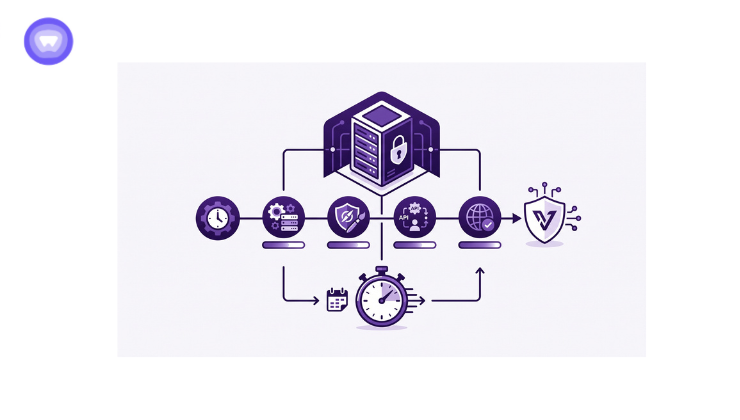
The provider’s provisioning pipeline sits underneath all three. Account creation, server assignment, and billing sync must work before launch day.
White Label VPN Deployment Timeline by Model
Each model trades speed against brand depth and store ownership. The right choice depends on where your users already spend their time. The planning ranges below are illustrative estimates built from the gates covered later, not provider guarantees.
Branded Standalone App
A standalone app carries your name in the store listing. The provider customizes the client apps, and your team owns the store submission. This path usually runs four to eight weeks. Store accounts and review drive the schedule, not engineering.
SDK Embedded in an Existing App
An embedded SDK adds VPN inside an app your users already have. As a result, the team skips a new store listing. The next app update still goes through review, though. This path often runs two to four weeks. An SDK that inherits an approved protocol stack also carries a lighter review burden.
API-Only Integration
Some teams only need provisioning and account control. Routers, connected devices, and admin dashboards often fit this model. Here, the timeline follows firmware release cycles and device testing. The VPN side can be ready in days, while the device schedule sets the date.
| Deployment Model | Provider-Side Work | Partner-Side Critical Path | Planning Range (Illustrative) |
| Branded standalone app | Branded clients, server setup | Store accounts, D-U-N-S number, VPN store review, billing | 4 to 8 weeks |
| SDK embedded in an existing app | SDK package, credentials, docs | App update review, connection states, leak testing | 2 to 4 weeks |
| API-only integration | API keys, provisioning access | Firmware or dashboard release cycle, device testing | Set by device schedule |
The Four Gates That Set Your Real Launch Date
In practice, the build rarely blocks a launch. Instead, four external gates do. Open each one on day one, and run them in parallel.
Gate 1: Store Accounts and Business Verification
Both major app stores tie VPN apps to organization accounts. Google Play requires developers of approved VPN apps to register as organizations. Apple also limits its VPN connection tools to organization accounts, not individual developers.
Next, organization accounts need a D-U-N-S number. Apple’s enrollment guidance allows up to five business days for a new number. Apple then needs up to two more business days to receive it. A mismatched business record adds more time on top.
There is one upside. Organization accounts on Google Play skip the closed test that new personal accounts face. That test requires 12 testers for 14 continuous days.
Gate 2: VPN-Specific Store Review
VPN apps face extra checks at both stores. On Google Play, every app using the VPN service must file a declaration form. The form explains why the app needs device-level tunneling. Apple states it reviews half of all submissions within 24 hours and 90% within 48 hours. VPN apps can sit longer, since reviewers check data declarations and permissions.
The store listing also carries a privacy label. That privacy label sits under your developer account, not the provider’s. It must also cover every SDK added after launch.
Gate 3: Internal Vendor and Legal Review
Security questionnaires, the data processing agreement, and procurement sign-off run on your company’s calendar. None of them start at signature by default. Teams that sell into regulated markets also need a data residency answer before launch, not after.
Gate 4: Billing and Provisioning Integration
Finally, your billing system must create, suspend, and cancel VPN accounts. Most teams connect this through the provider’s provisioning API. Webhooks keep account status current, while polling adds lag and support tickets. Test failed payments and cancellations before launch, not after the first refund request.
A Week-by-Week White Label VPN Deployment Plan
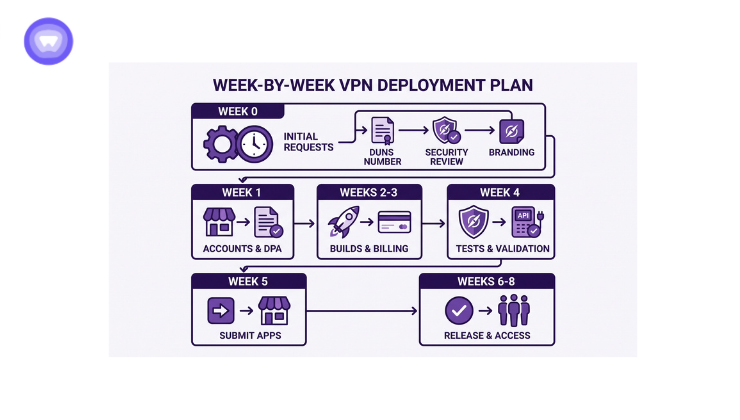
The plan below runs the gates in parallel instead of in sequence. It fits a branded standalone app, the longest common path. Treat it as an illustrative template, then adjust it to your own approval cycle.
- Week 0: Request the D-U-N-S number, open the vendor security review, and send branding assets.
- Week 1: Enroll both store organization accounts and start the data processing agreement.
- Weeks 2 to 3: Receive branded builds, connect billing to the provisioning API, and draft store listings.
- Week 4: Run leak, kill switch, and cancellation tests on real devices across networks.
- Week 5: Submit both apps with the VPN declaration and privacy label complete.
- Weeks 6 to 8: Clear review, soft launch to a small group, then open access to all users.
An embedded SDK shortens this plan. The store account steps disappear when the host app already exists. However, the update review and testing weeks remain.
Replacing an Existing VPN Changes the Timeline
A team that already runs a VPN feature faces a different white label VPN deployment. Existing users need a path to the new backend without losing access. For that reason, most teams move users in cohorts rather than all at once.
A staged cutover adds weeks to the plan above. Each cohort needs an app update, fresh credentials, and a rollback option. Support teams also need scripts ready before the first cohort moves. Plan the migration window before signing, since exit and switching terms shape it.
How Product Teams Shorten the Timeline
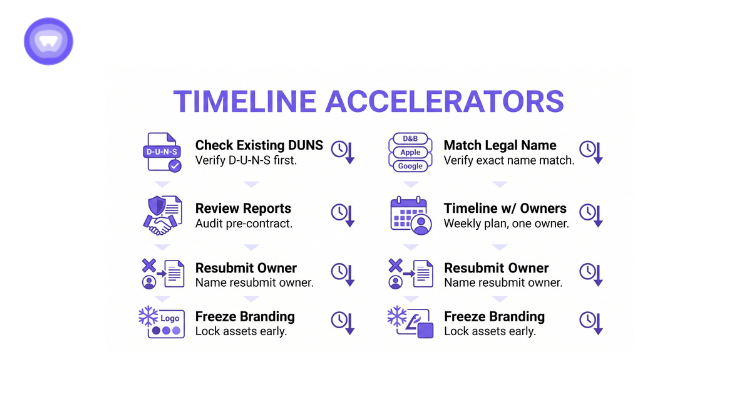
Most delays come from sequencing, not engineering. A few habits remove weeks from a typical white label VPN deployment:
- Check for an existing D-U-N-S number first, since many companies already have one.
- Match the legal entity name exactly across Dun and Bradstreet, Apple, and Google.
- Start security review with the provider’s audit reports before the contract is final.
- Ask for a written onboarding timeline with an owner for each week, not a range.
- Decide who resubmits after a store rejection before the first submission.
- Freeze branding assets early, because late logo changes restart app builds.
What the Evidence Shows
A fast launch only pays off when the feature meets a real user need. PureWL’s own productivity app case study shows why timing matters. The client’s churn analysis found that over 30% of users who uninstalled cited missing built-in security. These figures come from the client’s own reporting, not an independent audit.
For a product team, that finding turns deployment speed into a retention question. Every week without the feature leaves that churn driver in place. As a result, the gates above carry a direct revenue cost, not just a scheduling cost.
How PureWL Supports a Faster White Label VPN Deployment
PureWL gives product teams branded apps, an embeddable SDK, and a provisioning API on one platform. Partners pick the model that fits their launch path. PureWL then runs servers, protocol updates, and uptime. The SDK and APIs handle account creation, status sync, and session revocation.
PureWL reports 6,500+ servers across 88+ countries and 150+ active partners. These are PureWL’s own reported figures, not third-party audited data. Separately, KPMG audited the no-log policy, which gives security reviewers a document to check early.
Conclusion
A white label VPN deployment moves fast on the provider’s side and slower everywhere else. The build takes days. Store accounts, review, legal approval, and billing tests take weeks. Teams that open every gate on day one launch in the lower half of the range. Teams that wait for signature land at the top of it, or past it.
So plan your white label VPN deployment around the gates, not the build.
Request API sandbox access for a 20-minute integration walkthrough.
Frequently Asked Questions
How long does a white label VPN deployment take?
Most launches take 2 to 8 weeks, while the provider’s branded build itself takes only days.
What is the slowest part of deploying a white label VPN?
Store verification, VPN store review, and internal vendor approval each take longer than the branded build.
Do I need a D-U-N-S number to launch a VPN app?
Yes, because Apple and Google tie VPN apps to organization accounts that require a D-U-N-S number.
Is an embedded SDK faster than a standalone branded app?
Yes, an embedded SDK skips new store accounts and listings, so it often launches in 2 to 4 weeks.
How long does Apple take to review a VPN app?
Apple reviews 90% of submissions within 48 hours, and VPN apps face added permission and data checks.