
Quick answer: VPN SDK providers fall into three groups. Managed vendors such as PureWL, Pango, and VPNGN ship client libraries plus the server network. Open-source libraries such as WireGuard and the Outline SDK ship client code only, so your team runs the servers. A third group offers only an API, with no SDK at all.
Key Takeaways
- VPN SDK providers split into managed vendors, open-source libraries, and API-only vendors with no SDK.
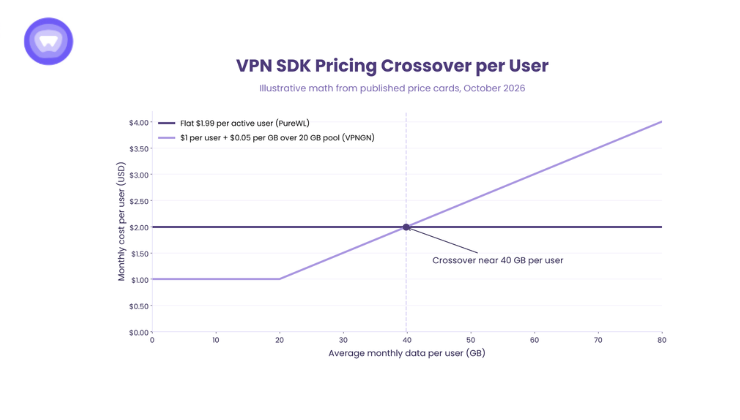
- Only VPNGN publishes a full price card; its per-user cost doubles at 40 GB of monthly use.
- iOS caps tunnel memory at 50 MiB, and Android allows one active VPN at a time.
- From February 1, 2027, Play blocks updates whose native code lacks 16 KB page support.
- Check every SDK for shared credentials, proxy enrollment, and bundled ad or analytics modules.
A VPN SDK is not a normal dependency. It runs a network tunnel inside an app signed with your developer account. So when the SDK misbehaves, the store listing, the reviews, and the removal notice all carry your name.
That risk is documented. In 2024, researchers at HUMAN Security traced a hidden proxy library to 28 applications. The apps turned phones into proxy nodes, and the library was later sold inside a monetization SDK. Notably, seventeen of those apps were free VPNs, and Google removed all of them. In 2025, Citizen Lab researchers studied VPN app families with over 700 million downloads. Many of those apps shared hard-coded server passwords. An eavesdropper holding that password could decrypt user traffic.
This guide compares five VPN SDK providers for mobile and desktop apps. It uses each vendor’s own public pages, checked in October 2026. In addition, it covers the platform limits and supply-chain checks that decide whether an SDK survives production.
What VPN SDK Providers Actually Supply
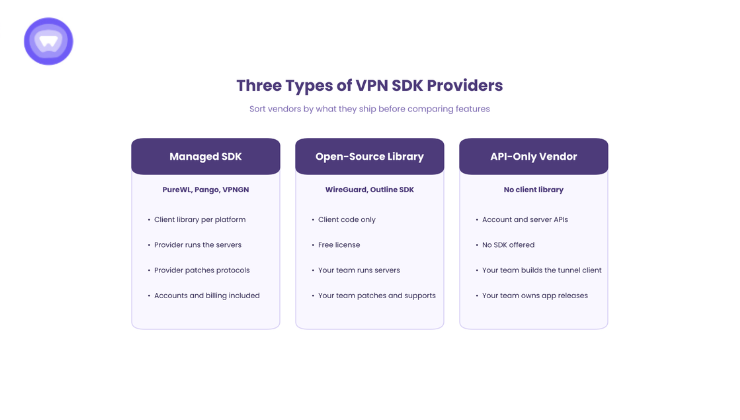
The label “VPN SDK” covers products that do different jobs. Sorting vendors by what they ship removes half the shortlist in minutes.
Managed SDK Providers
A managed provider ships a client library for each platform. In addition, it runs the servers, the account system, and the protocol updates. Your app calls connect, disconnect, and status functions, and the vendor handles the rest. PureWL, Pango, and VPNGN all sit in this group.
Open-Source Protocol Libraries
An open-source library ships client code with no network behind it. WireGuard’s official libraries and the Outline SDK are the best-known examples. The license is free. However, your team then buys servers, issues keys, patches code, and answers outages.
API-Only Vendors
Some white label vendors offer account APIs but no client library. Windscribe, for example, states on its white label page that it does not offer an SDK. As a result, teams on that route build the tunnel client themselves. The split between the two layers is covered in this SDK and API comparison.
VPN SDK Providers Compared Side by Side
The table below scores five VPN SDK providers on published facts only. Where a vendor does not publish a figure, the cell says so rather than guessing.
| Factor | PureWL | Pango Partner SDK | VPNGN In-App SDK | WireGuard Libraries | Outline SDK |
| Category | Managed | Managed | Managed | Open source | Open source |
| Platforms | iOS, Android, Windows, macOS | Android, Apple, Windows | Apps for six platforms; SDK list not published | iOS, macOS, Android, Windows | Android, iOS, macOS, Windows, Linux |
| Protocols named | WireGuard, OpenVPN, IKEv2, IPSec | Hydra, OpenVPN, plus WireGuard on Windows | Not named publicly | WireGuard only | Shadowsocks-based proxy transports |
| Public pricing | Quoted per partner | Not published | $250 monthly commitment plus $1 per user | Free license | Free license |
| Data allowance | Quoted per partner | Not published | 20 GB pooled per user, then $0.05 per GB | You pay hosting | You pay hosting |
| Who runs servers | Provider | Provider (830 bare-metal servers) | Provider | Your team | Your team |
| Published audit | KPMG-certified no-log network | None on cited pages | None on cited pages | Not applicable | Not applicable |
| Kill switch and split tunneling | Both documented | Both documented | Kill switch documented | You build both | You build both |
| Maturity signal | Public demo apps and docs | Public docs and changelog | Public docs | Versioned 1.0 releases | Labeled beta |
In short, the first split is not features. It is who runs the servers and who answers the outage at 3 a.m.
The Five VPN SDK Providers in Detail
Each profile below sticks to what the vendor states publicly. Read them against your own platform list and team size.
PureWL
PureWL ships native SDKs for iOS, Android, Windows, and macOS, plus a provisioning API. Its public iOS demo installs through the two standard Apple package managers. The demo also lists five protocol options, including WireGuard and OpenVPN, with automatic protocol fallback.
The SDK also supports a mode with no partner backend. In that setup, the app passes a unique ID, and the SDK then creates credentials. Pricing is quoted per partner, so request a written per-user rate.
Two details matter for teams beyond phones. The iOS demo states support for Apple TV on tvOS 17 and later. In addition, one published partner build used a React Native SDK for its cross-platform app.
Pango Partner SDK
Pango offers unified SDKs for Android, Apple platforms, and Windows. Its own Hydra protocol sits alongside OpenVPN, with WireGuard listed for Windows. Pango states it runs 830 bare-metal servers across 125 virtual locations.
One documented detail stands out, though. When the Apple tunnel extension cannot serve traffic, the SDK switches to a bypass mode. That stops the system from retrying forever. Because pricing is not public, expect a sales-led quote.
VPNGN In-App SDK
VPNGN comes from VPNWholesaler, a company founded in 2018. It publishes its price card in full. The in-app SDK costs a $250 monthly commitment and $1 per user. Each user adds 20 GB to a shared monthly pool, and excess traffic costs $0.05 per GB.
Meanwhile, its directory listing names apps for Windows, macOS, iOS, Android, Android TV, and Fire OS. However, its pricing page does not name protocols or publish a server count. Ask for both in writing.
WireGuard Libraries
WireGuard’s official client code covers Apple platforms under the MIT license and Android under Apache 2.0. On Windows, the Wintun driver then supplies the network adapter. The protocol itself is lean and widely deployed.
The library is only the client, though. Your team still needs servers, key distribution, account billing, and abuse handling. On Apple platforms, the package also needs an extra manual build step for its Go-based core.
Outline SDK
The Outline SDK began at Google’s Jigsaw unit and now sits with the Outline Foundation. The code is written in Go, licensed under Apache 2.0, and still labeled beta. Mobile apps add it through generated libraries for Android and iOS.
However, its focus is censorship resistance, not general privacy. It offers proxy transports and tactics that dodge blocking based on the website name a connection requests. Teams serving users in heavily filtered networks will find it useful as a second layer.
The Platform Limits Every VPN SDK Must Handle
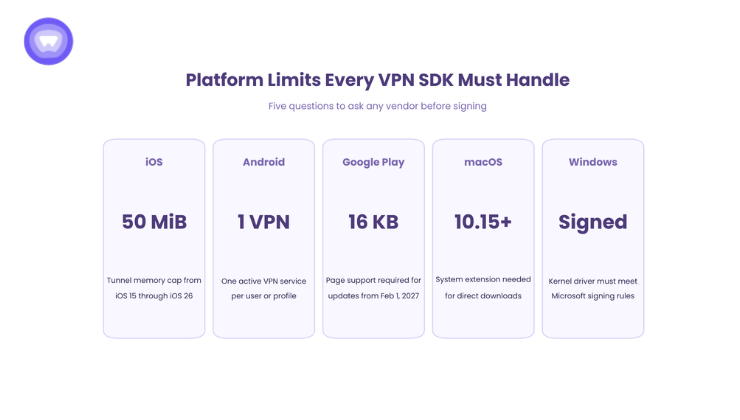
Vendor pages rarely mention these limits. Yet each one can break a production app, and each one is a fair question for any vendor.
iOS Caps Tunnel Memory at 50 MiB
On iOS, the tunnel runs in a packet tunnel extension with a hard memory ceiling. Apple engineers confirm a 50 MiB limit from iOS 15 through iOS 26. Once usage crosses it, the system kills the tunnel.
Older iPhones also run current iOS with far less memory to spare. So ask each vendor for peak extension memory during a sustained upload test. A vendor that has never measured it will learn on your users.
Android Allows One VPN at a Time
Android permits only one active service per user or profile. So if a user starts another VPN app, your tunnel loses its slot. Always-on mode, available since Android 7.0, adds a second state to track.
Therefore, the SDK must detect a lost slot and report it clearly. Silent failure here reads as “the app is broken” in your reviews.
macOS Splits App Store and Direct Builds
On macOS, a tunnel packaged as an app extension ships through the App Store only. A system extension supports both the App Store and direct download with Developer ID signing. However, it requires macOS 10.15 or later.
Many desktop products sell outside the App Store. Confirm the SDK ships a system extension build before you plan a direct-download launch.
Android Requires 16 KB Memory Pages by February 2027
Google Play now requires apps targeting Android 15 or later to support 16 KB pages on 64-bit devices. From February 1, 2027, updates that fail this check cannot be released.
The rule hits any app that links native libraries, including third-party SDKs. Most VPN SDKs ship native or Go-based tunnel code. So one outdated SDK can freeze every release of your app. Ask each vendor for the first SDK version that passes, and test it before signing.
Windows Needs a Signed Kernel Driver
Windows tunnels depend on a kernel-mode network driver. The Wintun project notes Microsoft’s driver signing requirements and ships prebuilt, Microsoft-signed packages. The project also warns against shipping renamed copies, which clash with other installs.
Ask who signs the driver your SDK installs, and how updates reach it. A kill switch built on the built-in Windows traffic filter deserves the same question.
Run a Supply-Chain Check Before You Sign
The two studies above share one cause. In both cases, apps inherited behavior from code their developers did not inspect. A short supply-chain review targets that gap directly.
- Per-user credentials: confirm each user gets unique credentials, never a password shared across every install.
- Background behavior: get a written statement that the SDK never enrolls devices as proxy nodes or resells bandwidth.
- Ownership disclosure: ask for the legal entity that operates the servers and its home jurisdiction.
- Bundled modules: list every analytics or ad module the SDK pulls in, and confirm each one is optional.
- Component inventory: request a component list per release, so security reviews take hours, not weeks.
PureWL’s iOS demo shows what the bundled-module answer can look like. Its analytics module is a separate package, and the SDK runs normally without it.
What VPN SDK Pricing Costs at Scale
Only one managed provider in this comparison publishes a full price card. The others quote per partner, so the billing unit matters more than any headline rate.
VPNGN bills a $250 monthly commitment, then $1 per user plus pooled data. Its overage counts inbound and outbound traffic. As a result, every 20 GB a user moves beyond the pool adds another $1.
That makes usage the real price driver, shown here as illustrative math. At a 40 GB monthly average, VPNGN’s per-user cost doubles to $2. At 60 GB, it reaches $3. So compare any flat per-user quote against your own usage data, not against the base rate.
Two details decide how a quote compares, so settle them in writing:
- User definition: ask whether “user” means every created account or only accounts that connect.
- Data limits: ask whether any pool, cap, or fair-use rule applies to the quoted rate.
By contrast, open-source libraries carry no license fee, but the costs move elsewhere. Servers, key management, abuse desks, and protocol patching all land on your team. One SaaS partner estimated a VPN built from scratch would have taken about a year. This guide to pricing models shows how each billing unit behaves at scale.
A Scorecard for VPN SDK Providers
Feature pages look alike across vendors, so score each one on evidence instead. Next, ask for written answers on these twelve points:
- Peak iOS extension memory under sustained upload
- Behavior when Android hands the VPN slot to another app
- The first SDK version that supports 16 KB memory pages
- Support for React Native or Flutter, if your app uses them
- macOS system extension support for direct downloads
- Who signs the Windows driver, and how it updates
- Named protocols, plus the patch window for each
- Unique credentials per user, with no shared secrets
- A written ban on proxy enrollment and bandwidth resale
- Pricing unit, data limits, and minimum treatment
- Audit scope covering the partner network, not only a retail app
- A public demo app your team can build in one day
Pair this scorecard with these vetting questions on contracts, SLAs, and exit terms. Together, they cover both the code and the commercial terms.
What the Evidence Shows
Published case studies show what a managed SDK route can deliver across platforms. A mobile app developer serving communication, fintech, and productivity apps embedded PureWL SDKs on Android, iOS, macOS, and Windows.
According to that cross-platform integration case study, 40% of users enabled VPN in their first session after the update. The company also reported connections 22% faster on average than standalone VPN apps. Its macOS build also used notarized modules to meet signing rules.
A second partner, a UK-focused VPN app, used the same SDKs for a freemium launch. It reported growth from zero to more than 10,000 active users in about six weeks. Both sets of figures come from the partners’ own reporting, published by PureWL. They are not independently audited.
How PureWL Fits
PureWL gives product teams native SDKs for iOS, Android, Windows, and macOS, plus a provisioning API on one platform. Integration guides, demo apps, and an API playground sit on its developer hub. In addition, pricing is quoted per partner, so teams can request a written rate built on their own usage.
The network behind the SDKs carries a KPMG-certified no-log policy, described on the white label VPN page. Ask for the audit scope document early, so security review runs in parallel with integration.
Conclusion
The best VPN SDK providers are not the ones with the longest feature lists. They are the ones that survive iOS memory limits, Android slot and page rules, macOS signing, and Windows drivers. They also pass a supply-chain check and price on a unit that matches your users. Score every vendor on that evidence before your team writes integration code.
Request API sandbox access for a 20-minute integration walkthrough.
Frequently Asked Questions
What is a VPN SDK provider?
A VPN SDK provider ships client libraries and runs the server network, so apps add VPN without building tunnels.
Which VPN SDK providers publish pricing?
VPNGN publishes $250 monthly plus $1 per user, while PureWL and Pango quote pricing per partner.
Is WireGuard a VPN SDK provider?
No. WireGuard’s libraries supply client code only, so your team runs servers, keys, billing, and patches.
How much memory can an iOS VPN SDK use?
An iOS packet tunnel extension gets 50 MiB, a limit Apple confirms from iOS 15 through iOS 26.
Can two VPN SDKs run at once on Android?
No. Android allows one active VPN service per user, so a second VPN app takes over the tunnel.