

- Economic Damage: The JLR cyberattack cost the UK economy $2.5 billion, making it the most financially damaging cyberattack in British history.
- Attribution: Investigators traced the breach to Russian hackers, working with the FBI, the UK’s National Crime Agency, and Google’s Mandiant unit.
- Entry Point: The attackers got in through stolen credentials and exposed remote access, not an advanced exploit.
- Business Impact: Production stayed shut down for roughly five weeks and the damage rippled through more than 5,000 supply chain organizations.
- The Fix: A white label VPN solution gives businesses centralized control over remote logins, closing the exact gap that let the JLR breach happen.
The Jaguar Land Rover cyberattack is trending in the news. For five weeks in the autumn of 2025, robotic arms at three Jaguar Land Rover factories sat idle while one of the world’s most recognizable car brands fought off hackers instead of building vehicles. Production at Solihull, Halewood, and Wolverhampton stopped completely. Staff were sent home. Dealers lost access to inventory systems. Engineers lost access to design files.
By the time systems came back online, investigators had traced the breach to Russian hackers. The UK’s Cyber Monitoring Centre put a number on the damage: $2.5 billion to the British economy, making it the most financially damaging cyberattack in UK history.
This was not a Hollywood-style zero-day exploit. It was a breach built on stolen credentials and remote access. Those are the same weak points that show up in ransomware reports year after year. That detail matters more to ordinary businesses than the size of the ransom or the identity of the attackers. It means the same gap that took down JLR exists in thousands of smaller companies right now, many of them without any VPN security for businesses worth the name.
What Actually Happened at Jaguar Land Rover
JLR’s IT teams detected an intrusion into their network on September 1, 2025, a day after abnormal activity was first flagged at the Halewood plant. The company made the decision to shut down its own IT systems to contain the spread. That single move halted production across its UK facilities and rippled through its global supply chain within days.
A group calling itself Scattered Lapsus$ Hunters claimed responsibility on Telegram within days of the breach becoming public. Months later, a joint investigation involving the FBI, the UK’s National Crime Agency, the National Cyber Security Centre, Google’s Mandiant unit, and Palo Alto Networks pointed to a different conclusion. According to reporting based on that investigation, the operation was carried out by Russian hackers, though investigators have not confirmed whether they acted directly for the Kremlin or independently.
Timeline of the Breach
| Date | Event |
| Aug 31, 2025 | Abnormal system activity detected at JLR’s Halewood plant |
| Sept 1, 2025 | Intrusion confirmed; JLR shuts down IT systems and pauses production |
| Sept 2, 2025 | JLR issues first public statement confirming a cyber incident |
| Sept 16, 2025 | Production pause extended; forensic investigation continues |
| Sept 28, 2025 | UK government approves a £1.5 billion loan guarantee for JLR’s supply chain |
| Oct 8, 2025 | Phased production restart begins |
| Jan 5, 2026 | JLR reports Q3 wholesale sales down 43.3% and retail sales down 25.1% |
The financial fallout did not stop at JLR’s own balance sheet. More than 5,000 organizations across the company’s supply chain felt the impact. The Bank of England later cited the shutdown as one factor behind slower UK GDP growth in the third quarter of 2025.
Suppliers who had never touched a line of JLR’s code still lost weeks of orders. That is the part of the story that gets lost in headlines about hackers and ransom notes. A single compromised login turned into a national economic event within a matter of days.
How the Hackers Got In
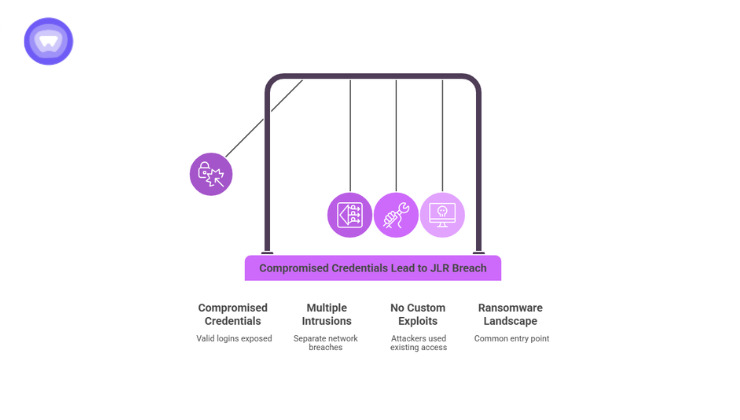
Multiple reports describe an attack built on well-worn tactics rather than exotic malware. Investigators found evidence of several separate intrusions into JLR’s network over time, not a single clean break-in. That included credentials harvested through infostealer malware and access tied to logins compromised years earlier.
The common thread across nearly every account of the breach is identity and access. Attackers did not need to write custom exploits when valid logins and remote access paths were sitting exposed.
This pattern is not unique to JLR. It shows up across the ransomware landscape at a scale that should concern any business that lets employees, contractors, or vendors connect remotely.
- Compromised credentials for VPNs and remote desktop services accounted for 48% of ransomware attacks in the third quarter of 2025 alone, nearly double the next most common entry point.
- VPN compromises made up 73% of ransomware intrusions where the entry vector could be identified in 2025, up from 38% in 2023.
- Zero-day exploitation against network edge devices and VPNs rose to 22% of all vulnerability-exploit breaches, an almost eight-fold jump from the prior year, according to the same 2025 claims analysis.
Why This Reaches Far Beyond the Auto Industry
JLR is a manufacturer, but the vulnerability that let attackers in has nothing to do with building cars. It has to do with how remote access is managed, monitored, and secured. Any company that lets staff log in from outside the office, and nearly every company does, carries some version of the same exposure.
The economic damage from this single incident is a useful reminder of how fast costs compound once a network is breached. Production stoppages, supply chain disruption, emergency government financing, and months of depressed sales all followed from one compromised access point.
Smaller businesses rarely have the balance sheet to absorb a shock like that. A ransomware incident that would barely register on a company JLR’s size can be existential for a mid-sized manufacturer or a regional retailer. Both types of business often rely on the exact same categories of remote access tools, just with far less budget for VPN security for businesses at scale.
Where Businesses Keep Getting Exposed
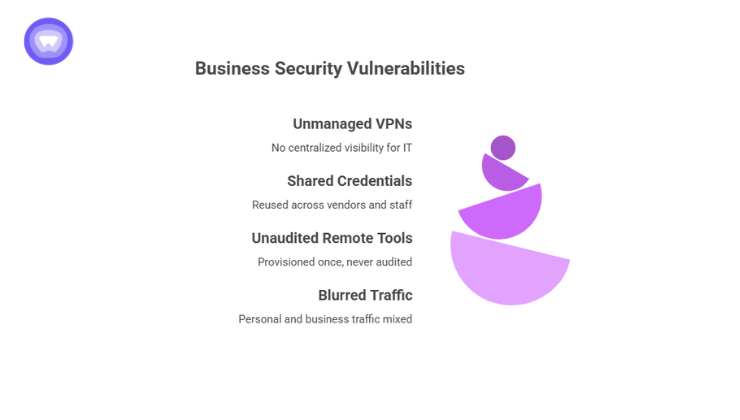
- Consumer-grade or unmanaged VPN connections used for business access, with no centralized visibility for IT teams.
- Shared or reused credentials across vendors, contractors, and remote staff.
- Remote access tools that are provisioned once and never audited again.
- No clear separation between personal browsing traffic and business traffic on the same connection.
None of these gaps require a nation-state adversary to exploit. They require an attacker with a list of purchased credentials and patience, which is exactly what multiple reports describe in the JLR case.
Closing the Gap That Keeps Getting Exploited
Fixing this does not require ripping out existing infrastructure. It requires businesses, and the resellers and IT providers who serve them, to treat remote access as a managed asset rather than a checkbox.
That means centralized control over who connects, from where, and through what device. It means audit trails that flag unusual login patterns before they become a five-week production shutdown. It means giving IT teams and managed service providers the ability to enforce this consistently across every client and every device, instead of relying on a patchwork of free or personal VPN tools that nobody is actively monitoring.
For managed service providers, IT resellers, and telecom companies, this is also a business opportunity. Clients are actively looking for a security vendor they can trust after headlines like JLR’s, and the ones who can offer a branded, controlled VPN service under their own name have a real answer to give.
What This Means for IT Providers Right Now
Clients rarely ask for a VPN by name anymore. They ask for proof that a breach like JLR’s cannot happen to them. That shift changes what providers need to offer.
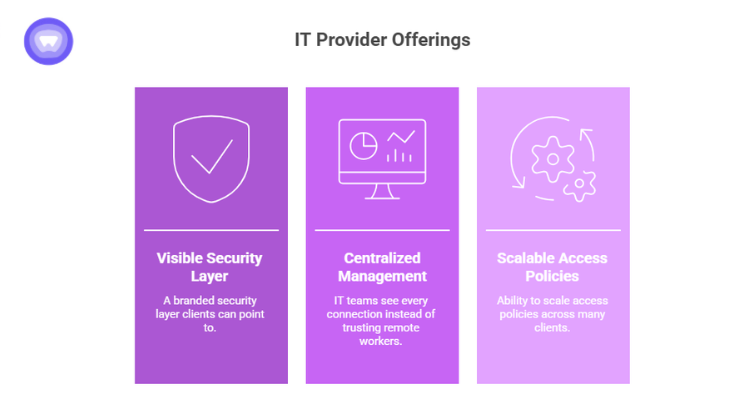
- A visible, branded security layer clients can point to when their own customers or auditors ask about remote access controls.
- Centralized management so IT teams see every connection instead of trusting that each remote worker configured their own tool correctly.
- The ability to scale access policies across dozens or hundreds of clients without rebuilding the wheel for each one.
None of this requires predicting the next attack. It requires closing the door that keeps getting used.
Where PureWL’s White Label VPN Solution Fits
This is precisely the gap PureWL’s white label VPN solution is built to close. It gives resellers, MSPs, and IT service providers a fully brandable VPN platform they can launch under their own name. That platform runs on enterprise-grade infrastructure with centralized access controls and the kind of audit visibility that catches a compromised login before it becomes a JLR-scale incident.
Instead of stitching together unmanaged tools or pointing clients toward consumer VPN apps with no oversight, providers get a white label VPN solution they control end to end. That control spans branding, server infrastructure, and account management in one place. For any business rebuilding trust with clients after a year of headline-making breaches, that level of control is not a luxury.
It is the baseline clients now expect, and it is a faster path to real VPN security for businesses than assembling five separate tools and hoping they hold together.
Final Thoughts
The JLR breach did not succeed because Russian hackers had access to secret technology. It succeeded because a well-worn gap in remote access security was left open long enough to walk through. That gap exists in far more networks than one carmaker’s, and closing it is a far smaller investment than the one JLR is still paying off.