

Doxxing prevention for executives removes, monitors, and governs the personal data attackers use to find leaders at home. The same program now has to cover public facing staff, because attackers often reach them first. Security providers can run it as a managed service, priced per person and renewed every year.
Key Takeaways
- Executive targeting incidents doubled in 2025, and 75% of Dow 30 directors appear on people search sites.
- Attackers build profiles from three layers: broker listings, breach and stealer data, and family posts.
- Help desk, HR, and assistant roles face the same exposure, so they belong in the program too.
- Start removals six to eight weeks before planned news, since DROP gives brokers up to 90 days.
- Enrollment must be opt-in, and employers should see removal status, not raw personal findings.
Executive targeting doubled in 2025. The Security Executive Council found incidents had already doubled 2024 totals by the end of October. Most of those attacks started with data anyone can buy. A 2025 study of Dow 30 boards found 75% of directors listed on people search sites. Home addresses and relatives showed up on every site it checked.
That exposure is now a revenue line. Doxxing prevention for executives used to sit with concierge firms that served a few hundred families. Today, MSPs, MSSPs, and enterprise security vendors can deliver it inside the stack they already sell. This guide calls that group “security providers.” It covers who to protect, when to start, how consent works, and how to package the service.
Why Doxxing Prevention for Executives Is Now a Budget Line
Boards now treat personal exposure as a corporate risk, not a private matter. The research from the past year explains why.
- The Security Executive Council logged a 463% rise in incidents motivated by activism. It also tracked a 400% rise in attacks in the executive’s home city.
- The same research found a 225% rise in attacks on non-CEO leaders since 2023.
- The Allied Universal World Security Report found 46% of U.S. security chiefs saw rising threats against executives. Yet only 24% of U.S. firms protect executive families.
- Ponemon’s 2025 research found attacks on executives’ personal digital lives rose to 51%, up from 43% in 2023.
The financial side is just as sharp. The FBI’s 2025 Internet Crime Report put business email compromise losses at $3.046 billion. Many of those schemes start with a convincing executive persona. Attackers build that persona from a home address, a personal phone number, and family names. Each item sits on a broker site today.
The cost of waiting lands on the client. One exposed home address can trigger a security review, a guard detail, legal work, and lost leadership time.
What Executive Doxxing Looks Like in 2026
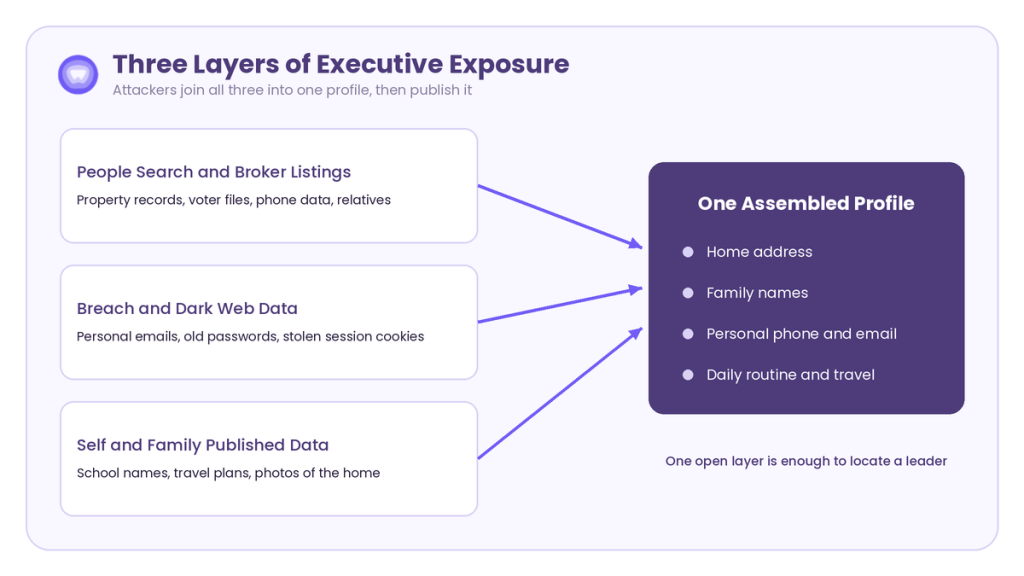
Doxxing is rarely a hack. It is assembly. An attacker joins three layers of exposure into one profile, then publishes it.
Layer 1: People Search and Broker Listings
Brokers merge property records, voter files, phone data, and relatives into one page. The page often lists past addresses and a map. Attackers check this layer first, because it is cheap and fast.
In 2025, two sites published contact data on executives from 1,000 organizations. The first site came down, but archived copies stayed online. Removal after a leak does not reach every archived copy.
Layer 2: Breach and Dark Web Data
Breach dumps link a name to personal emails, old passwords, and phone numbers. Infostealer logs go further. They hold stolen session cookies that let an attacker skip MFA on personal accounts. A leader’s personal email often resets bank, cloud, and social accounts. So one leak can open many doors.
Layer 3: Self and Family Published Data
Spouses and children post school names, travel plans, and photos of the home. Staff post team photos with badges in view. No removal request covers this layer. Training and privacy settings cover it instead.
A program that handles only one layer leaves the other two open.
Why Public Facing Staff Need the Same Protection
Executives are the obvious target, but they are not the easiest one. Attackers often go through the people around them.
Unit 42 found that 36% of incidents in its 2025 caseload began with social engineering. Its responders saw attackers call IT help desks posing as locked-out staff. They passed identity checks with leaked and public personal details. Help desk resets still lean on facts like a birth date, a manager’s name, or a home city. Brokers sell all three.
Public facing roles share one trait: their work already makes their names public. That group includes:
- Help desk and IT support staff, who hold password reset power
- HR teams and recruiters, who post on job sites and handle hard cases
- Spokespeople, investor relations, and legal staff named in filings
- Executive assistants, who know calendars and travel plans
- Store managers, clinicians, and field technicians who meet the public daily
Doxxing reaches ordinary workers too. A 2025 SafeHome.org survey found about 4% of U.S. adults have been doxxed. Workplace details ranked among the most exposed items. Employee doxxing is a staff safety issue and an access control issue at once.
A Role Based Tier Model for Doxxing Prevention
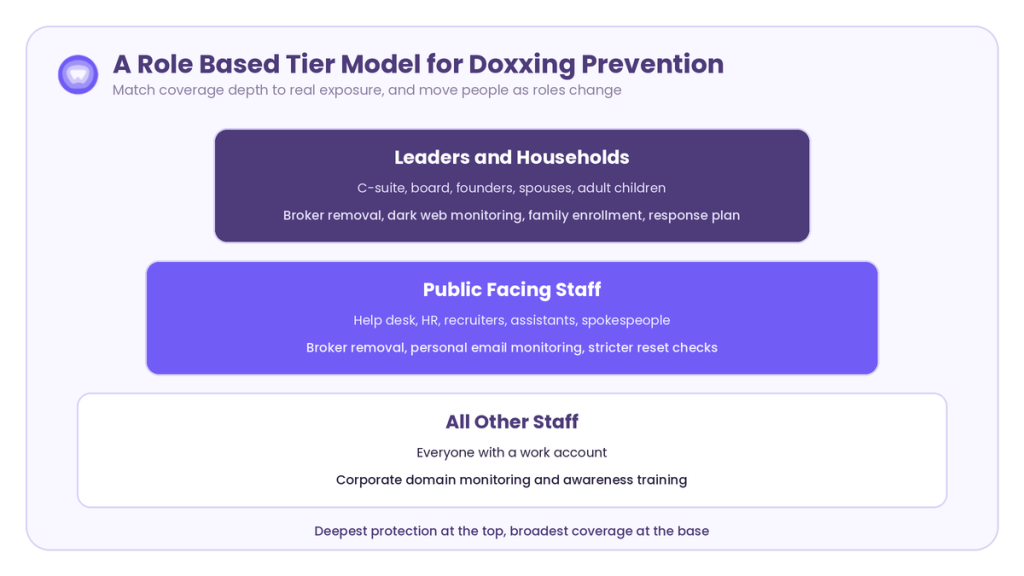
Protecting every employee at the same depth wastes budget. A tier model matches doxxing prevention for executives and staff to real exposure.
| Tier | Who It Covers | Main Exposure | Core Controls | Recheck Cadence |
| Tier 1 | C-suite, board, founders, and their households | Home address, family names, personal email | Broker removal, dark web monitoring, family enrollment, response plan | Monthly, plus event checks |
| Tier 2 | Public facing staff: help desk, HR, assistants, spokespeople | Personal phone, birth date, home city | Broker removal, personal email monitoring, stricter reset checks | Monthly |
| Tier 3 | All other staff | Work credentials | Corporate domain monitoring, awareness training | Continuous alerts |
Tier 3 runs on credential exposure monitoring for the corporate domain. It needs no personal data from staff. Tiers 1 and 2 need personal identifiers, which is why consent matters later in this guide.
Move people between tiers as roles change. A new CFO joins Tier 1 on day one. A recruiter who runs a large layoff moves up for that period.
Event Triggered Protection: Start Before the Announcement
Risk does not stay flat. It spikes around news, and the spike is often predictable. Timing is the most overlooked part of doxxing prevention for executives.
Common triggers include:
- Layoffs, plant closures, and restructuring
- Mergers, acquisitions, and earnings surprises
- Price increases, product recalls, and service outages
- Public statements on contested issues
- Lawsuits or regulatory actions that name a leader
Removal takes time. Under California’s DROP rules, brokers must begin deleting requested data within 90 days. They must also check for new requests every 45 days. So the scrub has to start before the news breaks.
A practical rule works well. Begin Tier 1 and Tier 2 removals six to eight weeks before a planned announcement. Run a fresh exposure scan one week out. Then keep daily monitoring on for 30 days after. Unplanned events give no head start, which is why a standing program beats a one-off clean-up.
Consent, Authorization, and Who Sees the Findings
This is where many programs stall. Doxxing prevention for executives handles personal data that belongs to the employee, not the company. Three rules keep the program lawful and trusted.
Make Enrollment Opt-In
Employees choose to join, and they can leave at any time. On California’s DROP portal, you may help another person only if they authorized you. The portal bars adding anyone’s details without that permission. So collect written authorization at enrollment, and store it with the record.
Separate the Findings From the Employer
The employee sees the raw findings: which sites list them, and what each site shows. The employer sees status only: enrolled, in progress, or removed. This split builds trust. A security team does not need a staff member’s family names or old addresses to run the program.
Enroll Family Members Separately
Spouses and adult children often leak the most location data. Each adult needs to give their own consent. Minors join through a parent. Never infer a family member’s details from an employee’s file.
Legal cover is thin for most private sector leaders. New Jersey’s Daniel’s Law lets covered officials demand removal within ten business days. That law covers judges, prosecutors, police, and child protective investigators, not corporate executives. It also remains in litigation. Corporate leaders rely on general privacy rights and company programs instead.
The Doxxing Prevention Workflow, Step by Step
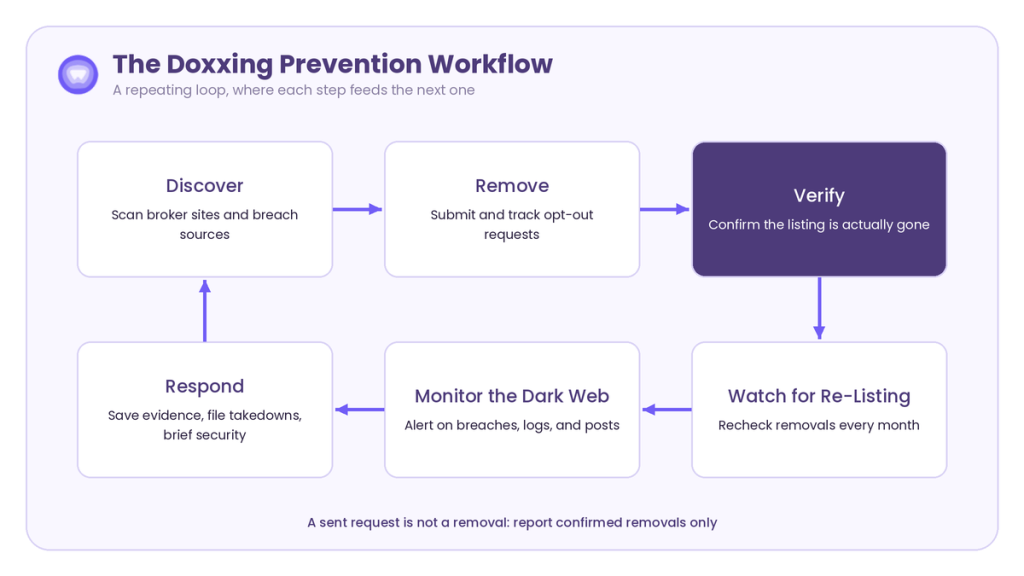
Once tiers and consent are set, the work runs as a loop. Each step feeds the next one.
- Discover. Scan broker sites and breach sources for each enrolled person. Record the listing, the data shown, and a screenshot.
- Remove. Submit opt-out requests to each broker and track each one to completion.
- Verify. Confirm the listing is gone, not just that a request went out.
- Watch for re-listing. Brokers rebuild profiles from fresh public records. Scraped data tends to recirculate, so removals need monthly rechecks.
- Monitor the dark web. Alert on new breaches, stealer logs, and forum posts that name the person.
- Respond. When a dox goes live, save evidence, file platform takedowns, and brief physical security.
Step 3 separates a real program from a form-filling service. A sent request is not a removal. Report confirmed removals only, so the client sees true progress.
How Security Providers Package Doxxing Prevention for Executives
The service fits the way managed service providers already sell. It is recurring, priced per person, and easy to explain to a board.
Three Ways to Deliver It
Security providers have three real options. Each one decides who owns the client when an attacker exposes an executive.
| Delivery Option | Who Owns the Client | Whose Brand | Best Fit |
| Refer clients to a third-party consumer removal service | The other brand | Not yours | Lowest effort, no recurring margin |
| Hand off to a concierge executive protection firm | The firm | Not yours | Top leaders only, high cost per person |
| Offer a white-label privacy service in your stack | You | Yours | Every tier, recurring margin, one bill |
Referral feels easy, but it hands the relationship to another brand. The client learns to call someone else when a leak hits a leader. White-label delivery keeps the alert, the report, and the renewal under your name.
An Illustrative Packaging Model
The math below uses round numbers and is illustrative only. Picture an MSP that serves 40 mid-size clients. Each client enrolls 6 Tier 1 leaders and 20 Tier 2 staff. That gives 240 Tier 1 leaders and 800 Tier 2 staff. Add spouses and adult children, and Tier 1 grows to about 600 people.
The MSP sells Tier 1 as a premium seat and Tier 2 as a standard seat. An event pack covers short spikes, such as a layoff month. Every seat renews monthly. Each confirmed removal then shows up in the quarterly business review as proof of value.
What Buyers Check Before They Sign
Enterprise buyers test five points before they commit to doxxing prevention for executives:
- Broker coverage by region, not just a total site count
- Recheck frequency after each removal
- Who sees raw findings, and who sees status only
- Personal email and stealer log monitoring, not just corporate domains
- Audit reports that cover the provider’s own controls
Proof From a Bundled Security Rollout
No doxxing-specific case study exists yet, so the closest evidence is a bundling result. A U.S. MSP with two decades in antivirus added a white-label VPN to its antivirus and VPN offer. The MSP reported a 32% cut in operating costs and a 15% rise in client retention. It also reported 20% growth in enterprise clients and 25% revenue growth within two months of launch.
These are the MSP’s own reported results, not an independent audit. They come from a VPN bundle, not a privacy removal service. Still, they show how one added privacy line can change retention for a security provider.
How PureWL Helps
PureWL Digital Privacy Protection gives security providers both halves of doxxing prevention under their own brand. Data broker opt-out covers 400+ people search and broker sites in the US, the EU, and other regions. The service rechecks removals monthly and reruns them when data reappears. Dark web monitoring scans breaches and stealer logs, including cookies and device context. Partners can launch the full platform, add one module, or connect through the monitoring API and SDK.
PureWL holds ISO 27001 and SOC 2 Type II, and it shares audit reports with partners under NDA. Its 150+ partners figure is PureWL’s own reported data. Partners set their own pricing for end clients. Partners who want broker removal alone can start with the data removal service.
Conclusion
Doxxing prevention for executives now starts with data, not guards. Attackers assemble profiles from broker pages, breach dumps, and family posts. The same profiles reach help desks, recruiters, and assistants first. A strong program tiers people by exposure, starts before big news, and runs on consent. It confirms removals, rechecks them monthly, and watches the dark web between scans. Security providers that deliver it under their own brand keep the client, the data, and the renewal.
Request a 20-minute margin and audit-scrutiny review.
Frequently Asked Questions
What is doxxing prevention for executives?
It removes, monitors, and governs the personal data attackers use to locate leaders and their families.
How do you stop executives from being doxxed?
Remove broker listings, monitor breach data, limit family posts, and recheck every removal each month.
Can doxxed information be removed from the internet?
Opt-outs clear broker listings, but archived copies and reposts need separate platform takedown requests.
Who in a company is most at risk of doxxing?
Executives, board members, and public facing staff such as help desk, HR, and executive assistants.
How often should data broker removals be rechecked?
Monthly, because brokers rebuild profiles from fresh public records after a removal.
Does employee doxxing prevention require consent?
Yes. Each employee and adult family member must authorize enrollment, and employers see status only.
Is doxxing illegal in the United States?
No federal law makes brokers delete a private executive’s home address, so prevention falls on the company.