

- Two separate owners. White label VPN privacy splits into a vendor audited network layer and a reseller owned account, billing, and analytics layer.
- The app store label is the reseller’s job. It gets filed under the reseller’s own developer account and must cover every SDK added after launch, not just the vendor’s original build.
- GDPR roles differ by design. The reseller usually acts as data controller while the VPN vendor acts as processor under a Data Processing Agreement.
- Deletion does not end at the app. Article 19 still requires notifying every recipient the data was shared with, including the vendor, once deletion completes.
- Scrutiny is rising on both sides. Consumers are deleting apps over privacy concerns and regulators are auditing erasure practices directly, so mapping vendor and reseller obligations early protects the compliance story.
Quick answer: White label VPN privacy splits into two layers. The vendor audits and secures network traffic under a no-log policy. The reseller brand controls account data, billing, analytics, and the app store privacy label as the GDPR data controller.
White label VPN privacy is not one policy. It is two policies, written by two different companies. Most product teams only read the one they signed themselves. A VPN vendor publishes a no-log audit for the network layer. The brand running the app publishes its own privacy policy for everything above that layer. Users only ever see one interface. They assume one company answers for both.
For product teams building a branded VPN into an existing app, that assumption creates real exposure. Without a map across the vendor, billing system, and analytics SDKs, one deletion request can become a multi-system investigation. GDPR still gives only one month to close it, not to start it. A privacy label filed with an app store lands on the reseller first. A deletion request sent to support lands on the reseller first. A GDPR audit starts with the reseller too, not the vendor. Understanding white label VPN privacy means knowing exactly where the vendor’s responsibility ends and the reseller’s begins.
The Two Layers Behind White Label VPN Privacy
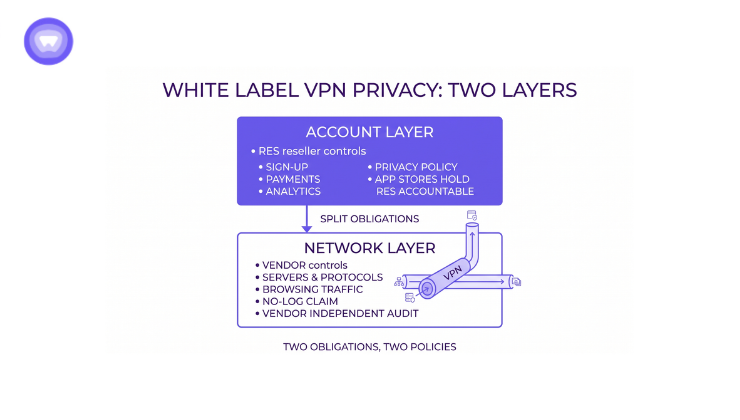
A white label VPN app runs on infrastructure built by one company. It gets branded and sold by another. Privacy obligations split along that same line. The vendor answers for what happens to traffic once it enters the tunnel. The reseller answers for everything a user does before that: signing up, paying, granting permissions, and generating in-app analytics.
Treating white label VPN privacy as one combined policy is a mistake. It surfaces during an audit. It surfaces during a data subject request. It surfaces fastest during an app store review.
What the Vendor Controls
The VPN vendor owns the network layer. That includes server infrastructure, tunneling protocols, and whether browsing traffic gets logged. A serious vendor backs this with an independent audit, not a self-reported claim. PureWL’s own no-log policy carries a SOC 2 Type II audit. That audit is scoped specifically to the network layer.
This audit says nothing about the app’s account database. It says nothing about analytics SDKs or the support ticketing system either. Those sit outside the vendor’s infrastructure entirely.
What the Product Team Controls
The reseller owns the account layer. That means the sign-up flow, the payment processor, and push notification tokens. It also covers crash reporting and any analytics SDK bundled into the app. That includes account data and the privacy policy users actually read. The vendor’s own policy rarely appears inside a white label build at all.
This is the layer regulators and app stores hold the reseller accountable for. That holds true regardless of whose servers move the traffic underneath it.
Why the App Store Privacy Label Belongs to the Reseller
Every app submitted to Apple’s App Store or Google Play must disclose what data it collects. That disclosure gets filed under the developer account submitting the build. For a white label VPN app, that developer account belongs to the reseller, not the vendor.
Apple’s own guidance states the label must cover data collected by the app itself. It must also cover any third-party SDKs bundled inside it. That includes analytics and crash reporting tools added after launch, not just the SDK the vendor originally shipped.
What Counts as Collected Data
A branded VPN app can collect more than the tunnel implies. Common categories include:
- Device identifiers used for push notifications or licensing
- Crash logs and diagnostic data sent to a third-party analytics tool
- Support ticket contents tied to an account email
- Payment metadata from the billing processor
None of this falls under the vendor’s no-log audit. All of it falls under the reseller’s own privacy label, filed and maintained under the reseller’s developer account.
Third-Party SDKs Count Too
A product team that adds an analytics SDK after launch inherits that SDK’s own data practices. The same applies to a customer support widget or a crash reporter. The privacy label has to reflect every one of them. Skipping this step is the most common reason a white label VPN app gets flagged during review. That happens independent of anything the VPN vendor does correctly on its own side.
The GDPR Chain Behind a Deletion Request
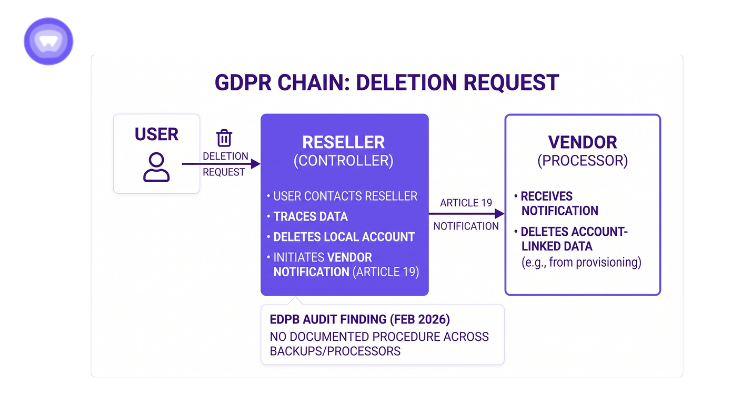
GDPR treats the reseller and the vendor differently. The reseller usually acts as the data controller, since it decides why data gets collected and how the product works. The VPN vendor typically acts as a processor, handling infrastructure on the controller’s instructions under a Data Processing Agreement.
That distinction decides who has to act first once a user asks for their data to be deleted.
Who Receives the Request First
A deletion request almost never reaches the VPN vendor directly. It arrives at the reseller’s support inbox. It arrives inside the branded app’s own account settings, or through a privacy contact listed in the reseller’s own policy. From there, the reseller has to trace which systems actually hold that user’s data, including anything held by the vendor.
What Article 19 Requires After Deletion
Deleting a local account record does not close a GDPR request on its own. Article 19 requires a controller to notify every recipient the data was shared with, once deletion completes. That obligation lifts only when notification proves impossible or disproportionate. For a white label VPN app, that recipient list includes the vendor’s own systems. That applies whenever any account-linked data ever passed through them, even briefly at provisioning.
A February 2026 erasure enforcement report from EDPB covered 32 data protection authorities auditing 764 controllers. It found many organizations still have no documented procedure for erasure across backup systems or third-party processors. A white label stack with an undocumented vendor relationship fits that gap directly.
Three Questions Product Teams Ask Before They Ship
A few questions recur once a product team starts mapping its own white label VPN privacy split.
The first is who actually files the app store privacy label. The answer is whoever holds the developer account, not whoever built the VPN backend. The second is whether the vendor’s no-log audit extends to the product’s own account or analytics data. It does not, since that data never enters the vendor’s infrastructure. The third is what happens to a session token once a user cancels inside the product’s own billing flow. That question matters most when cancellation happens separately from the VPN vendor’s own portal. The token still needs its own revocation step, tracked in the DPA, not assumed to expire on its own.
Vendor-Controlled vs Reseller-Controlled: A Side-by-Side View
The table below separates white label VPN privacy into what each side actually owns. A product team can check its own coverage against it before an auditor asks the same question.
| Data Type | Who Controls It | Covered by Vendor Audit | Example |
| Network traffic and browsing activity | VPN vendor | Yes | Site visited while connected |
| Account creation and login credentials | Reseller | No | Email used to sign up |
| Billing and payment metadata | Reseller (via processor) | No | Card token, invoice history |
| Crash logs and diagnostic data | Reseller | No | SDK-collected device errors |
| Support ticket contents | Reseller | No | Message sent to the help desk |
| Server infrastructure and protocol logs | VPN vendor | Yes | Session length on a given server |
A Practical Walkthrough: Handling One Deletion Request End to End
A single request shows how white label VPN privacy actually moves between two companies, step by step.
- A user emails the reseller’s privacy contact asking for full account deletion.
- The reseller’s support team verifies identity, then checks its own account, billing, and analytics systems.
- The reseller checks its Data Processing Agreement to confirm what the vendor’s systems retain for that user, if anything.
- The reseller sends a deletion instruction to the vendor’s account management endpoint, referencing the same user identifier used at provisioning.
- The vendor confirms deletion from its side within the timeframe set in the DPA.
- The reseller closes the request and logs the confirmation, since GDPR expects a documented response trail, not just a completed action.
Skipping the DPA-check step is the most common gap. A product team that never mapped which vendor systems hold account-linked identifiers cannot honestly confirm a deletion request is complete. This matters most for smaller product teams without a dedicated privacy or legal-ops function. For those teams, the DPA is often the only document mapping the vendor relationship at all. It should match the partner’s own compliance obligations, not a generic default. It needs a named internal owner, not just a signature on file.
Why White Label VPN Privacy Scrutiny Is Increasing Now
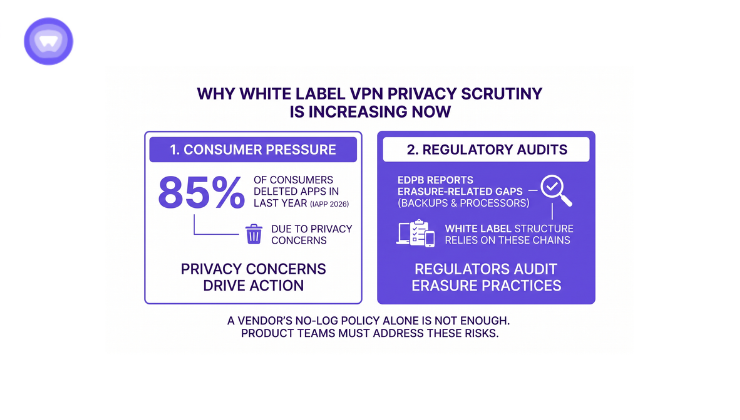
Two separate pressures are pushing this issue higher on a product roadmap.
Consumers are acting on privacy concerns rather than just reporting them. An IAPP consumer trust report published in 2026 surveyed consumers on this exact behavior. It found 85 percent had deleted a phone app over the past year specifically due to privacy concerns. A confusing or overly broad privacy label reads as a warning sign before a user opens the app. Product teams rarely get a second chance at that first impression.
At the same time, regulators are auditing erasure practices directly instead of waiting for complaints. The same EDPB report found erasure-related gaps span both backup systems and third-party processor chains. That is the exact structure a white label VPN app relies on by design. A product team that treats white label VPN privacy as the vendor’s problem alone is building against both trends. It ends up exposed to a consumer trust drop and a regulatory finding at the same time.
How PureWL Supports White Label VPN Privacy
PureWL separates what gets audited from what gets assumed. The network layer carries a SOC 2 Type II audit verified by KPMG, scoped to traffic and server logs. That scope is stated plainly rather than implied to cover the whole app. Partners get third-party audit documentation they can hand directly to their own compliance reviewers. That saves a product team from reconstructing audit scope out of marketing pages during a live client review.
Account data, billing, and analytics stay where they belong under a white label build: with the partner. PureWL’s provisioning model keeps customer data inside the reseller’s own account system. It does not route account data through a shared vendor database. That structure keeps the controller-processor line clean for a GDPR review. A productivity SaaS partner added a built-in VPN and later reviewed its uninstall data. More than 30 percent of prior uninstalls cited a lack of built-in security. That result speaks to the VPN feature itself, not to privacy-label handling. Worth reading with that distinction in mind.
Handling a Deletion Request Without Losing Control
White label VPN privacy only works when both sides know exactly which half they own. A vendor’s no-log audit proves one thing convincingly: traffic is not stored. It says nothing about the account system, the analytics SDK, or the privacy label filed under a reseller’s developer account. Product teams that map both layers early stay in control of their own compliance story. Teams that wait tend to discover the gap during the review itself, with far less room to fix it quietly. A 20-minute walkthrough of PureWL’s provisioning and audit scope is enough to map that split for an existing app.