

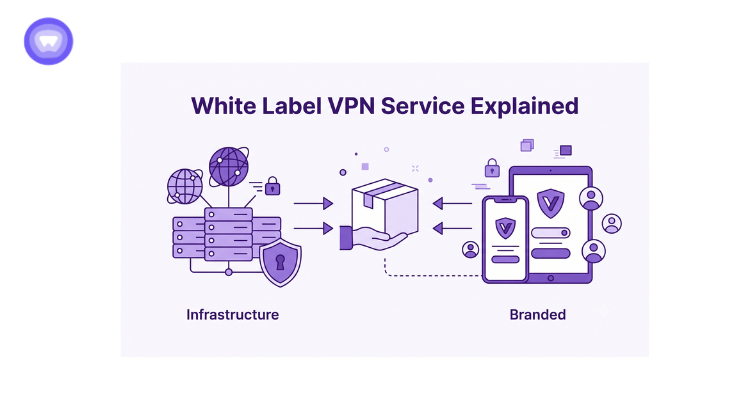
- A white label VPN service is four separate layers, not one purchase. Network and server, protocol and encryption, application and SDK, and billing and support each fail independently and carry a different owner.
- Skipping VPN has a real, calculable cost. Several major consumer security brands already bundle it by default, and an illustrative example shows an antivirus vendor with 50,000 subscribers could lose 240,000 dollars a renewal cycle to competitors who do.
- Compliance liability starts at the protocol layer, not the app layer. If a provider runs an outdated protocol build, the breach headline lands on the vendor’s brand, not the provider’s.
- Building in house takes 12 to 18 months; a white label VPN service can launch in weeks. The real comparison is time to revenue against the cost of the feature gap while building.
- Exit terms matter as much as onboarding terms. Data portability, a defined migration window, and app store listing continuity should all be settled in writing before signing, not after a vendor needs to switch providers.
A white label VPN service is not one product. It is four separate layers stacked under a single login screen. Most buying decisions treat it as one purchase.
That mistake gets expensive fast. A security vendor that picks a provider on price alone often finds out later that one layer causes the outages. That layer was never vetted. It was the layer nobody asked about during the sales call. The real question is not whether to add a white label VPN service. It is which layer of that service a vendor is actually buying, and who owns the risk at each one.
Why Security Vendors Are Adding VPN Now
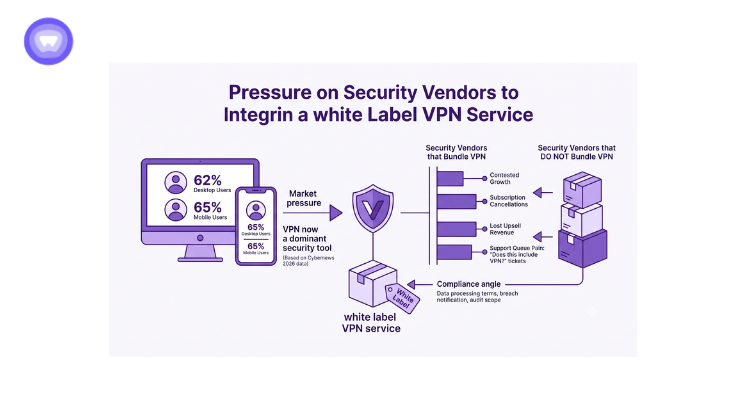
Antivirus, threat intelligence, and phishing protection vendors that skip VPN are losing a feature fight they did not choose. Several major consumer security brands already bundle VPN by default. Others package VPN, antivirus, and breach alerts into one subscription line.
Cybernews reported in its 2026 antivirus usage study that VPN is now the dominant security tool used alongside antivirus. Adoption sits at 62 percent among desktop users and 65 percent among mobile users. Users no longer treat VPN as optional. They expect it bundled with whatever security product they already pay for.
The antivirus market itself is not shrinking either. It sits at 4.23 billion dollars in 2025. It is projected to reach 5.52 billion dollars by 2029, a growth rate of 6.9 percent a year. Every point of that growth is being contested by vendors who already bundle VPN and vendors who do not.
For a security vendor evaluating a white label VPN service, the pain is not abstract. It shows up as subscription cancellations. It shows up as lost upsell revenue. It shows up as a support queue full of “does this include VPN” tickets with no good answer.
There is a compliance angle too, separate from competitive pressure. A security vendor that routes customer traffic through a white label VPN service becomes part of that traffic’s data path. Data processing terms, breach notification duties, and audit scope all extend to whichever infrastructure carries the traffic. They do not stop at the app the customer sees.
What a White Label VPN Service Actually Means
A white label VPN service lets a company sell VPN access under its own brand. A separate provider runs the underlying network. The buyer controls pricing, packaging, and the customer relationship. The provider controls servers, protocols, and uptime.
That split sounds simple. It is not. “The provider runs it” hides four distinct systems that fail, scale, and get audited on their own schedule. Treating a white label VPN service as a single unit is a mistake. That is exactly where vendors lose track of their own liability.
PureWL’s guide on white label VPN basics covers the launch mechanics step by step. This piece answers a narrower question. Once a service is live, which layer breaks first, and who answers for it.
The Four Layers Inside Every White Label VPN Service
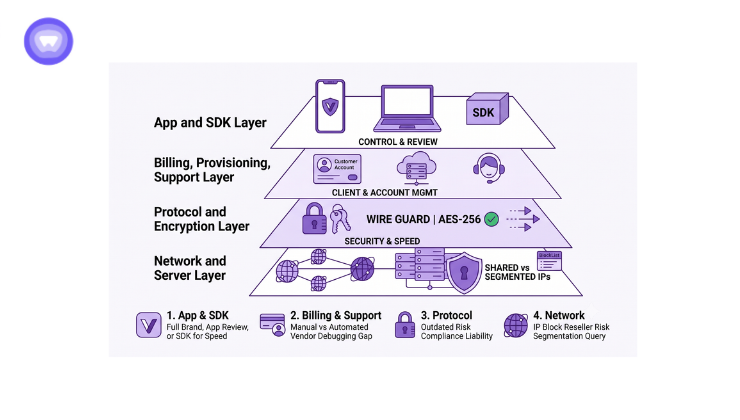
Every white label VPN service is built from four layers. Each one carries a different failure mode and a different owner.
Network and Server Layer
This layer is the physical and virtual server footprint the traffic actually routes through. It includes server count, country coverage, and IP address pools.
Shared IP pools carry a specific reseller risk. If one reseller’s abusive user gets an exit IP blocklisted, every other reseller sharing that IP inherits the block. Vendors should ask whether IP pools are shared across all resellers or segmented per partner. The answer decides who absorbs a blocklisting event.
Protocol and Encryption Layer
This layer decides how traffic gets encrypted and how fast it moves. WireGuard runs on the Noise framework with ChaCha20 and Curve25519. OpenVPN typically uses AES-256-GCM. IKEv2 and IPsec manage network switching, which matters for mobile users moving between WiFi and cellular data.
The protocol layer is also where compliance liability starts. If a provider runs an outdated protocol build, the vendor’s brand carries the breach headline. The provider’s name rarely appears in that headline at all.
Application and SDK Layer
This layer is what the end customer actually sees and touches. It ranges from a fully branded standalone app, to an SDK embedded inside an existing product. A thin referral link sits at the shallow end of that same range.
A full branded app gives the deepest integration and the most control over the customer experience. An SDK ships faster. It limits how much of that experience carries the vendor’s own brand from end to end. App store review teams treat the two differently. A referral link points traffic to a third-party listing. An embedded SDK stays inside the vendor’s own app review instead.
Billing, Provisioning, and Support Layer
This layer handles account creation, plan changes, and the support ticket when a customer cannot connect. Multi-tenant provisioning determines how fast a vendor can onboard a new client cohort without manual setup work.
Support ownership is the layer vendors underestimate most. A provider that only supports its own infrastructure leaves the vendor’s team debugging connection issues it did not build. That gap shows up first in average ticket resolution time, long before it shows up in a churn report.
Who Owns What When Something Breaks
The table below maps each layer to what a buyer typically controls and what the provider controls. It also shows where liability tends to land when something fails.
| Layer | Buyer Controls | Provider Controls | Liability If It Fails |
| Network and Server | Country selection, IP tier | Server uptime, IP reputation | Provider, unless buyer chose a shared low-cost tier |
| Protocol and Encryption | Which protocols are offered | Implementation, patch cadence | Provider technically, but disclosure lands on buyer’s brand |
| Application and SDK | Branding depth, UI, feature toggles | App stability, store compliance | Shared, split by integration depth |
| Billing and Support | Pricing, plans, communication | Provisioning speed, backend logic | Buyer for customer-facing failures, provider for outages |
Reading this table before signing a contract turns a vague pitch into a specific list of questions. It also shows why one invoice line, “white label VPN service,” can hide four different risk profiles. The tier a vendor selects at each layer decides which profile applies.
Build Versus White Label: The Real Cost Comparison
Security vendors weighing an in-house VPN build against a white label VPN service usually underestimate the build side. A basic VPN backend needs global server contracts, protocol engineering, IP reputation management, and around-the-clock monitoring.
That build typically takes 12 to 18 months before a single customer connects. A white label VPN service can launch in a matter of weeks, since the network and protocol layers already exist. The comparison is not build cost against subscription cost alone. It is time to revenue against the cost of the feature gap during that build window.
There is a smaller-scale version of this decision too. Some vendors choose an SDK instead of a full white label app to cut integration time further. That choice trades brand depth at the application layer for a faster launch. It is a fair trade when the vendor’s own app is already the primary customer touchpoint.
What Happens If a Vendor Needs to Switch Providers
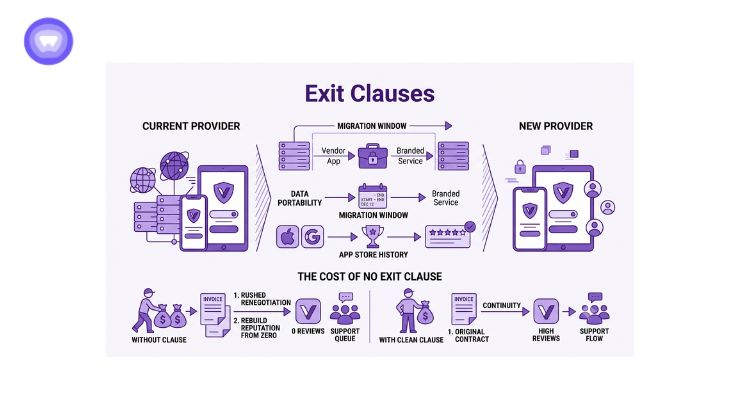
Few security vendors ask about exit terms before signing. That question matters more for a white label VPN service than for most infrastructure decisions. Customer accounts, session data, and app store listings all stay tied to the current provider’s backend.
A clean exit clause should cover three things in writing. It should cover data portability for existing customer accounts. It should cover a defined migration window instead of an open-ended one. It should also cover whether the vendor keeps its app store listing history. Without that clause, a vendor may have to rebuild review credibility from zero under a new backend. Vendors that skip this question at signing often pay for it twice. They pay once in the original contract, then again in a rushed renegotiation later.
A Realistic Rollout: The Math Behind Waiting
Consider an antivirus vendor with 50,000 active subscribers and no VPN offering. Suppose 8 percent of those subscribers switch to a bundled competitor over one renewal cycle. That is 4,000 lost accounts.
At an average annual subscription of 60 dollars, that works out to 240,000 dollars in lost recurring revenue. That figure does not include the cost of acquiring new accounts to replace them.
This is illustrative math, not a guarantee tied to any single vendor. It shows why choosing a white label VPN service is a margin question first. It is a technical question second. Waiting a full product cycle to decide carries a real, calculable cost.
Proof: A Security Vendor That Added VPN the Right Way
A managed service provider bundled antivirus with a white label integration. Operational costs dropped 32 percent first, since the provider stopped managing two separate vendor relationships for two separate products.
That cost drop preceded the growth numbers. Enterprise clientele grew 20 percent after launch. Retention rose 15 percent, and revenue grew 25 percent within two months of the bundle going live. These figures come from the MSP’s own reported results following launch, not from an independently audited source.
The pattern behind that result is not unique to one MSP. Bundling removes a second login for the end customer. It removes a second bill and a second support line too. Each removal compounds into retention on its own.
How PureWL Approaches White Label VPN Service Delivery
PureWL runs the infrastructure across all four layers. A security vendor does not need to source and audit four separate systems on its own. By PureWL’s own reported figures, the network spans more than 6,500 servers across 88-plus countries. A KPMG-verified no-log policy and SOC 2 Type II certification cover the underlying platform, independently of that server count.
Partners get one point of ownership across network, protocol, application, and billing layers. That replaces the work of stitching four vendors together and hoping the handoffs hold. PureWL’s own partner data shows bundled users churn 50 percent less than standalone security subscribers. That figure is internal data and has not been independently audited.
Conclusion
A white label VPN service is not a feature checkbox on a roadmap slide. It is four systems a vendor inherits once a contract is signed. Each one carries its own failure mode and its own owner. Vendors who map that ownership before signing avoid the support fires, compliance gaps, and churn that surface months later. The vendors already bundling VPN are not waiting for competitors to catch up, and neither should the ones still deciding.
Request a 30-minute infrastructure and liability review with PureWL before choosing a provider.