

- White label VPN authentication runs on four layers: registration, login session issuance, token-based access, and deprovisioning.
- Compromised VPN credentials drove 83 percent of remote-access ransomware cases in At-Bay’s 2024 data and 48 percent of all ransomware incidents in Beazley’s Q3 2025 report.
- Missing SSO support is one of the most common reasons white label VPN vendors get disqualified during a client’s security review, and building SAML, OIDC, and SCIM in-house typically takes three to six months.
- Webhook-based session revocation detects and logs access changes within seconds, while polling can leave a terminated user connected for minutes depending on the check interval.
- Proper multi-tenant isolation separates each client’s user records, tokens, and session logs by namespace, preventing one client’s data from ever touching another’s.
Ransomware groups do not break into VPNs anymore. They log in with credentials someone already stole.
That shift changes what white label vpn authentication has to defend against, especially for MSPs reselling VPN access under their own brand. A login screen and a password field satisfy almost nobody evaluating it during a client’s security review. What that client wants to see is whether the identity layer can survive a credential-based attack, prove it in an audit, and revoke access the moment an employee is no longer trusted.
The Cost of One Reused Password
At-Bay’s 2024 claims data found compromised VPN credentials served as the initial access route in 83 percent of remote-access-based ransomware cases across its insured client base. Beazley’s Q3 2025 threat report put compromised VPN credentials behind 48 percent of all ransomware incidents that quarter, up from 38 percent the quarter before, per threat intelligence findings built on that data.
Consider an MSP managing VPN access for 40 SMB clients, roughly 25 users each. That is 1,000 credentials behind one system, illustratively speaking. One reused password from an unrelated breach hands an attacker a foothold inside one client’s network, and every other client now watches how that incident gets handled.
The Four Layers of White Label VPN Authentication
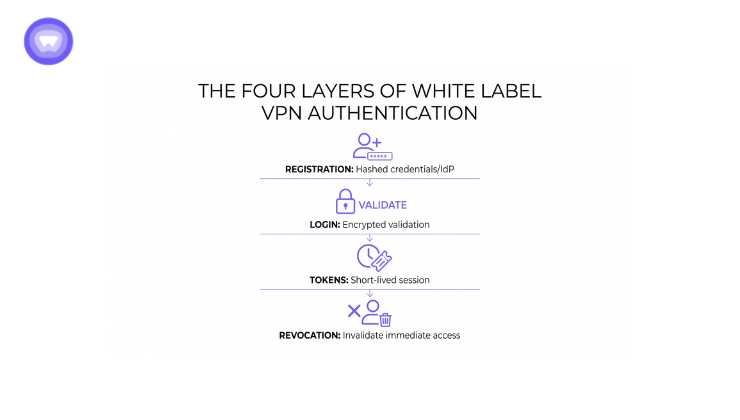
Every branded VPN app runs the same identity sequence underneath, regardless of front end.
Registration, Login, and Tokens
New users register with hashed credentials or an identity provider. Login validates over an encrypted channel and issues a session instead of re-checking a password on every request. That session generates an access token with an expiry window, so the client never resends the raw password to connect.
Deprovisioning and Revocation
When a client’s employee leaves or a device is flagged, the backend must invalidate access immediately. This layer gets the least attention in most white label vpn authentication write-ups, and it is the one clients scrutinize hardest during onboarding.
Where Generic Authentication Fails the MSP Security Review
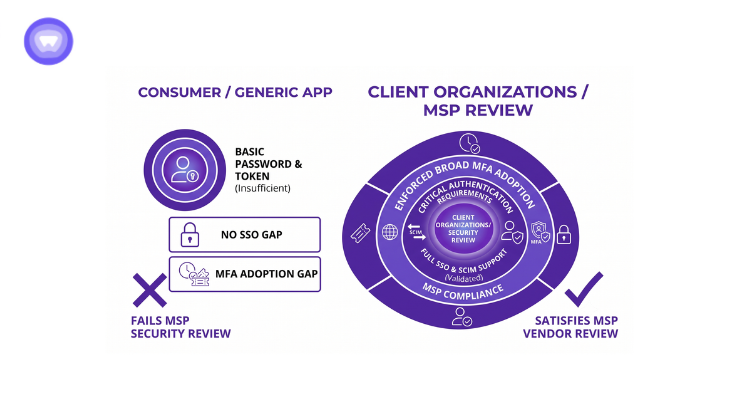
A password field and a token system satisfy a consumer app, not a client running a formal vendor review.
The SSO and SCIM Gap
Missing single sign-on support disqualifies vendors during the security review stage often enough that vendors report six-figure contracts evaporating over it. Building SAML, OIDC, and SCIM provisioning in-house typically takes an engineering team three to six months, plus upkeep per identity provider added.
The MFA Adoption Gap
Larger client organizations enforce MFA broadly, but the adoption gap between large and small organizations stays wide, and stolen credentials still drove most basic web application breaches last reporting year.
An MSP reselling a branded VPN needs answers to three questions before a client renews: does it support SSO through the client’s own identity provider, can an admin deprovision one client’s user in seconds, and is every event logged in a way the client’s auditor can read.
Webhook vs Polling: The Revocation Decision Nobody Names
Session revocation propagates two ways. Polling has the client check back on a fixed interval. A webhook pushes the event the moment it happens.
| Revocation Method | Detection Latency | Audit Trail Quality | Best Fit |
| Polling | Minutes, depends on interval | Adequate, timestamped at check | Small client base, low compliance need |
| Webhook | Near-immediate | Strong, timestamped at trigger | MSPs serving audited clients |
| Manual admin action | Depends on staff response | Weak unless separately logged | Very small teams |
A five-minute polling interval sounds trivial until a terminated employee at one client stays connected that long on a live network. Webhook-based revocation closes that gap and hands the MSP a timestamped record for the client’s auditor.
Multi-Tenant Isolation Across an MSP’s Client Book
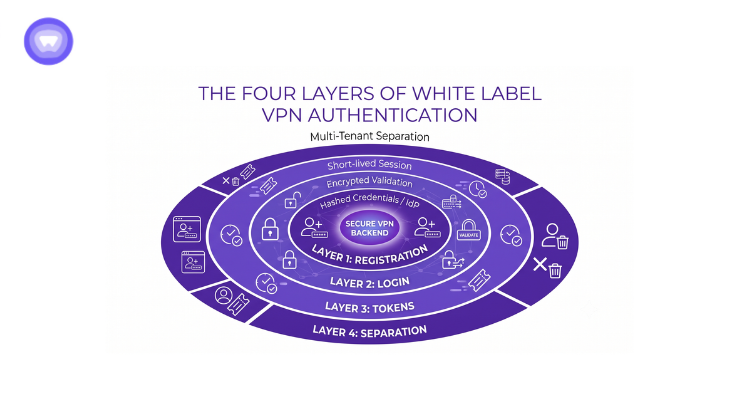
One backend serving many clients still has to separate them fully. Each client’s user records, tokens, and session logs need namespace-level separation, not just separate branding on a shared table. A bug in one client’s account logic could otherwise expose another client’s users, and that failure would surface in every renewal conversation that quarter.
Proof: What This Architecture Changed for One MSP
An MSP that layered a branded VPN into its antivirus suite offers a concrete before-and-after. Documented in a partner case study, the combined suite drove a 20 percent increase in enterprise clientele, a 32 percent reduction in operational costs, a 15 percent gain in retention, and 25 percent revenue growth within two months.
Those results came from the bundled suite, not authentication alone. The authentication layer’s specific contribution was narrower: centralized provisioning let the MSP onboard both products under one identity record per client user, cutting the duplicate account management that made the cost and retention numbers achievable.
Where PureWL Fits Into This
PureWL White Label VPN Solution handles the authentication layer above as core infrastructure. The backend issues access tokens through a secret-key exchange, manages users through dedicated account endpoints, and supports webhook-based session updates so an MSP’s admin panel reflects revocation in real time.
Client authentication data stays isolated at the account level, with centralized logging through the partner dashboard for audit purposes. MSPs bundling VPN into a security suite get an identity layer already built for client reviews, instead of retrofitting one after a client asks.
Closing Thoughts
White label vpn authentication is not a login screen with a password field behind it. It decides whether one client’s stolen credential becomes a five-minute inconvenience or a lost renewal.
MSPs winning larger client contracts are the ones whose authentication architecture answers SSO, revocation, and isolation questions before a client’s review has to ask twice. Request a technical walkthrough of PureWL’s authentication and session management architecture to see where the gaps sit in your current client stack.