

- Provider selection isn’t the hard part. Pricing, provisioning, and contract terms are what actually decide whether a white label VPN business turns a profit.
- MSPs, SaaS platforms, telecom providers, hardware manufacturers, and cybersecurity vendors all run this model for different reasons, and standalone VPN sellers are already losing ground to bundled competitors.
- Margin comes down to three numbers: wholesale cost, retail price, and support overhead per user, and per-device pricing can quietly triple your costs if you don’t check the billing model upfront.
- Managing multiple client brands and planning for migration between providers need to be built into the contract from day one, not handled after growth or a provider switch forces the issue.
- Contract terms like uptime penalties, audited no-log policies, and exit clauses protect margin more than the app itself does, yet most partners sign the first agreement offered without negotiating them.
Most partners approach a white label VPN business the same way. Pick a provider, add a logo, and hope the margin math works out. It rarely does.
The provider selection step gets most of the attention in existing guides. Pricing, provisioning, and contract terms decide whether the business actually turns a profit. This guide skips the generic build versus buy debate. It goes straight to what decides margin in a white label VPN business once the branding is done.
That means what to charge per user without eating your own margin. It means how to provision multiple brands or products from one console. It also means which contract terms protect you when uptime fails a customer.
What a White Label VPN Business Actually Includes
A white label VPN business lets a company sell VPN access under its own brand. A partner runs the infrastructure behind it. The partner supplies servers, protocols, and apps. You supply the brand, the price, and the customer relationship. This is the structural difference between reselling and building.
- Rebrandable client apps for desktop and mobile
- A global server network with redundancy built in
- Modern tunneling protocols and encryption standards
- An admin console for managing accounts and servers
- API and SDK access for backend integration
The Technical Baseline You Should Expect
A good partner already covers the basics below. Anything less is a risk to your customers.
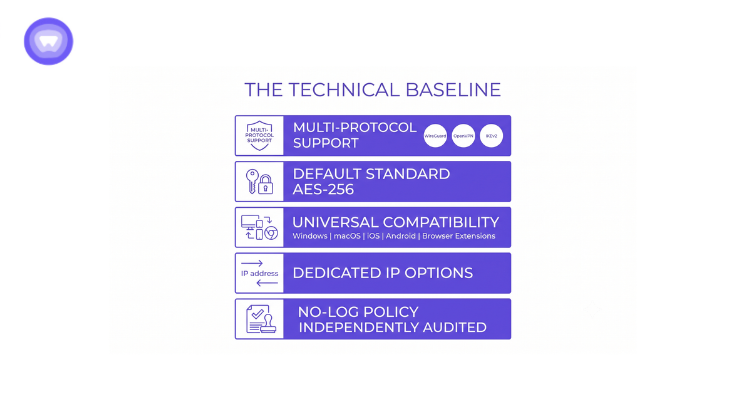
- WireGuard, OpenVPN, and IKEv2 protocol support
- AES-256 encryption as the default standard
- Apps for Windows, macOS, iOS, Android, and browser extensions
- Dedicated IP options for business customers
- An independently audited no-log policy
Who Is Actually Running a White Label VPN Business
VPN demand is no longer a niche privacy concern. Global VPN adoption has crossed 1.6 billion users, per DemandSage’s 2026 VPN usage data. Future Market Insights puts industry value at 77.8 billion dollars in 2025. That figure is projected to reach 481.5 billion dollars by 2035, a 20 percent yearly growth rate. That growth is not spread evenly. Norton 360 and Bitdefender already bundle VPN access into their antivirus suites by default. Any security vendor still selling VPN as a separate add-on is competing against suites that already give it away.
A white label VPN business shows up under several different roofs, each with a slightly different reason for running it.
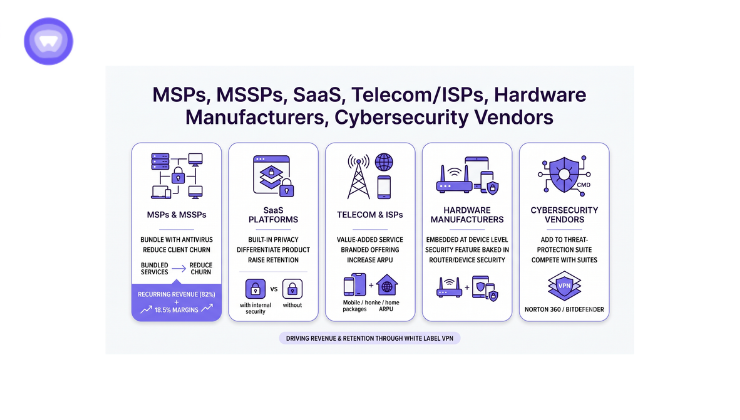
- MSPs and MSSPs bundle it with antivirus and endpoint protection to reduce client churn on an existing contract
- SaaS platforms build it into their own app as a built-in privacy feature that differentiates the product
- Telecom providers and ISPs offer it as a branded value-added service to raise average revenue per user
- Hardware manufacturers embed it at the router or device level for a security feature baked into the product
- Cybersecurity vendors add it to an existing threat-protection suite to compete directly with Norton 360 and Bitdefender, which already include VPN
MSPs have a concrete reason to move now, not later. Recurring revenue already makes up 82 percent of MSP income. Average MSP profit margins sit near 18.5 percent, according to Gitnux’s MSP industry report. A white label VPN business fits directly into that recurring model instead of competing with it. Every renewal cycle without it is one more chance for a bundled competitor to win the account. SaaS platforms see a different benefit. Bundling a privacy feature into the product raises retention. Users no longer need a separate app for it.
The gap most partners miss is not demand. Adding a white label VPN business as a side offer is one option. Running it as a structured, priced product line with its own margin target is the real opportunity.
The Real Economics of a White Label VPN Business
Margin in a white label VPN business is not decided by brand or app design. It is decided by three numbers. Those numbers are wholesale cost per seat, retail price per seat, and support overhead per customer.
Illustrative Margin Math
Consider a simple illustrative example, not a sourced figure. Assume a wholesale cost of two dollars per active user per month. Assume a retail price of six dollars, with one dollar of support overhead per user. That leaves three dollars of gross margin per user before churn. At two hundred active users, that is six hundred dollars in monthly gross margin from one product line. No infrastructure has to be maintained to earn it.
The number that actually moves is churn, not price. A white label VPN business with weak provisioning and slow support loses margin to churn quickly. It gains margin from new signups far more slowly.
Scale that same math across five branded products instead of one. This is a realistic picture for a reseller network or a partner with several client accounts. At two hundred active users per brand, five brands produce three thousand dollars in monthly gross margin before overhead.
The infrastructure cost does not multiply by five along with it, since the same partner network serves every brand. Revenue scales linearly while cost scales far more slowly. That gap is the actual case for running a white label VPN business at scale.
Per Seat vs Per Device Pricing
Most partner contracts default to per-seat pricing, billed by active users. Per-device pricing counts every connected device on its own. If your customers average three devices each, per-device pricing changes the math fast. It can quietly triple your wholesale cost while the retail price stays the same. Confirm which model a partner uses before setting your own price sheet, not after your first invoice arrives.
| Factor | In-House Build | White Label Partner Model |
| Time to first paying customer | 4 to 6 months minimum | 1 to 2 weeks |
| Upfront cost | 10,000 dollars or more | 500 to 2,000 dollars monthly |
| Cost to add a second brand or product | Near full rebuild | Configuration only, same infrastructure |
| Support overhead per customer | Fully internal | Shared with the partner |
| Migration risk if switching providers | Not applicable | Depends entirely on contract terms |
Provisioning a White Label VPN Business Across Multiple Brands
Generic launch guides describe provisioning for one brand. Many partners eventually manage more than one. An MSP might run several client-facing sub-brands. A telecom group might run regional variants, and a SaaS company might run separate tiers. Each one needs its own branded app, its own billing line, and its own support queue. All of it sits on the same underlying white label VPN business infrastructure.
Multi-Tenant Control Without Multiplying Overhead
A partner built for this should let you manage every brand from a single console. It should not require a separate instance per brand.
- One admin console covering every branded sub-account
- Per-brand server lists and pricing tiers, set independently
- Per-brand billing export, so invoicing does not require manual reconciliation
- Webhook or API-based account creation, so onboarding a new brand does not require manual setup each time
Ask a prospective partner directly how account creation scales past ten brands. If the answer involves manual steps for each one, the model will not hold once you grow.
Migrating an Existing Customer Base Between Providers
Few guides on starting a white label VPN business address what happens after year one. Some partners already running one VPN provider need to switch, whether for pricing, uptime, or support reasons. Migration risk is rarely discussed before the switch happens.
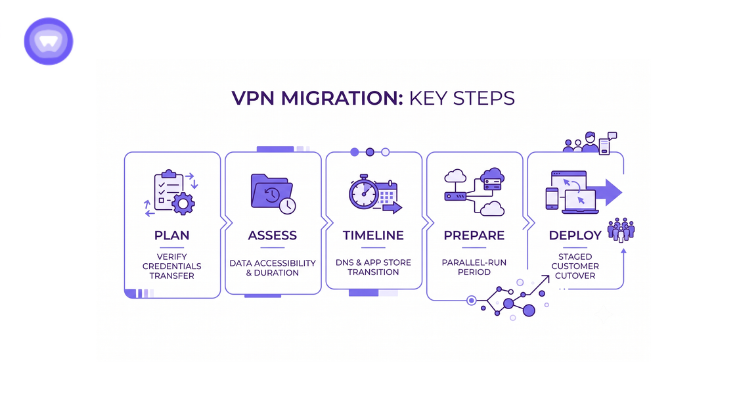
- Confirm whether existing credentials can transfer without forcing every user to re-register
- Check how long historical billing and usage data remains accessible after a contract ends
- Get a written timeline for DNS and app-store transition, not a verbal estimate
Building this in from the start costs nothing. Finding the gap mid-migration costs trust, and often costs the contract itself.
A DNS cutover handled without warning can break an app for days, not hours. Push for a parallel-run period where both the old and new provider stay active. Devices then switch over gradually, not all at once during a single change window. A migration case study covering a phased move of 3 million VPN users shows this staged approach working at scale.
Contract Terms That Protect Margin in a White Label VPN Business
The contract, not the app, decides what happens when something goes wrong. Most partners sign the first agreement offered instead of working out terms that protect margin.
- An uptime guarantee with a stated penalty, not just a target number
- A documented no-log policy backed by independent audit, not a self-reported claim
- A clear exit clause covering what happens to your existing customer base if you switch providers
- Clarity on who owns the provisioning API and account data during the contract term
These terms rarely show up in basic provider comparisons. They matter once a customer base exists. For any partner serving customers today, they matter from day one.
A concrete example makes this easier to negotiate. A 99.9% uptime guarantee still allows roughly 43 minutes of downtime per month. Ask what happens past that threshold, in writing, before signing. A service credit clause beats a vague apology every time a customer asks why their VPN dropped mid-shift.
What Stays on Your Plate After Launch
A partner handles the servers, protocols, and app updates in a white label VPN business. Several tasks still sit with you, and they decide whether customers renew.
- First-line support and ticket triage for your branded app, before escalating to the partner
- Customer-facing billing and invoicing, even when the partner handles backend billing infrastructure
- Onboarding documentation written for your own customer base, not generic partner documentation
- Renewal conversations and upsell timing, since the partner has no direct customer relationship
Missing this list is the most common reason a white label VPN business misses its margin target in year one. The infrastructure was never the hard part.
Launching Once the Model Is Set
Once pricing, provisioning, and contract terms are settled, the launch sequence itself is short. Most of the real decisions have already been made by this point.
- Finalize the partner agreement, including the exit clause
- Configure branded apps across the platforms your customers actually use
- Connect the provisioning API to your existing billing and ticketing systems
- Soft launch with one cohort before a full rollout
- Track churn and support ticket volume from week one, not quarter one
Treat the soft launch as a margin test, not a marketing event. Real churn and support data will tell you more about the model than any provider demo.
Where PureWL White Label VPN Solution Fits
PureWL White Label VPN Solution is built around the parts of this model most partners need, whether you run one brand or several. That includes one console for managing many brands and per-brand billing export. It also includes a provisioning API built for onboarding many brands at once, not just one. The network runs on 6,500 plus servers across 88 plus countries, with a no-log policy checked by BigFour.
One MSP running this model reported 20 percent growth in enterprise clients, per a case study. The same case reported a 32 percent cut in running costs. Revenue grew 25 percent within two months of launch. That result came from provisioning and contract structure, not from the app itself. PureWL runs the same model for SaaS platforms, telecom partners, and hardware manufacturers too. With over 150 partners already running on this infrastructure, the margin math above is not theoretical.
Final Thoughts
A white label VPN business rewards partners that treat pricing, provisioning, and contract terms as the real product. The app skin on top matters far less. Get those three right, and a white label VPN business becomes a predictable revenue line. That holds whether you are an MSP, a SaaS platform, a telecom brand or any other domain. It requires no new infrastructure headcount to run.
If you are already pricing this out, the fastest next step is a direct walkthrough. Test the provisioning API and the shared console against your own product list, not another feature checklist.