

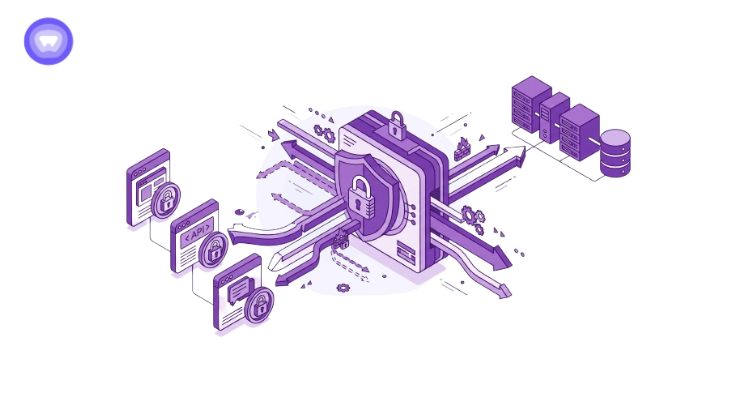
- Enterprise Application Layer Focus: Application layer security protects APIs, applications, and user interactions by inspecting traffic at Layer 7 instead of relying only on network-level controls.
- Modern Threat Surface: Modern enterprise risk is concentrated at the application layer, where attackers use legitimate-looking traffic to exploit APIs, sessions, and business logic.
- Traffic Management Role: Traffic management strengthens security by enabling inspection, routing, access control, and behavioral monitoring of application traffic in real time.
- API Security Needs: API-driven environments expand the attack surface, making authentication, rate limiting, schema validation, and anomaly detection essential security measures.
- White Label VPN Value: White label VPN infrastructure supports secure, controlled connectivity across distributed systems, helping enforce application-level security policies across users and services.
Applications have become the operational center of modern business. Customer portals, SaaS platforms, APIs, remote workforce tools, cloud services, and internal systems all communicate continuously across distributed environments. Every request, session, and transaction passes through multiple Enterprise Application Layer of infrastructure before reaching its destination.
That complexity creates a security challenge. Traditional network security focuses on protecting infrastructure and perimeter boundaries. Modern attacks target applications, APIs, sessions, and user interactions directly. Organizations need security controls that operate at the application layer while maintaining visibility and control over traffic moving across networks.
Enterprise application layer security and traffic management address this challenge by combining application-aware protection, policy enforcement, traffic inspection, routing intelligence, and performance optimization into a unified approach.
Why Application Layer Security Matters
Network-level protection remains important, but attackers increasingly focus on Layer 7, the application layer where users, APIs, and services interact.
Application-layer attacks often bypass traditional security controls because they resemble legitimate traffic. Attackers use valid protocols, authenticated sessions, compromised credentials, and API requests to gain access to systems.
Common threats include:
- API abuse
- Credential theft
- Session hijacking
- Bot-driven attacks
- Application-layer DDoS attacks
- Data exfiltration
- Unauthorized service access
- Business logic manipulation
Security teams can no longer rely solely on firewalls that inspect ports and protocols. They need visibility into application behavior, user actions, and service communications.
This shift is reflected in internet traffic trends. APIs account for approximately 57% of dynamic internet traffic, making application-level security a critical operational requirement.
Understanding Enterprise Application Layer Security
Application layer security focuses on inspecting, controlling, and protecting traffic at the level where applications communicate.
Instead of only examining IP addresses and ports, application-aware security evaluates:
| Security Function | Purpose |
| User Authentication | Verify identity before access |
| Session Validation | Ensure session integrity |
| API Inspection | Monitor API requests and responses |
| Content Filtering | Detect malicious payloads |
| Policy Enforcement | Apply business-specific rules |
| Access Control | Restrict application resources |
| Traffic Analysis | Identify abnormal behavior |
| Data Protection | Prevent unauthorized data movement |
This approach allows organizations to understand not just where traffic comes from, but what the traffic is doing.
For example, two HTTPS requests may appear identical at the network layer. Application-level inspection can determine whether one request is a legitimate customer transaction while the other is attempting credential stuffing or API abuse.
The Expanding Attack Surface
Enterprise environments have changed significantly over the last decade.
Applications now operate across:
- Public cloud platforms
- Private cloud environments
- Hybrid infrastructure
- Remote workforce networks
- Partner ecosystems
- Third-party APIs
- Mobile applications
- Edge computing environments
Every connection creates another pathway for traffic and another opportunity for attackers.
API ecosystems have become particularly challenging. Cloudflare’s analysis found that machine-learning-based discovery identified 30.7% more API endpoints than organizations expected, highlighting the prevalence of shadow APIs that often remain unmanaged and unprotected.
Security teams cannot protect assets they do not know exist.
Application-layer visibility becomes essential for identifying hidden services, unmanaged endpoints, and unexpected traffic flows before they become attack vectors.
Core Components of Enterprise Traffic Management
Traffic management is often associated with performance optimization, but modern enterprise environments require a broader approach.
Effective traffic management combines performance, availability, and security.
Traffic Inspection
Every request should be evaluated before reaching critical applications.
Inspection capabilities include:
- Protocol validation
- Header analysis
- API request verification
- Payload inspection
- Behavioral analysis
- Threat detection
This process helps identify malicious activity before it reaches application resources.
Intelligent Routing
Traffic management systems determine the most appropriate path for application traffic.
Routing decisions may consider:
- User location
- Service availability
- Network health
- Latency
- Security policies
- Regional restrictions
This improves both performance and operational resilience.
Load Distribution
Application availability depends on balancing demand across infrastructure resources.
Load distribution helps:
- Prevent service overload
- Reduce latency
- Improve scalability
- Support high availability
- Maintain user experience
Policy-Based Access Control
Not all traffic should receive equal treatment.
Organizations often require policies based on:
- User identity
- Device type
- Geographic location
- Application sensitivity
- Risk level
- Departmental requirements
Application-aware traffic management enables these controls without disrupting legitimate users.
Application Layer Security in API-Driven Environments
Modern applications rely heavily on APIs.
Internal services communicate through APIs. Mobile apps depend on APIs. Third-party integrations operate through APIs. Automation platforms use APIs to exchange data and execute workflows.
As API usage expands, API security becomes inseparable from application security.
Key API security requirements include:
Authentication and Authorization
Every API request should verify identity and permissions before processing data.
Rate Limiting
Rate controls prevent abuse and reduce the effectiveness of automated attacks.
Schema Validation
Request validation ensures APIs only accept expected inputs.
Behavioral Monitoring
Security teams need visibility into:
- Request frequency
- Access patterns
- Endpoint usage
- Data transfers
- Authentication anomalies
Threat Detection
API-specific threats include:
- Token abuse
- Enumeration attacks
- Injection attempts
- Credential stuffing
- Business logic exploitation
Application-layer inspection provides the context required to identify these attacks accurately.
Traffic Management as a Security Function
Performance and security are often treated as separate disciplines.
In reality, traffic management increasingly serves as a security control.
Traffic visibility allows organizations to:
- Detect unusual patterns
- Identify compromised sessions
- Monitor service behavior
- Enforce segmentation policies
- Prevent lateral movement
Application-aware traffic management creates an additional layer of defense between users and critical systems.
This capability becomes particularly important during high-volume attack events.
Cloudflare’s Application Security Report found that application-layer protections play a major role in mitigating malicious API traffic, with web application security controls accounting for most API attack mitigation activity observed across its network.
The Cost of Insufficient Visibility
Many organizations discover application security gaps only after an incident occurs.
The financial impact continues to rise. The cost extends beyond direct remediation.
Organizations often face:
- Service disruptions
- Customer churn
- Regulatory penalties
- Operational downtime
- Reputation damage
- Incident response expenses
Application-layer visibility helps reduce these risks by improving detection and response capabilities before incidents escalate.
Key Principles for Enterprise Application Security
Organizations building modern security architectures should focus on several foundational principles.
Security Must Follow the Application
Applications move between cloud providers, data centers, and edge environments.
Security controls should remain consistent regardless of location.
Visibility Must Be Continuous
Point-in-time assessments are insufficient.
Traffic patterns change constantly, requiring ongoing monitoring and analysis.
Policies Should Be Context-Aware
Security decisions should consider:
- User identity
- Device posture
- Session behavior
- Application sensitivity
- Risk indicators
Encryption Alone Is Not Enough
Encrypted traffic protects data confidentiality.
It does not automatically provide visibility, access control, or threat detection.
Organizations need mechanisms to inspect and manage traffic securely without sacrificing protection.
Automation Is Essential
Application environments evolve too quickly for manual oversight.
Automation supports:
- Threat detection
- Policy enforcement
- Traffic analysis
- Incident response
- Access management
Supporting Enterprise Application Security with White Label VPN Infrastructure
As organizations expand distributed operations, application-layer security increasingly depends on secure connectivity between users, applications, services, and infrastructure. Network access alone is not enough. Businesses need visibility into traffic flows, policy enforcement, session control, and secure communication across multiple environments.
PureWL’s white label VPN solution helps service providers and enterprises build branded secure access platforms that support application-aware traffic management. By securing connections between users and resources, organizations can establish controlled communication paths while maintaining visibility into how applications and services interact across distributed networks.
The platform supports secure remote access, encrypted communications, policy-based connectivity, and scalable deployment models that align with modern application security requirements. This allows providers to deliver secure connectivity services while integrating application-level governance and traffic management capabilities into their offerings.
Closing Thoughts
Enterprise security no longer revolves around protecting a fixed perimeter. Applications, APIs, users, and services now operate across highly distributed environments where traffic moves continuously between clouds, devices, partners, and remote workforces.
Application layer security and traffic management provide the visibility and control needed to protect these interactions. By combining traffic inspection, policy enforcement, session awareness, API protection, and intelligent routing, organizations gain a clearer understanding of how applications operate and where risks emerge.
The result is a security posture built around application behavior rather than network boundaries, allowing enterprises to protect critical services while maintaining the performance and accessibility modern operations demand.