

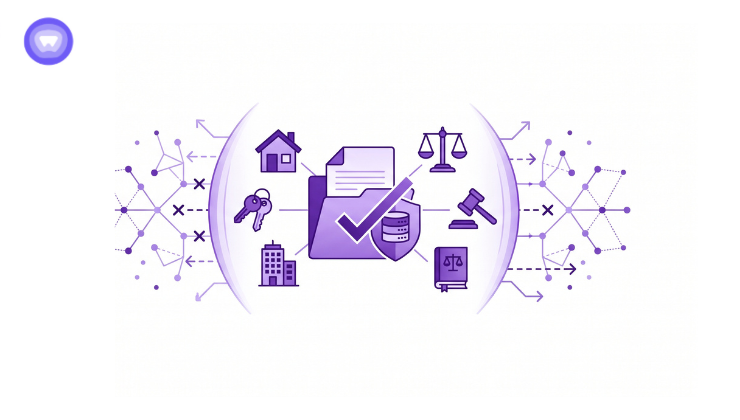
Attorneys and real estate agents share an odd problem. Their jobs require them to be easy to find. However, their homes should not be.
A data broker opt out program closes that gap. It removes home addresses, family names, and personal phone numbers from people-search sites. At the same time, it leaves the bar listing, license record, and agent profile untouched.
For platform teams in legal tech and PropTech, this is now a product question. After all, your users already live inside your practice management, transaction, or CRM software. So a branded data broker opt out feature can sit in the same login.
This guide covers the exposure both professions face and what can come down. It also shows how platform teams package the feature.
Key Takeaways
- Attorneys and agents must stay findable at work, so a data broker opt out targets the home profile only.
- Bar listings, license lookups, dockets, and deeds stay public; people-search listings come down.
- Most private attorneys and all agents fall outside judicial privacy laws like New Jersey’s Daniel’s Law.
- Brokers relist records, so removal needs monthly re-checks, not a one-time sweep.
- Legal tech and PropTech platforms can trigger enrollment at onboarding, matter intake, listing launch, or closing.
Why Data Broker Opt Out Matters More for These Two Professions
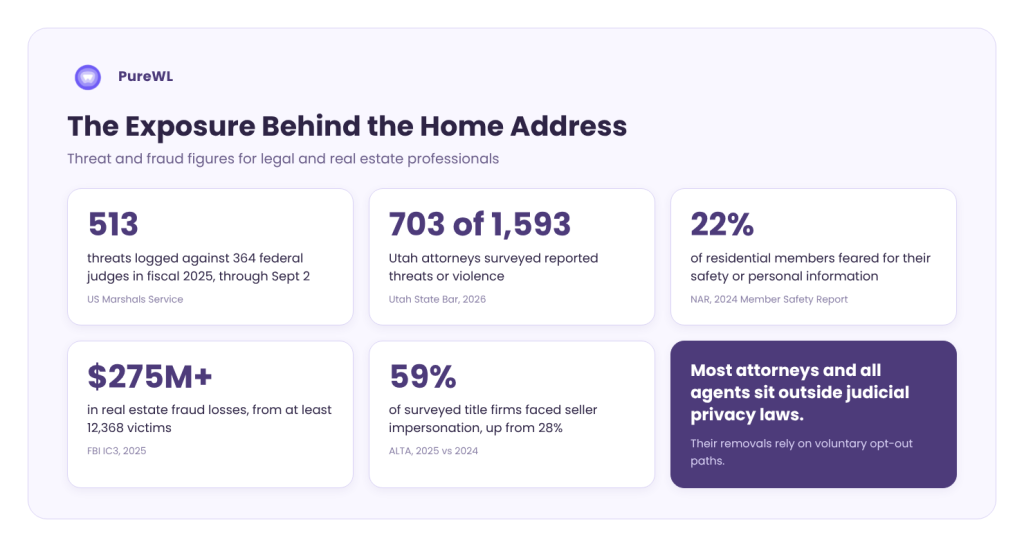
The threat numbers have climbed in both fields. Each figure below comes from the group that tracks it directly.
In fiscal 2025, the US Marshals Service logged 513 threats against 364 federal judges by September 2. That total already topped the full prior year. Private attorneys, in contrast, face the same pressure with less protection. A 2026 Utah State Bar survey found that 703 of 1,593 responding attorneys reported threats or violence. In addition, family law, prosecution, and criminal defense led the list.
Similarly, real estate shows the same pattern. The 2024 NAR safety report found that 22% of members in residential sales feared for their safety or data. Meanwhile, the FBI counted over $275 million in 2025 real estate fraud losses. At least 12,368 victims reported them.
The common thread is the home address. An angry litigant does not need the office address. Likewise, a fraudster does not need the brokerage phone line. Both want the personal layer that broker sites sell for a few dollars.
The Work Profile vs the Home Profile
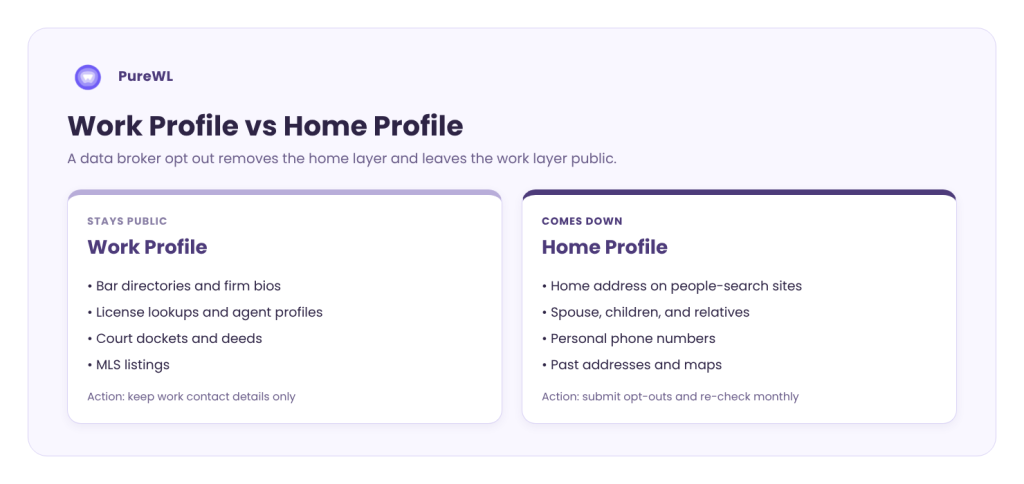
Most removal advice treats every listing the same. For these two professions, however, that approach fails. Some records must stay public by law or by business need.
For this reason, the useful split is simple. The work profile stays visible. The home profile gets removed and watched.
What Must Stay Public
Several records exist because the job requires them. For attorneys, these include state bar directories, court dockets, and firm bio pages. For agents, they include license lookups, MLS listings, and brokerage profiles.
As a result, a data broker opt out request does not touch these sources. Removing them would hurt the user’s business, and most cannot be removed anyway.
What Can Come Down
The home profile, on the other hand, is different. People-search sites merge property records, voter files, and phone data into one page. That page often links a professional name to a home address, a spouse, and children.
Therefore, these listings are the target. They carry no business value for the user, and most brokers offer an opt-out path.
Where the Two Profiles Collide
Overall, the risk sits in the overlap. A broker profile can show the same name as a bar listing, plus a home address. Anyone can connect the two in under a minute.
The table below sorts each source by the action that works.
| Source | Example Records | Can It Be Removed? | Best Action |
|---|---|---|---|
| Professional directories | Bar listings, license lookups, agent profiles | No, required for the job | Keep work contact details only |
| Court and transaction records | Dockets, deeds, closing filings | No, public record | Use an office or registered agent address where allowed |
| People-search and broker sites | Home address, relatives, personal phone | Yes, through opt-out requests | Submit requests and re-check monthly |
| Breach and stealer data | Leaked logins, session cookies | No, monitor only | Reset passwords and revoke sessions |
| Self-published content | Social posts, family photos, listing selfies | Yes, by the user | Review privacy settings during onboarding |
The pattern is clear. Platform teams can automate the third and fourth rows. The other rows need user guidance, not removal requests.
The Protection Gap Most Attorneys and Agents Fall Into
Some public servants have a legal shield. New Jersey’s Daniel’s Law covers judges, prosecutors, police officers, and child-protection investigators. It also covers immediate family members who live with them. At the federal level, the Daniel Anderl Act protects federal judges.
Yet most private attorneys and every real estate agent sit outside these laws. Because of this, they have no special takedown right. They rely on the same voluntary opt-out paths as any consumer.
What Enforcement Shows
Daniel’s Law shows what a firm deadline does. Covered people can demand removal and sue if a broker misses the 10-day window. Lawsuits under it have targeted hundreds of brokers. Tens of thousands of covered people assigned their claims to a third party.
Later, the state Supreme Court held that the $1,000 damages provision applies automatically. Plaintiffs do not need to prove negligence. That ruling sets a clear standard for covered officials.
What the Gap Means for Platform Teams
An uncovered attorney has none of that power. Instead, each removal depends on a broker’s own process and timeline. On top of that, many brokers relist records after fresh public data arrives.
As a result, the work has to repeat. A one-time cleanup decays within months. Platform teams that offer the feature need scheduled re-checks, not a single sweep.
Real Estate Faces a Second Exposure Layer
Agents carry their own risk, but they also handle client risk. Property transactions create a steady flow of owner data, and fraudsters use it.
The American Land Title Association found that 59% of firms it surveyed faced a seller impersonation attempt in 2025. That share stood at 28% in 2024. In these schemes, a criminal poses as the owner of vacant land or an absentee property.
A data broker opt out cuts one input to this fraud. Broker profiles add phone numbers, past addresses, and relatives to a public deed. That extra detail helps an impostor pass verification calls.
For PropTech platforms, this also opens a client-facing use case. A buyer could receive data broker opt out coverage at closing, under the brokerage brand. Similarly, sellers of absentee property could enroll before the listing goes live.
Where Data Broker Opt Out Fits Inside a Platform
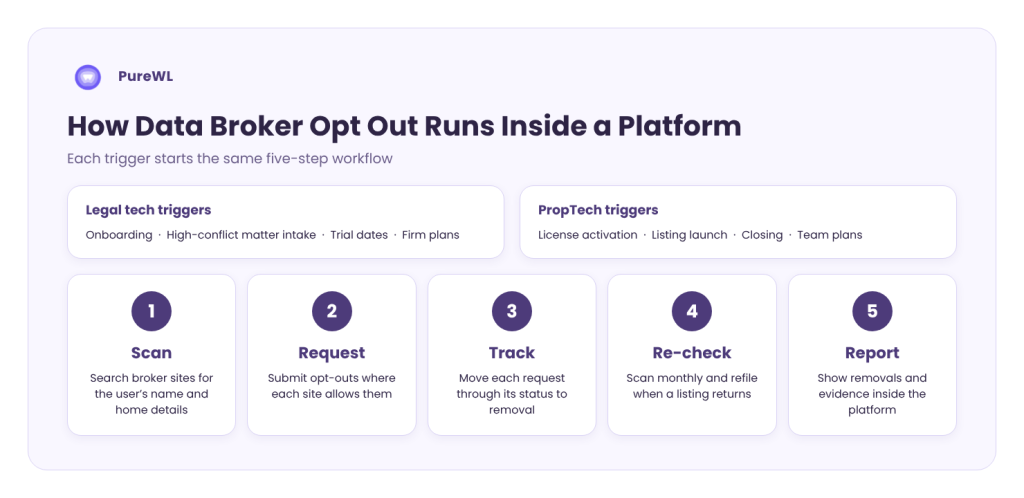
The best placement follows the user’s existing workflow. Each trigger below maps to a moment the platform already tracks.
Legal Tech Trigger Points
Practice management software already knows a lot about risk. It knows the practice area, the matter type, and the parties involved.
- New user onboarding: offer enrollment when an attorney or staff member first signs in
- High-conflict matter intake: prompt enrollment when a family law or criminal matter opens
- Public-facing events: flag users before a trial date or a widely covered filing
- Firm-level plans: let a firm sponsor coverage for every attorney and paralegal
PropTech Trigger Points
Transaction and CRM platforms see different signals. In practice, their triggers follow the agent’s career and each deal.
- License activation: offer coverage when a new agent joins a brokerage
- Listing launch: prompt the agent before an open house goes public
- Closing: extend coverage to buyers and sellers as a branded benefit
- Team plans: let a brokerage cover every agent on its roster
How the Workflow Runs
Next, behind each trigger, the process follows the same steps. The platform passes the identifiers, and the engine handles the rest.
- Scan: search broker sites for records tied to the user’s name and home details
- Request: submit opt-out requests where each site allows them
- Track: move each request through its status until the broker confirms removal
- Re-check: scan again on a schedule and refile when a listing returns
- Report: show the user what came down, with evidence, inside the platform
Users see status changes without leaving the product. As a result, support teams field fewer “is my address still online” tickets.
Consent and Privacy Rules for Firm-Sponsored Coverage
A firm or brokerage often pays for the plan. Even so, the findings belong to the individual user. A managing partner should not see an associate’s home address.
For this reason, the fix is a split view. The sponsor sees enrollment counts and completion rates. The user alone sees listings, addresses, and family details. This mirrors the consent model in our guide to doxxing prevention for leaders.
Finally, family coverage needs its own consent step. Spouses and adult children should enroll themselves, not get added by an employer.
The Business Case for Platform Teams
Privacy features change how users judge a product. One productivity app case study offers a useful signal here.
Proof From a Built-In Security Feature
In that case, more than 30% of uninstalls cited a lack of built-in security. The feature in that case was a VPN, not broker removal. Still, the lesson carries over. Users leave products that ask them to find protection elsewhere.
An Illustrative Workload Model
The figures below are illustrative, not data from any partner. Picture a PropTech platform with 2,000 enrolled agents.
- Broker sites checked per agent: about 400
- Checks per monthly cycle: roughly 800,000
- Family members enrolled at closing: added on top of that load
Clearly, no brokerage staff can run that queue by hand. The real choice is between an automated engine and no feature at all.
How PureWL Helps
PureWL offers Digital Privacy Protection as a white-label product for platforms that serve professionals. It pairs broker opt-outs across 400+ people-search and broker sites with dark web monitoring. PureWL reports 150+ partners worldwide; that figure is internal, not independently audited.
Platform teams can pick a hosted branded platform, an API and SDK integration, or a hybrid. Opt-outs are re-checked monthly, and removals re-run when data returns. For credential risk, alerts from stealer logs cover the breach layer that removal cannot reach. The controls carry SOC 2 Type II and ISO 27001 certification.
Conclusion
Attorneys and agents cannot vanish from the internet, and they should not try. Their work profiles keep them in business. Their home profiles, however, put them and their families at risk.
A data broker opt out for legal and real estate professionals respects that split. In short, it removes the home layer, watches for relisting, and leaves the work layer alone. For legal tech and PropTech platform teams, the feature fits the workflows users already trust.
Request a 20-minute walkthrough of the Digital Privacy Protection integration for your platform.
No. Opt-outs target people-search sites, so bar listings, dockets, and deeds stay public.
No. It covers judges, prosecutors, police, child-protection investigators, and their live-in family members.
No. License lookups stay public, but home addresses on people-search sites can come down.
Monthly. Brokers refresh records from new public data, so removed listings return without re-checks.
No. The sponsor sees enrollment counts, while each attorney alone sees listings and addresses.