

Key Takeaways
- Kaspersky counted 11 million leaked gaming account credentials in 2024, with 5.7 million from Steam.
- Most stolen gaming accounts start with infostealers hidden in fake cheats, cracked games, and unofficial mods.
- Sellers release logs months or years later, so monitoring must cover historical leaks as well as new ones.
- An infostealer match needs session revocation, not just a password reset, because stolen cookies skip MFA.
- NIST SP 800-63B-4 requires compromised-password checks and forced changes when evidence of compromise exists.
Stolen gaming accounts are now a supply chain, not a string of random hacks. Kaspersky researchers counted 11 million leaked gaming account credentials in 2024 alone. Steam accounted for 5.7 million of them. Another 6.2 million came from platforms such as Epic Games Store, Battle.net, Ubisoft Connect, GOG, and the EA app.
Each of those records lands on your platform as a problem you did not cause. A seller logs in, moves the skins, and lists the account. Then the real player opens a ticket, asks for a refund, and often quits.
This guide explains where stolen gaming accounts come from and why they sell. It also covers what dark web monitoring for gaming platforms should check. Next, it walks through the response when a match arrives. Finally, it shows how to offer that protection to players as a feature they can see.
Why Stolen Gaming Accounts Sell So Well
Gaming accounts carry value that most other logins lack. Therefore, criminals treat them as inventory with a resale price. The sections below explain what a buyer gets and how the supply reaches the market.
What a Stolen Account Carries
A mature player account holds several assets at once. For example, a single login can include:
- Tradable items such as skins, cosmetics, and rare drops
- In-game currency and unspent wallet balance
- Saved payment methods that fund new purchases
- Rank, progress, and play history that buyers pay extra for
- A linked email address that attackers test on other services
In addition, the account itself can be resold whole. That gives an attacker two paths to profit from one login.
Where the Supply Comes From
Most supply starts on the player’s own device. Attackers hide infostealer malware inside cracked games, cheat tools, and unofficial mods. Kaspersky detected more than 19 million attempts to spread fake game files in the year to March 2025.
The campaigns keep changing names. In late 2025, a new infostealer spread through fake Roblox mods and pirated software. Meanwhile, password reuse feeds a second channel. A player who reuses one password across services hands attackers a working key from an unrelated breach.
The Delayed Release Problem
Stolen credentials do not always appear right away. Sellers often release log files months or even years after the original infection. As a result, a player who changed nothing can wake up to an account that sold last night.
This delay breaks a common assumption. Many teams treat a quiet month as a safe month. In practice, old exposure keeps arriving, so monitoring has to cover historical leaks as well as new ones.
What Stolen Gaming Accounts Cost a Platform
The player loses items, but the platform absorbs most of the cost. Account takeover campaigns tend to run quietly at scale. One security vendor describes them engulfing support operations and driving player churn before teams notice.
The login layer is under steady pressure across every sector. One 30-day sample placed 26.6% of login attempts at the high or critical risk level. Gaming logins face that same pressure during launches and seasonal events.
Illustrative Math for a Mid-Size Platform
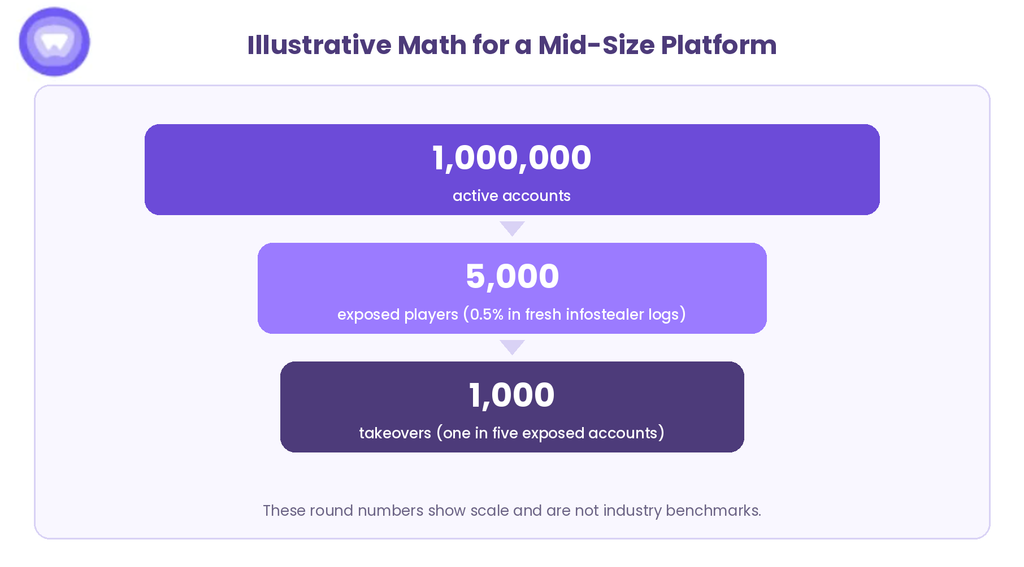
Consider an illustrative platform with 1,000,000 active accounts. These round numbers show scale and are not industry benchmarks.
- Assume 0.5% of accounts appear in fresh infostealer logs over a year. That equals 5,000 exposed players.
- Assume one in five of those accounts gets taken over. That equals 1,000 takeovers.
- Each takeover can trigger a ticket, an item restore, a trade reversal, and a refund review.
So, a 0.5% exposure rate turns into a thousand cases of manual cleanup. Early detection moves those cases from cleanup to prevention.
Signals That an Account Is Being Prepared for Sale
Sellers follow a routine once they hold a working login. Because of this, the takeover often looks different from normal play. Watch for these signals on any account that also appears in a leak:
- A login from a new device or region, followed by an email change
- Two-factor settings removed or replaced within minutes
- Bulk trades or gifts of high-value items to fresh accounts
- A new payment method added, then used for currency purchases
None of these signals proves fraud alone. However, any one of them on an exposed account justifies an immediate hold.
What Dark Web Monitoring for Gaming Platforms Should Check
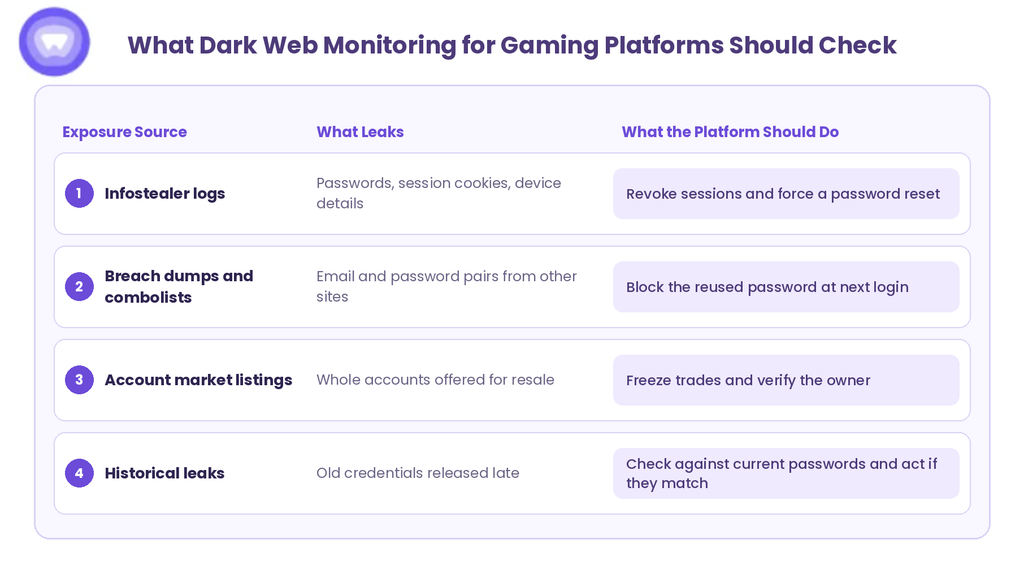
Stolen gaming accounts leave traces in more than one place. Consequently, a useful monitoring layer reads several sources and labels each one. The table below shows what each source exposes and what the platform should do next.
| Exposure Source | What Leaks | What the Platform Should Do |
|---|---|---|
| Infostealer logs | Passwords, session cookies, device details | Revoke sessions and force a password reset |
| Breach dumps and combolists | Email and password pairs from other sites | Block the reused password at next login |
| Account market listings | Whole accounts offered for resale | Freeze trades and verify the owner |
| Historical leaks | Old credentials released late | Check against current passwords and act if they match |
A good feed also tells you when each record appeared. Our monitoring API post explains how ingestion and normalization turn raw dumps into usable records. For gaming platforms, the freshness label matters most. A log from last week needs a lockdown, while a ten-year-old dump needs a password check.
Why Infostealer Logs Need Special Handling
Infostealer logs carry more than a password. They often include session cookies that represent a login that already passed MFA. Because of this, a password reset alone does not stop an attacker who holds a live session.
Gaming clients raise the stakes further. Launchers store authentication tokens locally, and stealers target those files directly. Therefore, an infostealer match should always trigger session revocation across web, launcher, and console logins.
A 6-Step Response Playbook for Stolen Gaming Accounts
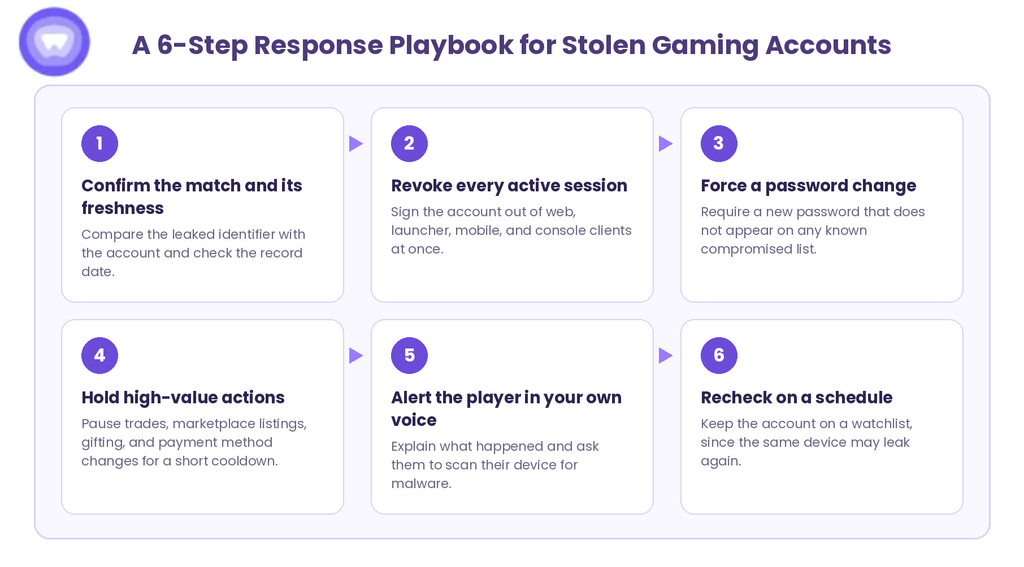
Detection only helps when the platform acts on it fast. The playbook below turns a monitoring match into a contained incident. Each step maps to a control most gaming platforms already run.
- Confirm the match and its freshness. Compare the leaked identifier with the account and check the record date.
- Revoke every active session. Sign the account out of web, launcher, mobile, and console clients at once.
- Force a password change. Require a new password that does not appear on any known compromised list.
- Hold high-value actions. Pause trades, marketplace listings, gifting, and payment method changes for a short cooldown.
- Alert the player in your own voice. Explain what happened and ask them to scan their device for malware.
- Recheck on a schedule. Keep the account on a watchlist, since the same device may leak again.
Step four protects items that cannot be clawed back once traded. Meanwhile, step five closes the loop on the infected device. Without that cleanup, a fresh password leaks again within days.
Why NIST SP 800-63B-4 Raises the Bar
Password guidance changed in 2025. NIST published SP 800-63B-4 in July 2025, and it took effect on August 1, 2025. It requires verifiers to check new passwords against a blocklist of compromised passwords.
The same section also requires a forced change when there is evidence of compromise. Gaming platforms are not federal agencies. Even so, this standard now sets the benchmark that partners, auditors, and payment providers expect.
Dark web monitoring supplies the evidence that this rule depends on. Without an exposure feed, a platform cannot tell which passwords are compromised. So, decide before your next season launch, not after a wave of takeovers forces the question.
Turning Monitoring Into a Player Feature
Most platforms run exposure checks quietly in the background. However, players value protection they can see and control. A branded exposure check on the account security page turns a back-office control into a trust signal.
What Players See
The player-facing version can stay simple. For example, it can include:
- A one-tap exposure check tied to the player’s email
- Plain alerts that show the source and the date of each leak
- A guided fix flow covering password, sessions, and device cleanup
- An ongoing watch that runs without new action from the player
How the Feature Fits Your Product
Platforms usually start with one of three models. A full white-label dashboard is the fastest route to launch. A modular integration embeds only the monitoring feature into an existing account page. Finally, a hybrid model mixes hosted screens with your own interface.
Each model keeps the brand relationship with the platform. Players see your name on every alert, not a third-party logo. That matters because the alert arrives at a stressful moment for the player.
What to Ask a Monitoring Provider
Not every exposure feed suits gaming platforms. Some vendors focus on corporate domains and employee logins, not player accounts. Use the checks below during evaluation, and ask for proof of each one.
- Source and date on every record. Your team needs both to separate a fresh log from an old dump.
- Infostealer depth. The feed should include cookies and device context, not only email and password pairs.
- Historical coverage. Late releases are common, so the provider must search past leaks as well as new ones.
- Player-level matching at scale. The service must check millions of player identifiers without slowing logins.
- Branded delivery. Alerts and screens should carry your name, with an API for teams that build their own interface.
- Audited security controls. Player data leaves your systems, so request current certification reports.
These checks also expose gaps in a home-built feed. Building collection, parsing, and matching in-house takes a dedicated team. For most platforms, that team is better spent on game features.
How PureWL Helps Gaming Platforms
PureWL runs dark web monitoring inside Digital Privacy Protection. Partners deliver it under their own brand through an API and SDK. It monitors breaches and infostealer malware in real time and across historical data. Deep scans read infostealer logs down to credentials, cookies, and device context. Every alert also carries its source and timeline.
PureWL holds ISO 27001 and SOC 2 Type II certifications, with full audit reports available to partners under NDA. It also reports 150+ partners and two decades in privacy infrastructure, which are PureWL’s own figures. The same platform includes data broker opt-out, which can protect public-facing staff such as community managers.
Conclusion: Catch Stolen Gaming Accounts Before They Sell
Stolen gaming accounts follow a clear path from infected device to resale listing. Platforms that watch that path can lock items, revoke sessions, and warn players first. Platforms that wait absorb the tickets, refunds, and churn instead.
Start by matching your player base against current and historical leaks. Then wire each match into the 6-step playbook above. For a provider comparison, our guide to API alternatives maps the market across four layers. Those layers are detect, correlate, remediate, and restore.
Request a 20-minute walkthrough of exposure monitoring for your player base.