

Key Takeaways
- Why MSPs switch: First-scan ticket floods, partner-only API access, and a pull toward the Kaseya 365 bundle.
- Three types: Dark Web ID alternatives split into domain monitors, bundled MSP suites, and branded personal exposure products.
- The real gap: Domain monitoring stops at work credentials, while attackers use broker data to call help desks.
- Five checks: Test data freshness, first-scan handling, API access, whose brand the client sees, and what follows an alert.
- Where PureWL fits: MSPs sell dark web monitoring plus removal from 400+ broker sites under their own brand.
A Dark Web ID alert tells your client that a work password leaked. It does not stop the next phone call. That call reaches the client’s help desk from someone who knows the employee’s manager, home city, and mobile number.
In practice, impersonation is where the money goes. The FBI recorded $3.047 billion in business email compromise losses in 2025. That works out to about $123,000 per reported incident. Meanwhile, the Verizon 2026 DBIR found credential abuse somewhere in 39% of breaches. It also began tracking pretexting as its own entry point.
As a result, MSPs searching for Dark Web ID alternatives (or ID Agent alternatives) usually want one of two things. Some want cleaner alerts for client domains. Others want to protect the people behind those domains. This guide compares six Dark Web ID alternatives on both needs.
What ID Agent Dark Web ID Does Today
Before switching, it helps to be precise about what Dark Web ID covers. Kaseya acquired ID Agent in 2019 and still ships updates in 2026.
According to Kaseya and ID Agent product pages, Dark Web ID covers:
- Business email addresses, domains, and IP addresses
- Personal email addresses, but only for executive and administrative users
- Supply chain credential monitoring
- Ticketing links into Kaseya BMS, Autotask, and ConnectWise
Today, Kaseya sells it on its own or inside the Kaseya 365 User bundle. Additionally, recent releases cleaned up the compromise table in January 2026. They also improved CSV and PDF exports in February 2026.
Credit is due here. ID Agent calls Dark Web ID the channel’s first dark web monitoring platform. Its Live Data Search also remains a common prospecting tool.
Why MSPs Look for Dark Web ID Alternatives
The reasons MSPs give for leaving tend to fall into four patterns. Each one points to a different type of replacement.
The First Scan Floods the Ticket Queue
Kaseya’s own help center is direct about this. If an initial scan finds 1,000 compromises, the MSP receives 1,000 tickets. Kaseya suggests holding off on ticket integration for the first 24 to 48 hours.
For example, a 40-client MSP repeats that onboarding load with every new client. That first import also includes older breaches, which buries the alerts that matter.
API Access Has Limits
Kaseya’s documentation states that API access cannot go to SMB users. In addition, partner admins must allowlist static IP addresses before making calls. That works inside a Kaseya stack. However, it slows MSPs who route alerts into their own SIEM or reporting tools.
The Bundle Pulls Toward Kaseya 365
Dark Web ID still sells on its own. Even so, Kaseya files its 2026 Dark Web ID release notes under Kaseya 365 User. An MSP on a different RMM or PSA needs a tool that does not assume one vendor stack.
Coverage Stops at the Work Identity
Dark Web ID watches work credentials, plus personal email for a small group of leaders. Kaseya’s own FAQ calls removal of dark web data generally implausible. It then advises affected individuals to enroll in an identity and credit monitoring service.
In other words, the tool hands the employee to someone else’s brand. The MSP keeps the alert but gives away the fix.
Three Types of Dark Web ID Alternatives
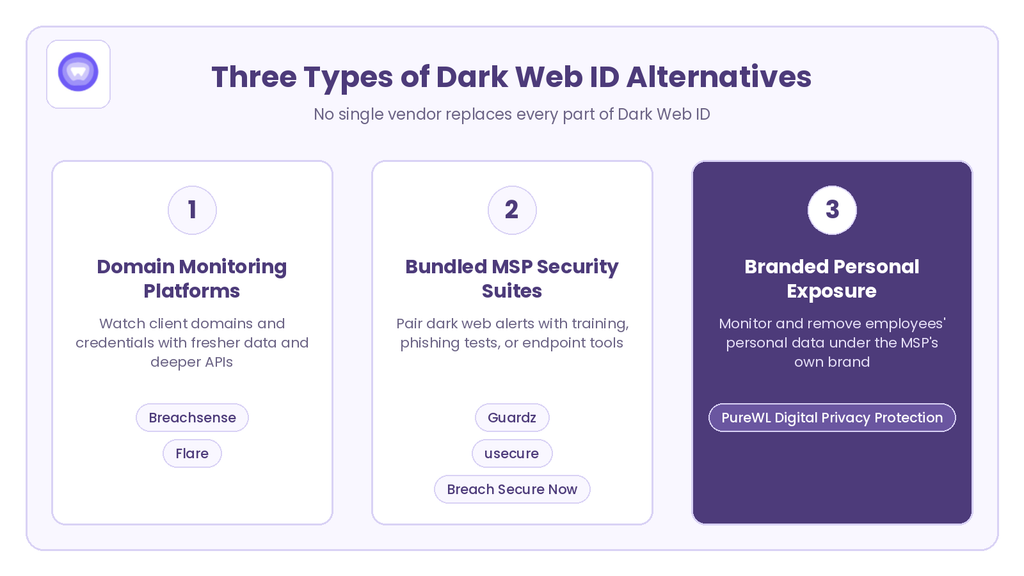
However, no single vendor replaces every part of Dark Web ID. Instead, the market splits into three groups.
- Domain monitoring platforms: These watch client domains and credentials with fresher data and deeper APIs. Breachsense and Flare fit here.
- Bundled MSP security suites: These pair dark web alerts with training, phishing tests, or endpoint tools. Guardz, usecure, and Breach Secure Now fit here.
- Branded personal exposure products: These monitor and remove employees’ personal data under the MSP’s own brand. PureWL Digital Privacy Protection fits here.
By contrast, product teams building consumer apps face a different choice. For them, identity data APIs matter more than MSP tooling.
Dark Web ID Alternatives Compared
The table below compares Dark Web ID with six Dark Web ID alternatives. Every cell comes from each vendor’s own public pages.
| Vendor | Type | What It Monitors | Under Your Brand | What Happens After an Alert | Pricing Shape |
|---|---|---|---|---|---|
| Kaseya Dark Web ID | Domain monitoring | Business emails, domains, IPs; personal email for executives and admins | Branded prospecting reports | Ticket to PSA; password reset by MSP | Standalone or Kaseya 365 User bundle |
| Breachsense | Domain monitoring | Client domains, stealer logs, Telegram, ransomware leak sites | Not published | Password reset by MSP | Usage-based, no per-seat charge |
| Flare | Domain monitoring and threat intel | Leaked credentials, stealer logs, Telegram, dark web forums | Not published | Alert triage and API workflows | Base provider license plus tenants |
| Guardz | Bundled MSP suite | Leaked credentials and company data per client | White-label platform option | Handled inside the wider suite | All-in-one platform price |
| usecure uBreach | Bundled MSP suite | Client domain credentials | Branded PDF breach reports | Remediation tracking per user | Starter and Pro tiers |
| Breach Secure Now | Bundled MSP suite | Client domain credentials | White-labeled marketing content | Paired with employee training | Add-on in blocks of 10 domains |
| PureWL Digital Privacy Protection | Branded personal exposure | Dark web and infostealer exposure, plus 400+ people-search and broker sites | Partner owns brand, pricing, and customer | Broker opt-outs submitted and re-checked monthly | Quoted per partner |
The 6 Best Dark Web ID Alternatives, Reviewed
To keep things fair, each review below follows the same format. It covers what the vendor does best and what to check before signing.
1. Breachsense
Breachsense targets MSPs that want fresher data and full API access. It says it indexes new stealer logs within hours. Pricing follows assets, data sources, and API requests.
- Best for: MSPs that want per-client domain watchlists and on-demand API queries
- Strengths: Covers criminal marketplaces, hacker forums, Telegram channels, and ransomware leak sites
- Watch for: No published branded reporting, and no coverage of personal data on broker sites
2. Flare
Flare runs a formal MSSP partner program on a multi-tenant platform. Partners buy a base provider license, then add a tenant for each client.
- Best for: MSSPs with analysts who want threat intelligence beyond credential alerts
- Strengths: Stealer logs, Telegram coverage, multi-tenant setup, and SIEM and SOAR integrations
- Watch for: Partners buy a base license before any tenant, so model total cost before signing
3. Guardz
Guardz bundles endpoint, email, identity, dark web, and awareness training into one MSP platform. Its partner materials also describe a white-label option.
- Best for: MSPs that want to replace several point tools with one billable service
- Strengths: Per-client exposure alerts inside a wider security stack
- Watch for: Dark web monitoring is one module among many, so ask how deep its sources go
4. usecure uBreach
usecure pairs uBreach with its training and phishing products. Over 2,000 MSPs use usecure, per its own site.
- Best for: MSPs already selling security awareness training
- Strengths: Branded PDF reports, prospecting scans, and remediation tracking per user
- Watch for: Deeper forum monitoring sits in the paid Pro tier
5. Breach Secure Now
Breach Secure Now focuses on employee risk. Its partner subscription includes one-time dark web scans for unlimited organizations.
- Best for: MSPs that sell training and want a simple prospecting scan
- Strengths: White-labeled marketing content and a dedicated partner manager
- Watch for: Ongoing monitoring is an add-on sold in blocks of 10 domain licenses
6. PureWL Digital Privacy Protection
PureWL takes a different approach from the other Dark Web ID alternatives. It protects client employees as people, not only as work accounts.
- Best for: MSPs that want a branded employee privacy service with recurring revenue
- Strengths: Dark web monitoring plus removal from 400+ people-search and broker sites
- Watch for: It does not replace domain-level SOC tooling, so many MSPs run it beside one
The Gap Domain Monitoring Does Not Close
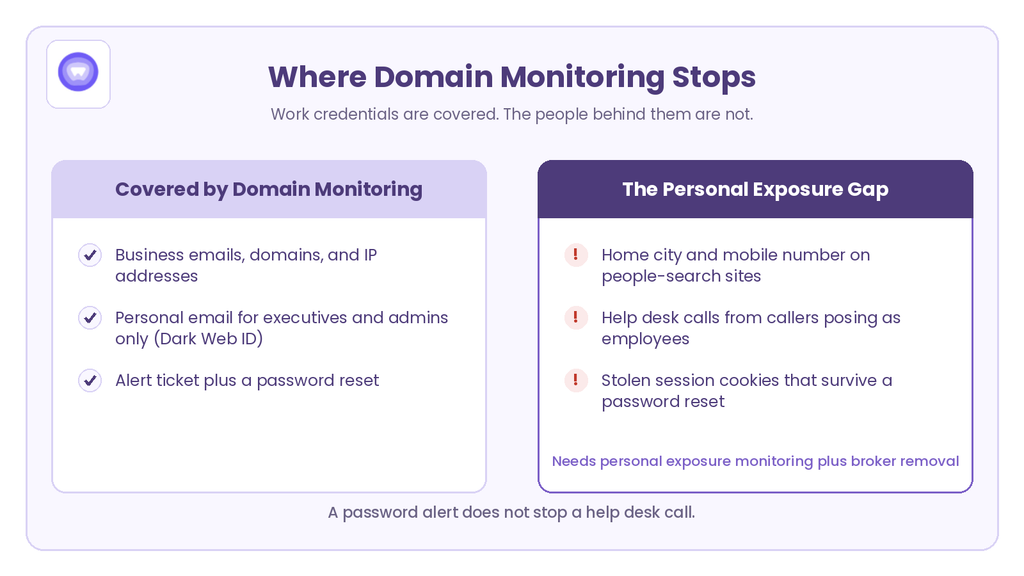
Every domain monitor answers one question: whether a work credential leaked. Attackers, however, now ask something else. They want to know everything about the person who owns that credential.
Attackers Call the Help Desk, Not the Login Page
For example, Okta Threat Intelligence tracked a group, O-UNC-034, from August 2025. The group called help desks posing as employees and requested password resets. Next, they enrolled their own MFA device. Then they changed payroll bank details.
Clearly, a password alert does not stop that call. The caller never needed the leaked password in the first place.
Broker Data Feeds the Script
Meanwhile, people-search sites supply the details that make a caller sound real. A 2026 survey of 421 security professionals, reported by Biometric Update, measured this directly. In that survey, 97.6% rated broker or people-search data as a significant source of attack intelligence. Also, 82.2% said personal mobile numbers are easy to find.
Not surprisingly, leaders carry the most exposure. Their personal email often resets bank, cloud, and social accounts. One leak can therefore open several doors at once.
Password Resets Leave Sessions Open
On top of that, dark web alerts miss a second gap. Infostealer logs carry stolen session cookies, and a password change does not always end those sessions. Monitoring must cover personal devices and infostealer data, not only breach dumps.
Illustrative Math for a 40-Client MSP
The numbers below are illustrative, not measured data. Picture an MSP with 40 clients and about 25 staff each. That is roughly 1,000 people.
- Start with three high-risk roles per client: finance, help desk, and one executive.
- That puts 120 people into an employee privacy service.
- A single BEC incident averaged about $123,000 in 2025, based on FBI totals.
For the client, one prevented incident outweighs any line item. For the MSP, it protects the relationship behind the renewal.
How to Choose Among Dark Web ID Alternatives
Unfortunately, demos rarely show the problems that surface in month three. These five checks expose them early.
- Data freshness: Ask how the vendor separates new compromises from old breaches. Then ask whether it tells you where data was found.
- First-scan handling: Ask how the first scan reaches your PSA. Bulk suppression of old records saves days of ticket cleanup.
- API access: Confirm which roles can call the API and whether static IPs are required.
- Whose brand the client sees: Check whether reports, alerts, and dashboards carry your name or the vendor’s.
- What happens after the alert: A password reset closes one gap. Broker removal and session revocation close others.
How to Switch Off Dark Web ID Without a Coverage Gap
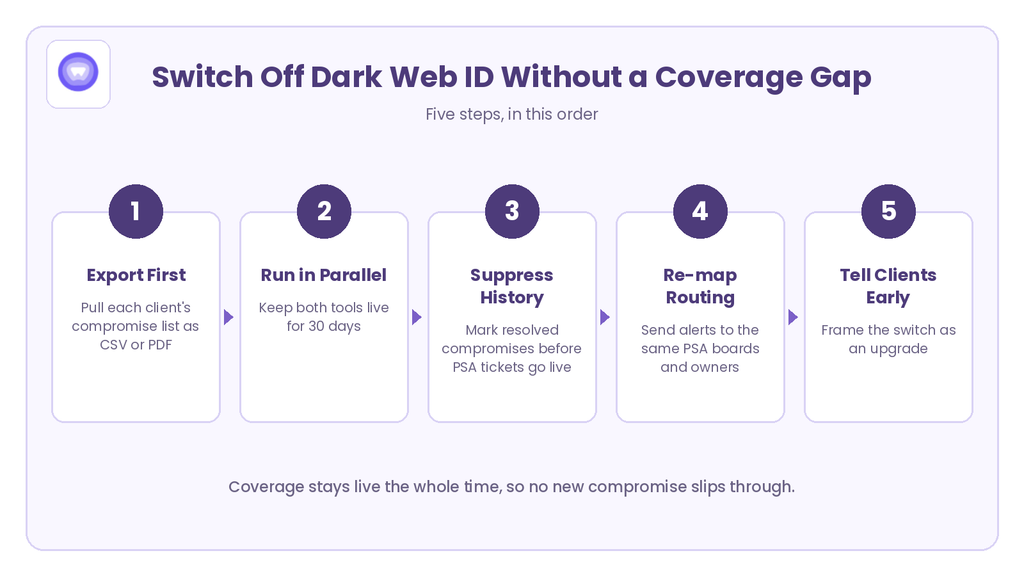
Switching tools creates a short blind spot when steps happen out of order. This sequence keeps coverage running.
- Export first: Pull your current compromise list for each client using CSV or PDF export.
- Run in parallel: Keep both tools live for 30 days so no new compromise slips through.
- Suppress history: Mark known, resolved compromises in the new tool before turning on PSA tickets.
- Re-map routing: Point new alerts to the same PSA boards and owners your team already uses.
- Tell clients early: Explain the change as an upgrade, especially if you add employee privacy protection.
MSPs that add personal exposure coverage can run employee cleanup as a managed service. In that model, the MSP handles enrollment and removal tracking, while the client keeps consent decisions.
How PureWL Helps MSPs Close the Personal Exposure Gap
PureWL Digital Privacy Protection lets MSPs sell dark web monitoring and data broker removal under their own brand. It scans 400+ people-search and broker sites and re-checks opt-outs monthly. It also re-runs removal automatically when data returns. Most important, the MSP owns the brand, the pricing, and the customer relationship. PureWL holds ISO 27001 and SOC 2 Type II, with full audit reports available to partners under NDA.
For proof, one PureWL MSP case study shows what bundling can do. A US MSP saw client retention rise 15%. Similarly, its revenue grew 25% within the first two months. That result came from a bundled VPN, not from privacy protection, and it is partner-reported data. MSPs that want both can add a bundled VPN under the same brand.
Conclusion
Most Dark Web ID alternatives improve the same thing Dark Web ID already does. They watch work credentials with fresher data, better APIs, or a wider bundle. That is a fair reason to switch.
Still, the larger opportunity sits one layer down. Today, attackers target the people behind client accounts through broker data, personal phones, and help desk calls. The MSP that protects those people keeps the client relationship and the margin.
Request a 20-minute margin and audit-scrutiny review.
Frequently Asked Questions
What is ID Agent Dark Web ID?
Dark Web ID is Kaseya’s dark web monitoring tool for MSPs, watching client emails, domains, and IP addresses.
What are the best Dark Web ID alternatives for MSPs?
Leading options include Breachsense, Flare, Guardz, usecure, Breach Secure Now, and PureWL Digital Privacy Protection.
Can Dark Web ID remove leaked data?
No, Kaseya’s own FAQ calls dark web removal implausible and points individuals to identity monitoring services.
Does Dark Web ID monitor employees’ personal email addresses?
Only for executive and administrative users, according to ID Agent’s own feature list.
Can an MSP sell dark web monitoring under its own brand?
Yes, PureWL Digital Privacy Protection lets MSPs own the brand, pricing, and customer relationship.