

- A single VPN account under one brand works for a single reseller, but it breaks the moment a platform has many downstream tenants who each need their own branded experience.
- Shared branding across tenants is a real risk, not a hypothetical one. Cross-tenant exposure from misconfigured APIs has risen 17% across SaaS environments, and the average data breach now costs close to $4.9 million.
- A true multi-tenant white label VPN platform needs three things: per-tenant branding at the app and API layer, isolated credentials and session boundaries per tenant, and usage-based billing scoped per tenant.
- Provisioning and offboarding have to run through the same API for every tenant, with bulk onboarding available for platforms adding many tenants at once, not manual setup per customer.
- Tenants often sit in different jurisdictions, so server assignment and data routing need to match each tenant’s own compliance rules instead of one blanket policy for the whole platform.
Quick answer: A white label VPN platform lets a business resell VPN access under its own brand. A multi-tenant version goes further: it issues separate branding, credentials, and billing for each downstream tenant from one backend. That lets a platform serve many customers without rebuilding its VPN layer each time.
A single VPN account under one brand is a solved problem. A digital platform can serve fifty downstream tenants. Each one expects its own branded app, billing line, and data boundary. That gap is where most white label VPN platform vendors stop short. It is exactly where product teams building marketplaces, agency tools, and multi-brand SaaS stacks hit trouble.
The cost of missing that gap is already measurable. Cross-tenant exposure from misconfigured APIs has risen 17% across SaaS environments, and the average data breach now costs close to $4.9 million. Platforms running many tenants on shared infrastructure carry more of that risk than single-brand products, simply because more tenant boundaries exist to get wrong.
This piece looks at what a white label VPN platform needs when the customer is not one company, but many. It covers branding at scale, credential isolation, provisioning, and the compliance questions that surface once a platform serves many tenants.
The Multi-Tenant Branding Problem a Generic Platform Misses
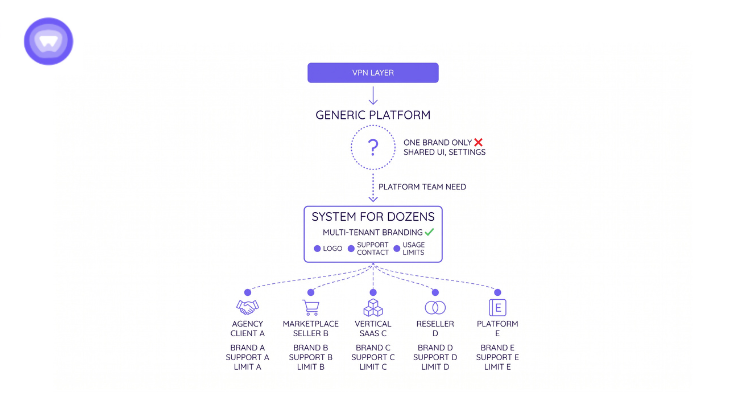
Most VPN vendors sell a white label VPN platform built for one brand, one listing, one customer base. That model works for a single reseller. It breaks the moment a platform itself has downstream customers who each need their own branded experience.
Marketplaces, agency dashboards, and vertical SaaS products increasingly resell features to their own client base. A platform selling security tools to a hundred smaller businesses cannot hand every one of them the same generic app.
One VPN Layer, Many Downstream Brands
A platform team is not asking for a single white label VPN platform. It is asking for a system that spins up dozens of sub-brands from one backend. Each one needs its own logo, its own support contact, and its own usage limits.
Generic reseller programs are not built for that. They assume the reseller is the end customer, not a distributor to further customers.
Why Shared Branding Breaks Trust at the Platform Layer
When two downstream tenants share the same underlying app shell with only a logo swap, support tickets start crossing lines. One tenant’s customer sees another tenant’s server list or billing artifact.
That is not a hypothetical edge case. It is a direct result of treating multi-tenant deployment as an afterthought, not a core requirement of the platform itself.
What a Downstream Branding Failure Actually Costs
Picture a platform running 60 downstream tenants on a poorly isolated VPN backend. One tenant misconfigures an API key. Without account-level boundaries, that single mistake can expose session data from every other tenant on the same instance. This example is illustrative, but the mechanism is real. Shared infrastructure without hard tenant boundaries turns one customer’s mistake into every customer’s incident.
The financial exposure is only part of the cost. A tenant that discovers a branding or data leak does not just distrust the VPN feature. It reconsiders the whole platform relationship.
What a True White Label VPN Platform Needs for Multi-Tenant Deployment
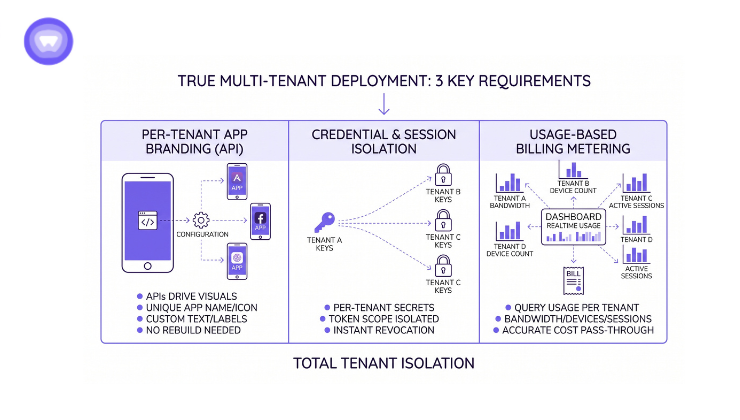
Supporting many downstream brands from one white label VPN platform requires more than a branding toggle. It requires the platform to treat each tenant as its own account, not a cosmetic variant of the same one.
Three requirements separate a platform built for this from one that only claims to support it.
Per-Tenant Branding at the App and API Layer
Branding has to extend past the app icon. Splash screens, support links, terms of service, and server-selection labels all need to be swappable per tenant. That runs through the provisioning API, not hardcoded per build.
Set app identity per tenant at provisioning time:
- Name, icon, and splash screen pulled from tenant configuration, not the parent platform
- Support and billing contact fields set per tenant, not shared across the platform
- Server naming and region labels customizable without a new app build
Isolated Credentials and Session Boundaries Per Downstream Brand
Every tenant needs its own secret key and its own token scope. One compromised credential should never expose another tenant’s data.
This is an authentication decision, not a branding one. Webhook-based session revocation confirms access changes in seconds, not minutes. It has to be built into the account layer from day one, not patched in after the first client signs.
Usage-Based Billing and Metering Per Tenant
Platforms reselling downstream need per-tenant usage data, not a single aggregate bill. Bandwidth, device count, and active-session totals should be queryable per tenant through the same API used for provisioning.
Pricing has to match the way a partner provisions multiple brands from one console. Without that, the platform cannot pass accurate costs to its own tenants, and margin visibility disappears.
How Provisioning Works Across Many Tenants on One White Label VPN Platform
Provisioning at multi-tenant scale runs through the same account creation and server-assignment sequence used for a single brand. The difference is that each tenant gets its own credential set issued through that sequence, not a shared one.
Offboarding works the same way in reverse. A single API call revokes one tenant’s access without touching any other tenant’s sessions. That matters when a customer relationship ends and the platform needs a clean, immediate cutoff.
Bulk onboarding matters as much as single provisioning. A platform adding twenty new tenants needs twenty credential sets in one batch call, not twenty manual setups.
| Aspect | Shared Single-Brand VPN | Multi-Tenant White Label VPN Platform | Fully Custom-Built VPN |
| Branding per tenant | Not supported | Per-tenant app identity, support contact | Fully custom, built in-house |
| Credential isolation | Shared account | Per-tenant secret keys and tokens | Built and maintained internally |
| Billing visibility | Aggregate only | Per-tenant usage and billing data | Built and maintained internally |
| Provisioning speed | Manual, one brand at a time | API-driven, bulk tenant onboarding | Months of internal build time |
| Offboarding | Manual account changes | Single API call per tenant | Custom-built revocation logic |
Data Residency When Tenants Sit in Different Jurisdictions
The multi-tenant SaaS market is on track to move from roughly $110 billion in 2025 to $300 billion by 2035. That growth is pulling more platforms into serving tenants across many countries at once. Each tenant carries its own data residency expectation.
A platform with tenants in the EU, the US, and the Gulf region cannot use one blanket compliance answer. Server assignment and data routing need to match each tenant’s own rules, not just the platform’s home jurisdiction.
- EU-based tenants often need in-region servers and a documented sub-processor chain
- US-based tenants usually care more about breach-notification timelines than server location
- Tenants under sector rules, such as fintech or healthcare, need audit trails scoped per tenant, not per platform
A platform that cannot route traffic and log data per tenant jurisdiction forces the operator to solve this by hand. That does not scale past a handful of customers.
Proof: Multi-Tenant Deployment in Practice
A managed service provider bundled antivirus and VPN into one branded suite for its own client base. Enterprise client growth hit 20%, with a 32% cut in operational costs within two months. Retention rose 15% and revenue grew 25% over the same period.
That result came from bundling, not from multi-tenant branding alone. It is the MSP’s own reported outcome, not an independently audited figure. The real lesson for platform teams is structural. Once the VPN account handled provisioning, billing, and branding on its own, the MSP added clients without rebuilding per account.
That is the same mechanic a digital platform needs when extending VPN access to dozens of tenants, not one.
How PureWL Supports Digital Platforms Running a White Label VPN Platform
PureWL provisions each tenant through its own secret key and access token. Platform teams onboard new tenants through the account-management API, with no new app build and no manual setup. Server assignment, branding fields, and usage data all stay scoped per tenant, not shared across the whole customer base.
The infrastructure runs on a network verified through a SOC 2 Type II audit, with a KPMG-reviewed no-log policy. Platform teams can pass that along as a compliance answer to their own tenants, instead of building the verification themselves. Teams weighing what white labeling requires at the account level can review PureWL’s core platform details before scoping a rollout.
Where This Leaves Platform Teams
A white label VPN platform built for one brand will always struggle with a second tenant, let alone a fiftieth. Each one needs its own identity, credentials, and billing line. That struggle shows up first as support tickets, then as compliance gaps, and eventually as churn.
Platforms that treat multi-tenant support as a core requirement, not an add-on, avoid rebuilding their VPN layer each time. Request a 20-minute walkthrough of PureWL’s multi-tenant provisioning API to see how tenant onboarding works before committing to a build.