

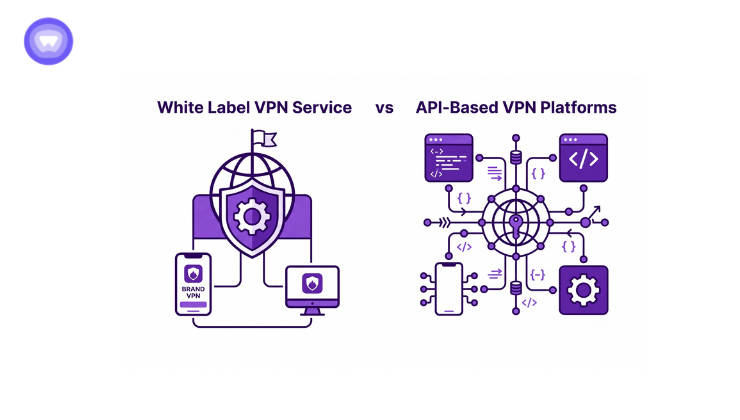
- Build vs. buy is really a staffing decision. A white label VPN service ships a complete, pre-built pipeline (provisioning, session sync, protocol, revocation), while an API based platform hands that entire pipeline to your own team to build and maintain.
- The real cost is recurring, not one time. Custom API integrations run $50,000 to $150,000 a year to build, and annual maintenance adds another 15 to 25 percent of that cost every year after, with no new features to show for it.
- Liability follows the code, not the infrastructure. The provider covers protocol security and patching either way, but any bug in webhook signature checks, token refresh, or credential revocation logic belongs to whoever wrote it.
- A regulatory deadline is now part of the calculation. The EU Cyber Resilience Act requires reporting actively exploited vulnerabilities within 24 hours starting September 11, 2026, and that duty falls on the team that owns the integration code.
- Most teams land on a hybrid. A white label VPN service provides the foundation, with an API layer added only at the specific points where custom integration genuinely adds value.
A product team choosing between a white label VPN service and a raw VPN API learns the real cost late. It shows up after the contract is signed, once the first sprint starts. The pitch for an API sounds simple. Call an endpoint, get a tunnel, ship a feature.
That pitch skips everything between the API call and a connection a customer can depend on. Token exchange, server assignment, state sync, and revocation all sit in that gap. The team that chose the API builds and maintains every piece of it.
A white label VPN service starts from a different point. That entire pipeline already exists and already runs in production. A product team brands it, prices it, and ships it.
Choosing between the two models is not a preference question. It is an engineering staffing question with a liability question attached.
The Cost of Getting This Decision Wrong
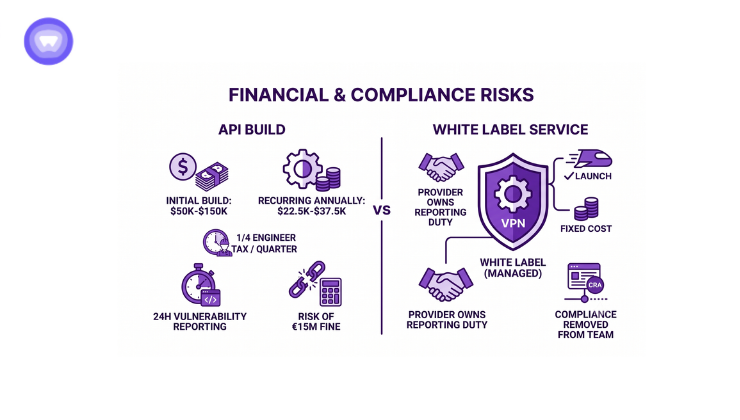
The financial exposure of this choice is visible before any protocol code gets touched.
Bindbee’s 2026 integration cost analysis puts custom API integration spend at $50,000 to $150,000 a year. That figure counts development, maintenance, vendor changes, and quality assurance together. It covers one integration, not a full VPN product.
The build is the cost every team budgets for. GMWare’s 2026 system integration cost breakdown found something similar. Maintenance on a connected API integration commonly runs 15 to 25 percent of the original build cost every year. Vendor APIs change, and integrations break because of it. On a $150,000 build, that is $22,500 to $37,500 in recurring spend. It repeats annually, for zero new features shipped.
Consider a five-engineer SaaS team building a modest $50,000 integration. That consumes roughly one engineer’s full quarter before launch. Every quarter after that carries a smaller, but real, maintenance tax on top.
A second clock runs underneath the financial one. The European Union’s Cyber Resilience Act sets a real deadline. Manufacturers of connected products and software must report actively exploited vulnerabilities within 24 hours, starting September 11, 2026. A product team that writes and maintains its own webhook checks, token refresh, or revocation code owns the reporting duty. The VPN provider’s obligations do not cover that code. Fines under the regulation reach fifteen million euros or 2.5 percent of global turnover.
A decision made before that deadline is a choice about the build. A decision made after it is a compliance gap already on the clock. This is exactly the calculus a white label VPN service is built to remove.
Proof: What a Built-In VPN Changes for a SaaS Product
One anonymized productivity SaaS client added a built-in VPN instead of leaving security to a separate download. More than 30 percent of that app’s uninstalls had previously cited a lack of built-in security as the reason.
That number sits inside retention data, not a support ticket queue. A missing security feature was not a complaint users filed. It was a reason they left, measured directly in the uninstall log.
What Building on a Raw VPN API Actually Requires
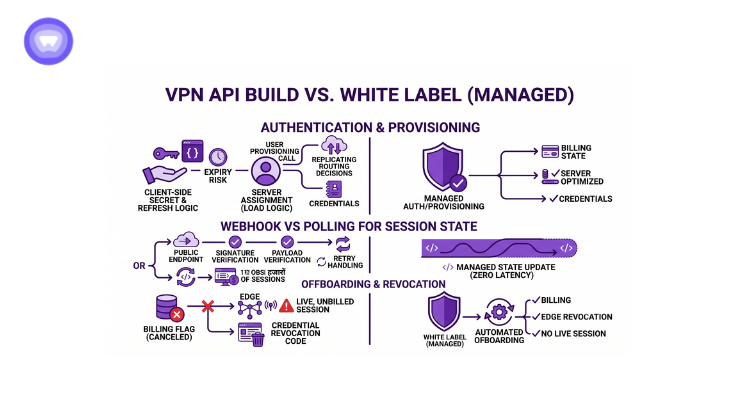
Every VPN API, PureWL’s included, follows a similar shape past the marketing page. A secret key gets exchanged for a short-lived access token. Provisioning and session calls sit layered on top of that. The work a product team inherits lives inside that shape.
Authentication and Provisioning
A server-side secret key authenticates the integrating application, not the end user. That key gets exchanged for an access token with a defined expiry. The integrating team owns refreshing that token before it lapses. Doing this wrong drops active connections mid-session.
Each new subscriber then requires a provisioning call. That single call does three things at once:
- Creates a user record tied to a plan and billing state
- Assigns that user to a specific server, based on region and current load
- Issues connection credentials scoped to that assignment
Server assignment is not a static lookup. A provider running near capacity in one region has to route new calls elsewhere. It has to do that without the user noticing a performance change. Building that load logic yourself means replicating routing decisions the underlying network already makes for itself.
Webhook vs Polling for Session State
Once a session exists, the integrating app needs to know its state. Connected, disconnected, expired, or revoked, all four matter. There are two ways to track that, and the choice carries real weight.
Webhooks push state changes the moment they happen. This needs a publicly reachable endpoint and signature verification on every payload. It also needs retry handling for calls that fail to deliver. Miss a delivery and the app shows a user connected when they are not.
Polling skips the public endpoint requirement. In exchange, it trades away latency and adds rate-limit management. The team decides how often to poll, then tunes that against cost. Polling every few seconds across thousands of sessions is not free.
Neither choice is wrong on its own. Both require ongoing engineering judgment. A white label service makes that judgment once, for every partner at once.
Offboarding and Credential Revocation
Cancellation looks simple from the billing side. Flip a status flag and move on. It is not simple at the session layer.
A credential issued during provisioning stays valid at the edge node until revoked there. Marking a row inactive in a database does not touch that node. Skipping the revocation step leaves a live, unbilled session running. Nobody notices until someone audits active sessions against billing.
What Ships Pre-Solved in a White Label VPN Service
A white label VPN service does not remove these mechanics. It moves them behind the provider’s line, already solved for every partner on the platform.
Protocol Choice Is Already Made and Maintained
An API-based build still has to pick a tunneling protocol. It also has to keep that implementation current over time. WireGuard uses the Noise protocol framework with ChaCha20 encryption and Curve25519 key exchange, built for speed. OpenVPN typically runs AES-256-GCM or ChaCha20-Poly1305 and carries a larger, more configurable stack. IKEv2/IPsec handles network switching, such as moving from WiFi to mobile data, more smoothly than either option.
Picking one is a real engineering decision with real tradeoffs. Picking wrong means a slower migration later, once real traffic depends on it. A white label VPN service ships with that decision already made. It arrives already patched and already tested against real network conditions.
Kill Switch and DNS Leak Handling Are Already Tested
A kill switch has to force the network interface down the instant a tunnel drops. It cannot just alert the user after traffic already leaked. Testing this properly means killing the interface programmatically and timing the result.
DNS leaks are the more common failure, particularly over IPv6. Many test environments run with IPv6 disabled by default. A leak that only appears on IPv6-enabled networks passes internal testing quietly. It then surfaces once real users hit production. An API-based team has to build and test all of this itself. A white label VPN service inherits it already verified.
Shared Exit IP Reputation Is the Provider’s Problem to Manage
Here is a detail most comparisons skip entirely. White label partners often share exit IP pools with other partners. One partner’s abusive user gets an IP blocklisted by a streaming service or spam filter. Every other partner sharing that address inherits the block instantly.
Ask a white label provider directly whether dedicated IP pools are available. Ask which tier includes them, before this becomes an unexpected support ticket.
Where Liability Actually Sits When Something Breaks
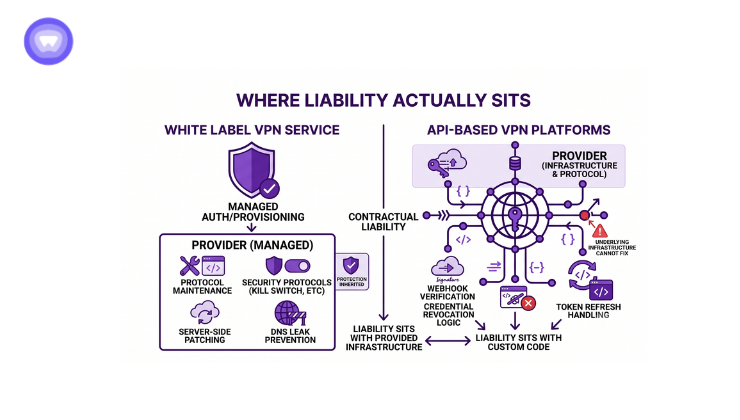
Every comparison of these two models eventually lists security as a bullet point. Few explain who is actually on the hook when a failure happens. A product team’s legal and security stakeholders ask that question before signing anything.
Under a white label VPN service, the provider owns protocol maintenance and security protocols like kill switch behavior. Server-side patching and DNS leak prevention come with it too. The integrating company inherits those protections without maintaining the code behind them. Liability for a failure at that layer sits with the provider under contract.
Under an API based model, the provider secures its own infrastructure and protocol code. Everything built above that layer is the integrating team’s own code. That includes webhook signature verification, credential revocation logic, and token refresh handling. A bug in any of those pieces creates a real vulnerability. The underlying VPN infrastructure cannot fix it, since that infrastructure never touches that code.
The Compliance Question Generic Comparisons Skip
Most SaaS platforms and connected device makers already carry GDPR obligations. Those obligations exist before VPN enters the picture at all. Neither model removes that obligation. Each model changes who signs the paperwork for it.
Under a white label VPN service, the provider typically sits as the data processor for VPN traffic. That relationship gets documented in the provider’s own compliance stack.
Under an API based build, the picture shifts. The integrating company often becomes the processor itself. It is the one storing access tokens and logging session state. It also handles the user identifiers tied to each provisioning call. That pulls the liability inside the product’s own audit scope, not the vendor’s.
For a device maker shipping firmware across regions, that distinction matters. It decides which entity answers a regulator’s question first. Confirm this in writing before a single line of code gets written. Waiting until an audit request arrives is too late.
Putting a Number on the Two Clocks
The build cost, the maintenance percentage, and the reporting deadline above trace back to real sources. They come from Bindbee’s integration cost analysis, GMWare’s system integration cost breakdown, and the regulation’s own text. None of that maintenance load or reporting duty touches a provider’s own protocol code. Choosing a white label VPN service removes both at once.
That maintenance also rarely lands on a predictable schedule. A vendor deprecates an endpoint or changes a token format without warning. A webhook signature scheme that worked last quarter can silently stop matching.
Cost and Control Side by Side
The pattern across every row repeats. A white label VPN service trades customization for a fixed liability line and a pipeline someone else already debugged. An API based platform trades that off for control. It keeps every layer of maintenance with the team that chose it.
| Factor | White Label VPN Service | API-Based VPN Platform |
| Time to launch | Weeks | Six to eighteen months |
| Protocol implementation | Chosen, patched, and tested by provider | Team selects and maintains WireGuard, OpenVPN, or IKEv2 |
| Session state sync | Handled internally by provider | Team builds and operates webhook or polling logic |
| Credential revocation | Managed at the provider’s edge nodes | Team must revoke at the node level on cancellation |
| Annual maintenance | Included in provider agreement | 15 to 25 percent of build cost, recurring |
| Data processor role | Provider, documented in its own stack | Often the integrating company itself |
| Customization depth | Branding, pricing, tiers | Deep, including custom routing and workflows |
| Best fit | VPN as an add-on to an existing product | VPN as a core, deeply embedded feature |
The Hybrid Model Most Product Teams Actually Choose
Few teams pick a pure version of either model once these mechanics are clear. Most choose a white label VPN service that also exposes an API layer. That layer covers only the specific integration points that matter, instead of the full pipeline.
One anonymized client, a hardware and router platform, needed VPN protection reaching past its own app. It wanted coverage on smart TVs and game consoles on the same network. Building a separate client for every device category was not realistic on their timeline.
Instead, the team integrated VPN functionality directly at the router level. That integration called into an already built white label foundation. It skipped standing up provisioning, server assignment, and revocation logic from scratch. It also removed the need for a standalone branded app entirely, while still covering every device on the network.
That is the practical pattern for most SaaS platforms and device makers. The protocol stack, server network, and session lifecycle come from a white label VPN service. The API layer sits on top only where a product genuinely needs custom behavior.
Decision Framework
Choose a white label VPN service when:
- Launch speed matters more than deep protocol-level customization
- The team does not want to own webhook infrastructure or revocation logic
- VPN is a secondary feature, not the core product
- Predictable, provider owned security patching is a priority
Choose an API based build when:
- VPN needs to sit deep inside an existing, complex backend
- Custom routing logic or proprietary session workflows are required
- The team already has backend, mobile, and DevOps capacity to spare
- Full control over protocol choice outweighs speed to market
How PureWL Fits Into This Decision
PureWL White Label VPN Solution provides the protocol stack, server network, and session lifecycle a product team needs. There is no from scratch build required. A white label VPN service from PureWL ships with provisioning, server assignment, and credential revocation already handled. Ready made apps across major platforms come with it. API and SDK access sits on top wherever a team needs deeper embedding.
This is the hybrid path most SaaS platforms and device makers land on. It happens once the engineering math becomes clear. A product team gets a working, branded VPN product from day one. The option to extend it through APIs stays open exactly where custom integration adds real value.
Closing Thoughts
The build versus buy question for VPN access comes down to ownership. Protocol selection, session state sync, credential revocation, and the maintenance tax that follows all three. A white label VPN service converts that entire pipeline into a branding exercise measured in weeks. An API based platform keeps every layer of control inside the team’s own code. It also keeps every layer of ongoing maintenance and liability there.
Neither model wins by default. The right one depends on whether VPN is the product or a feature inside a larger one. It also depends on the team’s appetite to own webhook retries and token refresh logic long term.
Book a 20 minute walkthrough with PureWL to map which model fits your current stack. Do it before the next sprint gets planned around the wrong one.