

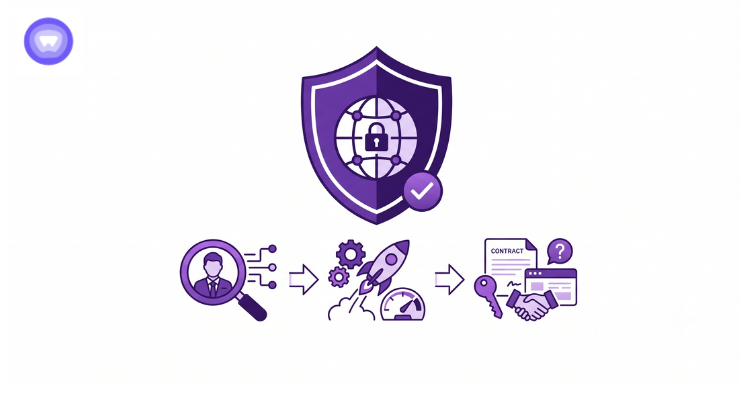
- Ask about channel conflict before margin or SLA terms. A vendor that can sell directly to your client list creates the biggest long-term risk. Research shows 60% of providers get deprioritized after unresolved channel conflict.
- Get margin structure in writing, not just the year-one number. Per-seat vs. per-device markup, price-increase triggers, and notice periods matter more at renewal, and unclear VPN margins can hurt an MSP’s valuation during a future sale.
- Downtime under your brand is your outage, not the vendor’s. Push for a written uptime guarantee, a real credit schedule, and clarity on whether you get notified before your clients do.
- Verify the audit actually covers your white label build. A no-log audit on the vendor’s main retail app does not automatically apply to your branded version. Ask for the audit scope document, not the badge.
- Onboarding speed and exit terms deserve upfront questions too. A written onboarding timeline predicts how the vendor handles commitments later, and knowing your data migration terms before signing protects your leverage if you ever need to leave.
Most white label VPN vendor calls cover the same six items: encryption, server count, apps, branding, pricing, and support. None of those items explain why a partnership fails eighteen months in. The failure point is almost never a missing feature. It is a term nobody thought to ask about during the vetting call.
A white label VPN checklist built around feature bullets tells you what a vendor has. It does not tell you what happens when that vendor’s incentives stop matching yours. This piece is built as questions instead. A bullet point cannot be cross-examined. A vendor’s answer to a direct question can.
The questions below are grouped by the moments where white label VPN partnerships actually break. Who else does the vendor sell to. How is the margin really structured. What happens when the service goes down. Who owns the client relationship when things change. Each question includes what a strong answer sounds like and what a weak one gives away.
Why a Feature List Cannot Replace a Vetting Call
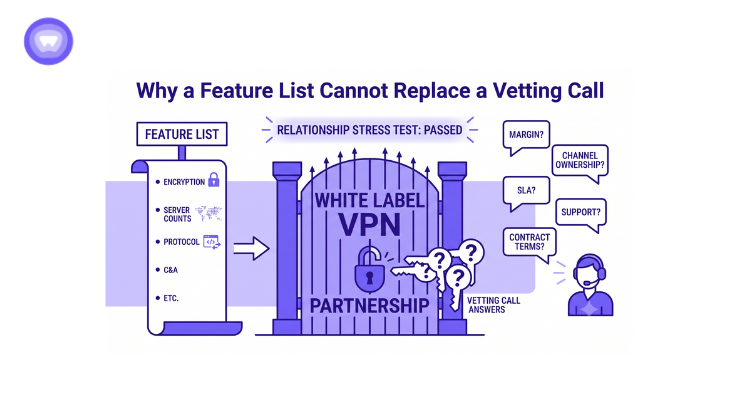
Encryption standards and server counts are easy to compare. Every vendor publishes them. The terms that decide whether a white label partnership survives past year one are rarely published anywhere. They surface only when someone asks directly and listens closely to the answer.
That gap has a cost. An MSP that signs a VPN deal without asking about margin or channel ownership is not protected by encryption alone. The real exposure sits in the contract terms nobody pressed the vendor on.
- Feature comparisons answer “can this vendor do the job.”
- Vetting questions answer “what happens when the relationship gets tested.”
A white label VPN checklist that only covers the first question leaves the second one for a partner to discover after signing. A useful checklist treats every vendor claim as something to verify. Confidence on a call is not proof.
Questions About Channel Ownership and Conflict
Channel conflict is the failure mode partners notice last and regret most. A vendor that white labels a VPN for you today can decide tomorrow to sell the same service directly. It can also hand the same territory to a competing partner.
Ask: Will you ever sell this VPN directly to the customers on my client list?
A strong answer draws a clear, written line between direct sales and partner-exclusive accounts. A weak answer talks about “focus on the partner channel” without committing to anything contractual.
Ask: If a client outgrows my white label plan, where do they go next?
Research from Journeybee, drawing on channel-conflict case data, found that sixty percent of providers quietly deprioritize a vendor after conflict. A third drop that vendor entirely. A VPN vendor with no clear escalation path for growing clients is building the exact conditions behind that number.
- Get the direct-sales boundary in writing, not in a sales call.
- Ask what happens to your commission if a client is later served by the vendor’s own team.
- Ask whether the vendor’s other partners operate in your market or client vertical.
This category belongs at the top of any white label VPN checklist. It decides whether every other contract term still matters two years from now. A generous SLA does not protect a partner whose top clients get pitched directly by the same vendor.
Questions About Margin Structure and Pricing Lock
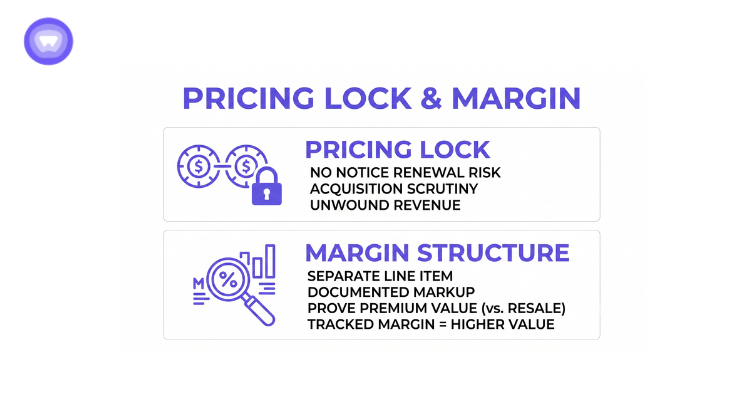
Margin questions get skipped more than any other category. The first-year number usually looks fine. The real exposure shows up at renewal, or during due diligence if the MSP is ever sold.
An MSP should treat this category as commercial due diligence, not a pricing formality.
Ask: Is my markup per seat, per device, or a flat wholesale rate, and does that change past a certain volume?
Ask: What triggers a price increase, and how much notice do I get before it takes effect?
A 2026 review of MSSP acquisition deals found buyers routinely unwind bundled security revenue during diligence. They discover it is really resold antivirus priced to look like a security line item. The same scrutiny applies to a VPN line sold as security revenue with no documented markup behind it. An MSP with no separately priced VPN margin carries exposure. It only becomes visible the day someone values the business.
Separately priced, well-documented add-ons also tend to perform better on their own terms. One 2024 analysis found bundled EDR-style services carried average gross margins eighteen points above plain antivirus resale. A VPN line without a tracked margin will not show that kind of premium. Nobody can prove it exists.
Run the numbers before the call, not after. A sixty-client MSP charging six dollars a seat on a four dollar cost runs a thin markup near thirty-three percent. That gap disappears fast if the vendor raises wholesale pricing mid-contract with no notice clause in place.
Questions About SLA, Downtime, and Escalation
This section belongs near the top of any white label VPN checklist. A VPN that goes down under your brand becomes your outage, not the vendor’s. Clients do not call their VPN provider when the app stops connecting. They call the company whose name is on the app icon.
Ask: What is the guaranteed uptime figure, and what credit do I receive if it is missed?
Ask: How fast does your team acknowledge an outage, and how is that communicated to me first?
Broader IT downtime research puts useful numbers on what is at stake here. A 2024 industry survey found over ninety percent of large enterprises now report an hourly outage cost above $300,000. Few white label VPN partners run at that scale. The direction of the number is still the point. Vague SLA language costs more as a partner’s client base grows, not less.
- Get the actual credit schedule in writing, not a general “high availability” claim.
- Ask whether status updates go to you first or get posted publicly at the same time as your clients.
- Ask how outages get worded on the public status page, since vague blame language does not protect your brand.
Questions About Data Handling Without Repeating the Compliance Binder
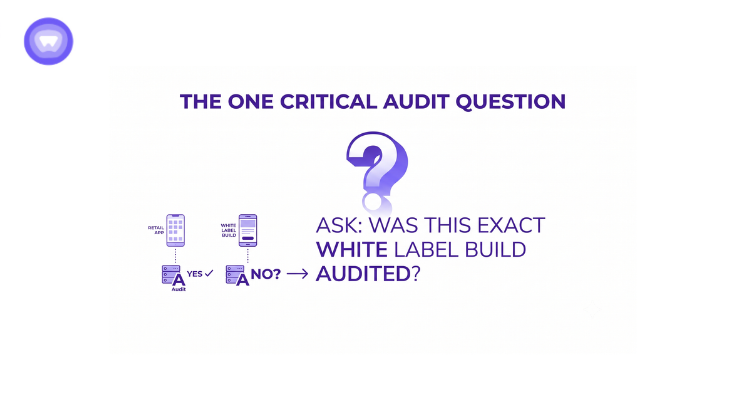
Encryption standards, logging policy, and jurisdiction belong in a separate compliance review. That review deserves its own depth, not a summary here. One question earns a place in this vetting call because it gets skipped constantly.
Ask: Was this exact white label build included in your last independent audit, or only your parent retail app?
A no-log audit performed on a vendor’s main consumer app does not automatically cover a white label build. Branding differs. Client onboarding differs. Server pools sometimes differ too. Ask for the audit scope document, not the audit badge.
Questions About Support Branding and Ticket Ownership
Support is where the white label promise gets tested daily, long before any outage happens. It belongs in every white label VPN checklist alongside SLA terms, not as an afterthought.
Ask: Does tier-one support run under my brand, or does a client hear the underlying VPN provider’s name during a call?
Ask: What is the average first response time, and is it measured separately from your retail customers?
A support queue shared with thousands of retail users has no separate service level for partners. Client tickets sit in the same line as everyone else’s. That detail rarely shows up until response times slip during a busy period.
Questions About Onboarding and First-Client Timeline
Most vetting conversations focus on what happens if things go wrong. Fewer cover what happens between signing and the first branded client login. That gap can cost an MSP real revenue if it runs long.
Ask: What is the actual timeline from signed agreement to a fully branded, app-store-ready client build?
Ask: Who owns the app store submission, the branding assets, and the domain setup during onboarding?
- Get a written week-by-week onboarding timeline, not a range like “four to eight weeks.”
- Ask what happens if an app store rejects the submission, and who resubmits it.
- Ask whether a dedicated onboarding contact exists, or whether new partners share a general support queue.
A vendor that will not commit to a written onboarding timeline is unlikely to hit its SLA commitments later.
The One Exit Question Worth Asking First
Contract termination and data portability deserve a full review before signing anything. Ask this single question early. The answer shapes how much negotiating room exists later.
Ask: If I leave, how long do I have to migrate client accounts before service cuts off? In what format do I get my client data back?
A vendor that hesitates on this question during a sales call will not get faster once a contract is signed.
Vetting Call Question Bank
Use this as a quick reference during the actual vetting call, not after it.
| Category | Ask This | Red Flag in the Answer |
| Channel Conflict | Will you ever sell direct to my client list? | Vague reassurance with nothing in writing |
| Margin Structure | Is markup per seat, per device, or wholesale flat rate? | Cannot state the number without checking |
| Pricing Lock | What triggers a price increase, and what is the notice period? | “We try to give advance notice” with no defined window |
| SLA and Uptime | What is the guaranteed uptime and the credit if missed? | General “high availability” claim, no written credit schedule |
| Support Ownership | Does tier-one support run under my brand? | Admits clients sometimes hear the underlying provider’s name |
| Audit Scope | Was this white label build inside the last independent audit? | Points only to the parent retail app’s certification |
What the Right Vendor Relationship Actually Produces
Vetting questions matter because the answers compound over time. They build either a stable margin or a slow erosion of one. PureWL’s published case study documents one such result, for a managed service provider client identified by industry rather than name. The MSP added antivirus and VPN together under one brand. It sold the pair as a single bundle to its SMB client base, not two line items.
Within two months, the MSP reported a twenty percent rise in enterprise clientele. Operational costs fell thirty-two percent. Client retention rose fifteen percent, and revenue grew twenty-five percent. These are the MSP’s self-reported results, published in PureWL’s case study. They are not independently audited. Read the full case study at the link before citing these numbers elsewhere. The outcome still makes the point. It depended on clear margin terms and support that held up under real demand, not a strong feature sheet.
Where PureWL Fits
PureWL White Label VPN Solution answers these questions directly, rather than routing partners toward a general feature page. Margin structure, channel boundaries, and SLA terms are documented per partner agreement. Partners keep direct client billing and support branding instead of sharing a queue with retail users.
PureWL also runs on infrastructure built over seventeen years. It spans 150-plus partners and 6,500-plus servers across 88-plus countries. Those two figures are PureWL’s own internal partner data, not independently audited. Its SOC 2 Type II status is a separate claim, verified independently by KPMG. Check the audit claim against the audit scope question above rather than treating either figure as a substitute for it.
Conclusion
A white label VPN checklist earns its value only when the answers hold up over time. Feature comparisons rarely help, since every vendor’s feature sheet reads the same. Direct questions about channel ownership, margin, downtime, and audit scope work differently. They either hold up in writing, or fall apart under pressure. Ask them before signing, not after the first renewal notice arrives. Request a 20-minute partner terms review with PureWL to walk through margin structure and SLA terms line by line.