

Quick cash is always tempting. Spend five minutes clicking through a few questions, get $5 in return—what could go wrong? That’s the promise platforms like 5 Surveys make. But if you’ve landed on this page, you’ve probably asked yourself: Is 5 Surveys legit?
Let’s unpack it. Because while the idea of easy survey money sounds harmless, the reality is more layered. Especially for privacy-conscious users and those managing online brands or reselling VPN tools.
What Is 5 Surveys and Why Is It a Concern for Businesses?
5 Surveys pitches itself as a quick-money platform: complete five surveys and get paid. Users log in via email, fill in demographic data, and start the process. But here’s where things turn.

The moment a user enters this funnel, they’re often exposed to:
- Ad-heavy landing pages
- Embedded trackers and session cookies
- Aggressive lead-generation scripts
- Potentially spoofed or phishing survey redirects
For businesses that prioritize user privacy, this is a data breach waiting to happen. Even if your product isn’t connected directly to 5 Surveys, if your users interact with it from your network or mobile app, you inherit the risk indirectly.
If someone logs in from your ecosystem, clicks a link, and ends up sharing personal details to a spoofed 5 survey login prompt, guess whose brand they’ll remember? Yours.
Where the Data Trail Begins?
When you register for a survey platform like this, you’re not just providing answers. You’re giving them:

- Your email
- Your location and IP
- Your device info
- Behavioral data via cookies and trackers
Every click, every pause, every redirect—it’s all recorded. 5 Surveys might be paying out small amounts, but in return, it’s collecting a user profile valuable to ad networks and data brokers.
This isn’t about just five surveys anymore. It’s about becoming part of a data supply chain that most users don’t realize exists.
What Users See vs. What’s Happening Behind the Curtain?

On the surface:
- A modern-looking UI
- A simple reward model (“5 surveys 5 dollars”)
- Login and demographic questions
- Lists of available surveys
Behind the scenes:
- Browser fingerprinting
- Persistent tracking
- Redirection through third-party ad networks
- Questionable use of cookies for affiliate fraud
When users complain that 5 surveys no surveys are showing up, it’s often because the platform has already captured enough data on them, and now chooses to serve someone else.
This kind of data-first monetization exposes your users to unnecessary risk. And if you’re running a B2B product with user trust at its core, proximity to platforms like these can become a problem.
The $5 Surveys Pitch: Real Reward or Bait?
That “$5 for 5 surveys” promise is what pulls people in. But let’s be real, anyone rarely gets paid that easily.

Complaints all over Reddit and Trustpilot reference repeated issues:
- “I completed the surveys but never got credited.”
- “After one, they told me I didn’t qualify.”
- “My account went under review with no reason.”
These aren’t edge cases. They show a consistent pattern. If you’re seeing Five surveys account under review or errors like Five surveys technical error, you’re not alone.
The payout model is confusing. Some users report needing to accumulate points over time. Others mention a mysterious “manual review” before any rewards go out. That’s a red flag, especially when you consider you’re sharing data upfront.
The Legitimacy Debate: Is 5 Surveys a Scam?
Is 5 Surveys a scam? That depends on how you define scam.
Technically, many users do receive gift cards or PayPal payouts. But the ratio of effort to reward is low. And the data you trade along the way—well, that’s worth far more than $5.
Some survey listings redirect to third-party sites. Others request account credentials, crypto wallets, or suspicious ID verification. There’s even talk of impersonated surveys under the tag Five surveys survey police, pretending to check your “security compliance” before releasing funds. It’s wild.
When legit users get locked out of their accounts, flagged for “suspicious behavior,” or simply ghosted after completing tasks, the term “scam” starts to fit—at least loosely.
What Happens to Your Info?
Here’s where it gets darker. Once you’ve filled in your first 5 surveys, the data isn’t just sitting in one database.
5 Surveys and similar platforms often work with multiple ad networks and affiliate programs. Your email may be funneled into lead-gen campaigns, your IP tagged for retargeting, and your device ID sold to advertisers.

You may suddenly see:
- Personalized scam emails
- Spam SMS messages
- Ads that know way too much about your interests
And if you’ve ever typed in sensitive information—say, your full name or address—you may even get flagged in phishing databases. All for five bucks.
Fakes, Spoofs, and “Too Good To Be True” Pages
Another problem is brand spoofing. Many of these surveys mimic big-name brands to look trustworthy.
You might get a “Netflix survey” or “Amazon gift card” offer, but it’s hosted on a generic redirect site. Some emails are styled exactly like Apple or USPS, trying to trick users into revealing login info.
If you’ve ever seen one of these and thought, “Wait, did I just give them access to something?” — you’re not alone. This isn’t just shady marketing—it’s phishing with extra steps.
Reviewing Complaints: The Red Flags Stack Up
You don’t have to look far. Type “5 survey reviews complaints” into Google, and you’ll find:

- Users being redirected to fake job or crypto sites
- Missing payouts
- Account blocks due to “suspicious activity”
- Surveys that never complete
- Errors like Five surveys technical error and Five surveys account under review
All of these not only reflect poorly on the platform but also hint at questionable backend operations, possibly linked to data resellers, affiliate arbitrage, or phishing ecosystems.
If you’re building a brand that deals with finance, productivity, health, or remote access — do you really want to leave your customers exposed to this?
Data Misuse in 5 Surveys: The Privacy Risk You Can’t Ignore
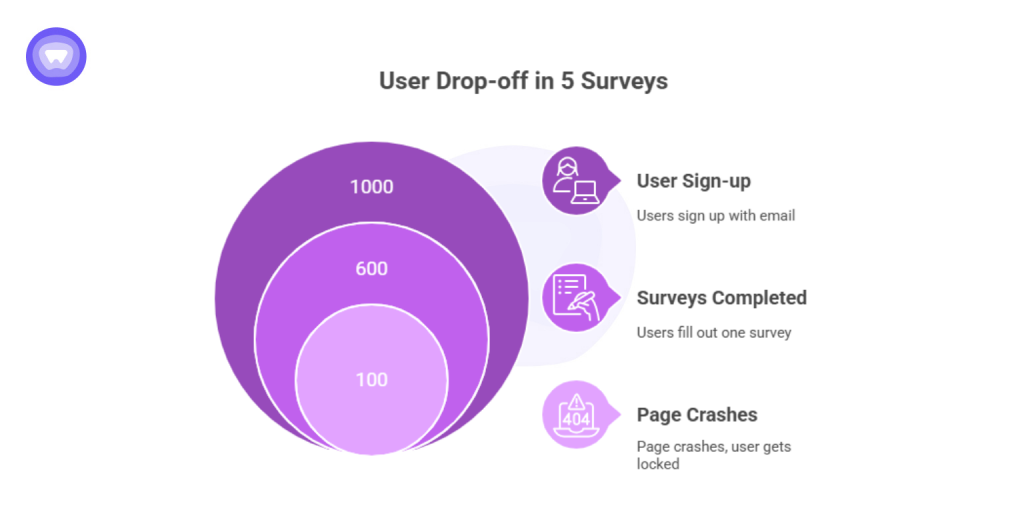
Most 5 Surveys complaints follow the same narrative:
- A user signs up using their email
- They fill out one or two surveys
- Then the page crashes, or they get locked out
- Suddenly, they’re getting spammed—email, SMS, even calls
It’s clear their data was harvested — name, age, email, location — and likely sold to third-party advertisers, fraud campaigns, or affiliate networks.
What makes this dangerous from a business perspective?

- It erodes customer trust
- It creates compliance headaches (especially under GDPR/CCPA)
- It damages your product’s reputation by association
You’re only as secure as the weakest site your user visits through you. And 5 Surveys isn’t just weak — it’s wide open.
The Data Broker Supply Chain: How 5 Surveys Fuels the Problem
When users complete surveys on 5 Surveys, they’re not just feeding a single platform. They’re entering a data supply chain that extends far beyond what most people realize.
Here’s how it works:
- User data is harvested. Email, location, IP, device info, browsing behavior—all collected on the 5 Surveys platform.
- Data is aggregated. 5 Surveys pools user profiles with millions of others into comprehensive behavioral datasets.
- Data is sold to data brokers. Brokers buy these lists in bulk and add them to their marketplaces, where they’re resold to advertisers, affiliate networks, and worse.
- Data brokers resell to bad actors. Once in a broker database, your email ends up in phishing lists, SMS spam campaigns, and social engineering databases.
- Users get targeted repeatedly. The person who filled out one 5 Surveys survey now receives months of spam, scam attempts, and targeted phishing emails.
The Economics of Data Harvesting
For 5 Surveys, the $5 payout is not the real business model. The real money comes from selling user profiles to data brokers. A single user profile—name, email, location, age, interests, device ID—can be worth $0.50 to $5.00 when bundled with thousands of others and sold on the data broker market.
If 5 Surveys harvests data from 100,000 users and sells those profiles to data brokers, that’s $50,000 to $500,000 in revenue before any survey completion ever happens. The $5 payouts? Those come from a tiny fraction of users. The data sales? That’s the real money.
This creates a perverse incentive: the platform profits most when users hand over data upfront and never complete a survey. The data is already sold.
Why This Matters for Your Business
If you’re building a SaaS product, fintech tool, or digital service, your customers are being targeted by platforms like 5 Surveys every day. They’re getting:
- Fake “verify your account” emails styled to look like your product
- SMS phishing texts claiming a security issue with their account
- Spoofed survey offers impersonating your brand to harvest credentials
When users get compromised through a phishing campaign targeting data harvested by 5 Surveys, they will blame you. Not the survey platform. You.
Your brand’s proximity to these data-harvesting ecosystems is a liability, even if you’re not directly connected. The data broker supply chain doesn’t ask permission, it just operates in the background while your users get progressively more compromised.
Breaking the Supply Chain: Data Broker Removal
There’s one direct way to disrupt this: remove your users’ personal data from data broker databases before platforms like 5 Surveys can sell it.
Data broker removal services scan the open data broker market and submit deletion requests to hundreds of brokers. Once data is removed, scammers and phishing operators lose access to the contact lists they depend on. Spam campaigns become less effective. Phishing targeting gets harder.
For platforms like 5 Surveys, data removal services remove the most valuable part of their inventory: fresh, recent user profiles bundled with behavioral data.
When you offer data broker removal to your users, either as a bundled feature or as a white-label service you’re not just protecting them individually. You’re making their data worthless to platforms like 5 Surveys and reducing the incentive for bad actors to target your users in the first place.
Why VPN Integration Can Stop the Damage Before It Starts?
This is where enterprise VPN solutions make sense, not for B2C privacy alone, but for platform integrity and B2B liability reduction.
A white-label VPN integrated into your app or offered as a companion solution does the following:

- Blocks known scam sites and affiliate redirect domains
- Masks IPs and geolocation, reducing behavioral tracking
- Encrypts sessions, even on shared Wi-Fi or mobile
- Filters DNS, preventing background data calls from survey scripts
- Flags phishing pages styled to mimic real brands
This isn’t about shielding one user, it’s about scaling security across your user base without compromising speed or UI.
Why Privacy-First Features Make Strategic Sense for Your Brand
Here’s what’s changing in user expectations: privacy is no longer a nice-to-have. It’s table stakes.
When you build privacy defenses into your platform, VPN, data broker removal, dark web monitoring—you’re doing more than protecting users. You’re signaling that your brand takes their data seriously.
A white-label solution gives you:
- VPN integration that blocks known scam sites and affiliate redirects (like 5 Surveys)
- Data broker removal that gets user data out of broker databases before scammers can buy it
- Dark web monitoring that alerts users when their personal information is being traded on underground markets
- Your own branding, pricing, and control over the UX
- Seamless integration into existing user flows
- Full control over marketing, policy, and user education
These are the features that actually reduce scam targeting. Not security theater. Not fear-based marketing. Actual defenses.
Users notice. And they stick around.
The Bigger Picture: User Safety as a Brand Value
Users today don’t just want security — they want silent security. They want tools that protect them without friction. When you build that into your service offering, your brand becomes stickier.
You also give users a reason to trust your platform beyond just features:
- “This app blocked a fake survey site I didn’t realize was dangerous.”
- “Their VPN showed me I was being tracked through 10 ad pixels on a page.”
- “They warned me before I opened a suspicious redirect.”
These are retention drivers. Not marketing gimmicks.
Privacy as a Competitive Differentiator
When you offer data broker removal alongside your core product, you give users a reason to trust you beyond features or price. You’re saying: “We know bad actors are coming after you. We’ve built defenses into our platform to stop them before they start.”
That’s not marketing. That’s brand credibility.
And it works.
Final Thoughts: Own Your Privacy Defense
5 Surveys and platforms like it will keep popping up. They work because data is valuable. And as long as data brokers exist as an open market, scammers will keep buying user profiles and targeting your customers.
You can’t stop scammers from trying. But you can stop them from winning.
By removing your users’ data from broker databases, you cut off the supply chain that enables these scams. By offering privacy-first features, VPN, data removal, dark web monitoring you transform your platform from a target into a fortress.
And once users experience that level of protection, they won’t go back.
The question isn’t whether to invest in privacy defense. The question is whether you’re willing to let your users stay exposed to platforms like 5 Surveys while your competitors build defensible brands.
Because the users who get compromised? They’ll remember which brand protected them and which didn’t.
Ready to build privacy into your brand?
Learn how data broker removal, dark web monitoring, and VPN integration can turn privacy into your competitive advantage.