

- Bundling reduces churn by 50% because customers tolerate mediocre tools inside value stacks but not standalone. Platform economics matter far more than feature lists when evaluating white label VPN solutions.
- Hidden implementation and operational costs often exceed per-user fees. A platform requiring 8 hours monthly overhead adds 0.1 FTE at scale ($60,000 annually for 100 customers), making lowest per-user cost irrelevant to total cost of ownership.
- Infrastructure reliability determines support burden and customer retention. Platform outages cost $0 to $2,500+ per incident depending on architecture. Distributed failover beats centralized backends every time.
- Compliance certifications like SOC 2 Type II and KPMG-verified no-log policies compress enterprise sales cycles by 8-12 weeks and enable 10x higher customer spend, justifying 20% platform cost premiums.
- Platform selection must align with business model and deployment strategy. MSPs need bundling optimization and automated provisioning. SaaS needs SDK maturity. Fintech needs compliance depth. Feature parity is irrelevant if economics don’t match.
Most MSPs and SaaS vendors comparing white label VPN platforms make the same critical mistake. They evaluate based on features alone and skip the operational questions that determine whether a platform actually scales revenue or drains margins. The difference between a successful deployment and a failed one often comes down to infrastructure reliability, churn impact, and integration complexity, not UI polish or server count.
This guide addresses what competitors don’t : how white label VPN platforms actually perform under real operational pressure, why bundled security services reduce churn significantly compared to standalone products, and which platform economics make sense for different business models.
What White Label VPN Platforms Actually Do: White Label VPN Platforms Compared
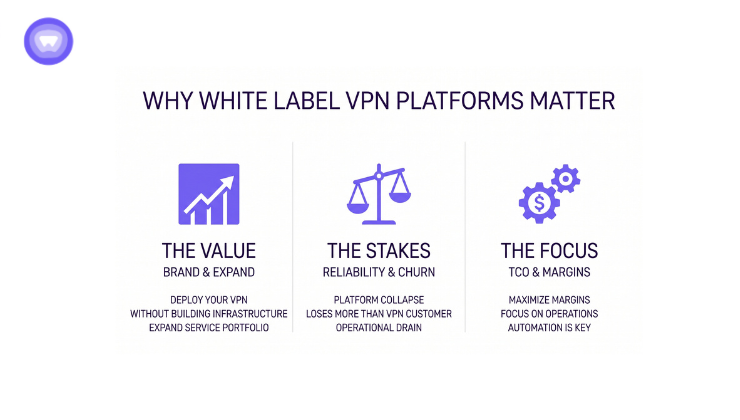
A white label VPN platform lets you rebrand and deploy VPN services under your own name without building the infrastructure yourself. MSPs use these to expand service portfolios. SaaS vendors embed them as security features. Telecom providers add them as value-added services. All of them share the same core question: which platform won’t collapse under load or drain operational resources.
The stakes are measurable. When an embedded VPN service fails, you lose the customer not just for VPN, but potentially for your entire product suite. When churn spikes on a bundled offering, your acquisition cost payback collapses. Generic comparison blogs focus on feature parity. They miss the operational layer where margins live or die.
The Churn Problem: Why Bundle Strategy Matters More Than You Think
Here’s the operational reality most VPN content ignores. MSPs who bundle VPN with antivirus or endpoint detection see 50% lower churn compared to those offering VPN as a standalone SKU. SaaS platforms embedding VPN cut customer churn by 18% on average. This isn’t about VPN quality. It’s about switching cost and value stack depth.
Single-threaded security stacks fail fast. Customers tolerate one mediocre tool in a three-service bundle. They don’t tolerate one mediocre tool standalone. This math changes platform evaluation completely. A platform optimized for bundling economics beats a platform optimized for standalone performance every single time.
Why does this matter? Because your CAC recovery timeline depends on it. If your bundled upsell takes 60% longer to churn than your core product, you can afford slower sales cycles and higher acquisition costs. If bundled upsell churns at the same rate as standalone, acquisition becomes unprofitable for lower-tier segments.
Infrastructure Reliability: The Cost of Downtime You Don’t See in Datasheets
Every white label VPN platform claims 99% or higher uptime. All of them publish SLA documentation. None of them publicize the operational cost of a failed deployment in your customer’s environment.
When a white label VPN service goes down, your support team owns the escalation. Your product gets blamed. Your customer success manager spends 8 hours troubleshooting someone else’s infrastructure. That’s not part of the published cost model, but it’s very real.
Platform selection determines whether outages stay isolated or cascade. Platforms with distributed architecture and regional failover absorb failures quietly. Platforms with centralized authentication or single-region backend force you into damage control. The difference in operational cost per incident ranges from $0 to $2,500+ depending on how fast your team can detect and escalate.
Infrastructure maturity also determines your maintenance window burden. Some platforms require coordination for routine updates. Others handle updates transparently. This affects your customer communication load, your support queue depth, and your ability to scale without scaling support headcount proportionally.
Implementation Speed vs. Long-Term Operational Load
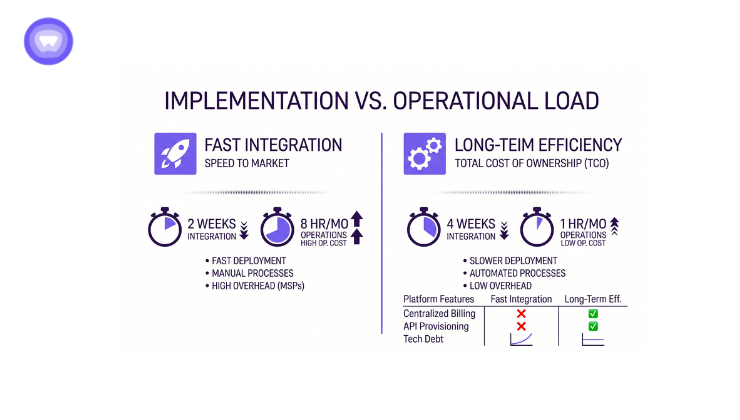
Most white label VPN platforms promise fast integration. Integration speed and operational complexity are not the same thing. A platform you integrate in 2 weeks might require 8 hours of operational management per month. Another might take 4 weeks to integrate but need 1 hour per month of operational management.
MSPs deploying to 50+ clients experience this as a multiplication factor. If Platform A requires weekly configuration syncs and Platform B requires monthly syncs, Platform A adds 200+ hours of operational overhead annually. That’s 0.1 FTE you didn’t budget for.
Look for platforms with automated deployment, centralized billing, and API-driven customer provisioning. Platforms requiring manual user setup per account create technical debt that compounds with scale.
Data Broker Exposure and Privacy Incident Costs
The compliance landscape around VPN platforms has shifted dramatically. Data brokers now operate in the US with minimal oversight. The California DROP platform, live since January 2026, requires deletion across 545 registered brokers with penalties starting at $200 per day per unfulfilled request beginning August 2026. Platforms with transparent no-log policies backed by independent audit become competitive advantages, not luxury features.
Customers increasingly ask about data handling and broker exposure. If your chosen white label platform can’t provide KPMG-verified audit evidence and transparent no-log protocols, you inherit customer skepticism and potential compliance exposure. This is a growing filter for enterprise and fintech customers.
Server Coverage and Geo-Routing Performance
White label VPN platforms vary dramatically in infrastructure. Some maintain 150+ global servers. Others operate 30-40 strategically positioned endpoints. Coverage depth matters less than query response time and consistent throughput from your target geographies.
If your ICP is North American SMBs, dense coverage in three US regions beats coverage across 80 countries. If your ICP is crypto platforms or fintech, coverage in restricted jurisdictions and reliable APAC routing becomes critical. Platform selection should map to customer usage patterns, not marketing headcount.
Throughput degradation under load is rarely published. Request a performance baseline from your target regions under realistic load (100+ concurrent connections per server). Platforms that won’t provide this data may hide performance cliffs.
SDKs, APIs, and Integration Friction
The difference between a smooth integration and an integration nightmare often comes down to SDK maturity and API documentation quality. Platforms offering native SDKs for iOS, Android, Windows, and web reduce your development timeline. Platforms requiring custom wrapper layers add weeks to deployment.
API documentation quality determines whether your backend engineering can move fast. Poor documentation creates back-and-forth with platform support, slowing feature release cycles.
Check whether the platform provides:
- Native SDKs for all target platforms
- Comprehensive REST API documentation with example calls
- Webhook support for customer provisioning and usage events
- Rate limits published and aligned with your scaling profile
- Development sandbox with realistic data
Platforms treating APIs as second-class features compared to dashboard UI suggest where customer priority sits. That priority determines how fast you can build on top of the platform.
Pricing Model Alignment: Where Most Deployments Fail
White label VPN platforms price per-user, per-seat, per-bandwidth, or hybrid models. Your business model determines which pricing structure actually works.
Per-user models work well for MSPs serving SMB. Costs stay predictable. Churn is obvious. Revenue per user is easy to model. Per-user becomes expensive for high-bandwidth use cases or volumetric users like SaaS platforms with millions of free tier users. Platform margins evaporate if your free tier has 40% conversion with small per-user fees.
Bandwidth-based models work for crypto platforms and high-throughput financial services. They require traffic monitoring and metering infrastructure. Cost predictability is harder. But total cost scales with actual usage, not theoretical maximum.
Hybrid models combine per-user tiers with bandwidth overage charges. They offer flexibility but create billing complexity and customer disputes over overage calculations. Make sure your finance team can audit the math.
Most failed deployments involve pricing misalignment, not platform quality. A premium platform that charges per-user won’t work profitably if your customer base is price-sensitive free-to-paid converters. A basic platform with commodity pricing won’t work if you need per-customer audit compliance and detailed reporting.
Compliance and Audit Requirements: Enterprise Deal Enablers or Blockers
Fintech platforms need GDPR, PCI-DSS, and CCPA evidence. Public sector needs FedRAMP or equivalent. Healthcare needs HIPAA documentation. Enterprise needs SOC 2 Type II audit trails.
Most white label VPN platforms can claim some compliance. Few have invested in the audit infrastructure to prove it at the level enterprise procurement demands. If your enterprise TAM is significant, make sure the platform’s compliance posture matches your target customer requirements.
A platform with SOC 2 Type II certification and KPMG-verified audits enables enterprise sales conversations that platforms with self-reported compliance simply cannot. The cost to your platform vendor to maintain these audits is substantial. That cost usually shows up in platform pricing. But the sales enablement ROI is outsized for enterprise-focused businesses.
Cost of Customer Support Integration: White label VPN Platforms Compared
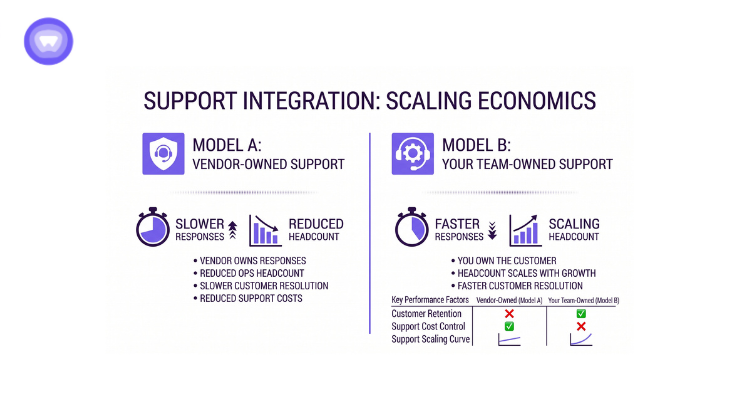
White label VPN platforms vary in how much they push support to your team versus absorbing it themselves. Some platforms provide tiered support where they own first-response and L2 troubleshooting. Others make your team the primary support interface and require you to escalate technical issues into their support queue.
If your platform vendor owns customer support, you reduce support headcount needs. You inherit slower response times to customer issues since support sits one layer removed from product engineering. If your team owns primary support, you scale support headcount with customer growth, but you respond faster and own the customer relationship quality.
This isn’t a feature. It’s a business model assumption that determines your scaling economics. Map your support cost model against your customer growth plan. If you can’t afford proportional support scaling, you need a platform that absorbs support load.
Building Competitive Advantage Through Platform Economics
Here’s the operational insight that separates thriving deployments from mediocre ones. The best white label VPN platforms are not the ones with the most features. They’re the ones whose economics align with your business model.
An MSP selling to mid-market should prioritize bundling economics, automated billing, and low operational overhead over feature richness. A SaaS platform embedding VPN as a security feature should prioritize SDK quality, churn reduction, and seamless authentication integration over server count. A fintech platform needs compliance audit trails and regulatory documentation more than customer dashboard polish.
Evaluate platforms against your actual operational constraints, not feature parity with public VPN vendors.
Operational Maturity: The Platform Attributes That Scale
White label VPN platforms compared that scale without operational breakdown share these characteristics:
Automated provisioning reduces manual user setup per customer from hours to minutes. Platforms with API-driven account creation, automated billing system sync, and webhook notification chains eliminate the repetitive operational work that compounds with growth.
Transparent usage reporting enables customer self-service and reduces support escalations. Platforms providing real-time bandwidth tracking, per-device usage visibility, and predictable cost breakdowns reduce customer disputes and surprise overages.
Proactive incident communication prevents customer escalations. Platforms that notify you of incidents before customer impact, provide root cause analysis, and publish incident postmortems build trust and reduce customer churn spikes during outages.
Centralized control panel keeps operational overhead flat. Platforms allowing bulk customer management, batch configuration changes, and single-pane-of-glass visibility prevent your team from managing customer accounts in spreadsheets or custom scripts.
Native CRM integration syncs customer data bidirectionally between your billing system and the platform. Manual data sync creates stale records and data inconsistencies that break customer provisioning or overcharge customers due to sync failures.
MSPs Bundling Antivirus Plus VPN: The Case Study Economics
One MSP partner integrated white label VPN with their existing antivirus bundle targeting mid-market businesses with 50-500 employees. Here’s what changed operationally.
Before bundling: VPN as standalone offering had 24-month churn at 35%. Customer acquisition cost was $800. Revenue per customer was $40/month. Payback was 20 months.
After bundling VPN with antivirus: Bundled package churn dropped to 18% within 6 months. Revenue per customer jumped to $75/month on same deployment base. Payback compressed to 11 months. Within 18 months, the bundled offering accounted for 32% of renewal revenue and 25% revenue growth.
This wasn’t about VPN quality. It was about bundling cost structure, customer switching cost, and perceived value density. The same platform they tested standalone would have stayed at 35% churn if they hadn’t changed the bundling and pricing model.
Fintech Use Case: Compliance-Driven Platform Selection
Fintech platforms process sensitive customer data and face escalating regulatory scrutiny. One fintech platform chose their white label VPN vendor based primarily on compliance posture, not features. The platform required GDPR evidence, PCI-DSS audit trails, and verifiable no-log policy backed by independent audit.
This decision accelerated enterprise sales cycles by 8-12 weeks because procurement could move to contract phase without additional security questionnaires. It also reduced customer support load around data handling questions by approximately 40% once word spread internally that compliance was pre-validated.
The platform they chose had smaller server footprint than competitors, fewer UI features, and slower customer support response times. But alignment with their compliance requirements eliminated a customer conversation altogether and compressed sales cycles enough to justify platform selection.
Comparison Table: Operational Attributes vs. Feature Lists
The left column determines whether your operational load stays flat or explodes with customer growth. The right column is what most comparison content focuses on.
| Operational Attribute | Impact on Scaling | Feature Checklist Impact |
| API-driven provisioning | Reduces manual onboarding from 4 hours to 15 minutes per customer | Not visible on feature list |
| Webhook notifications for provisioning events | Eliminates manual sync tasks, reduces support escalations by 30% | Listed as “automated provisioning” |
| SOC 2 Type II audit certification | Enables enterprise sales, compresses sales cycles 8-12 weeks | Not listed on feature checklist |
| Centralized billing sync | Prevents revenue leakage, reduces accounting overhead 60% | Listed as “integrated billing” |
| Per-region failover with transparent switchover | Reduces incident escalations, lowers support cost per incident | Buried in “99.9% uptime” claim |
| Native mobile SDK with offline support | Reduces mobile development time 6-8 weeks | Listed as “iOS/Android support” |
| Real-time usage reporting via API | Reduces customer disputes over overage charges | Listed as “usage analytics” |
| Dedicated infrastructure isolation per customer (optional) | Enables compliance-sensitive deployments | Listed as “multi-tenant architecture” |
The Integration Reality: Hidden Implementation Costs
Most white label VPN platform quotes focus on per-user or per-bandwidth cost. They don’t include implementation cost. Implementation cost determines actual total cost of ownership.
Platforms requiring custom authentication integration add 2-4 weeks of engineering. Platforms requiring manual testing per customer add operational overhead. Platforms requiring infrastructure setup on your side add hosting cost. These costs amplify across 50+ customers and become non-trivial.
When evaluating platforms, ask for implementation timeline, engineering resource commitment, and ongoing operational overhead in hours per month per 100 customers. The platform with the lowest per-user cost but highest implementation overhead often becomes the most expensive total cost of ownership.
Why Bundled Security Services Reduce Churn: The Behavioral Economics
Customer retention improves when white label VPN is part of a bundled security stack because of switching cost and perceived value depth. Removing one service from a three-service bundle feels like a downgrade. Canceling one service from a standalone product is just cancellation.
This principle applies across industries. MSPs bundling VPN with antivirus reduce churn. SaaS platforms embedding VPN with threat protection reduce churn. Telecom providers bundling VPN with device security reduce churn.
The platform you select should be optimized for bundling scenarios if bundling is your strategy. Platforms built for standalone deployment often create friction when integrated with other services. Platforms built for bundling provide centralized user management, unified authentication, and coordinated billing that make the bundled experience seamless.
Building Business Case Around Platform Selection
Your white label VPN platform choice should enable a business case, not just deliver a feature. Use these metrics to build internal business case for platform selection:
Customer acquisition payback period depends on bundling economics and churn. A platform that reduces bundled churn from 25% to 15% compresses payback from 18 months to 12 months. That’s $300,000 in annual working capital freed up for 50 customers.
Support cost scaling depends on operational maturity. A platform requiring 4 hours of operational overhead per month per 100 customers adds 1 FTE at scale. That’s $60,000 annual cost that competitors with automated platforms don’t carry.
Enterprise market enablement depends on compliance posture. A platform with SOC 2 audit backing might cost 20% more per user but enable enterprise customers spending 10x more per seat. The TAM expansion justifies the premium.
Revenue per customer depends on pricing model alignment. A platform priced per-bandwidth instead of per-user might increase your revenue per customer by 40% if your customer base has predictable high bandwidth usage. That’s $300,000 incremental annual revenue for 50 customers.
Platform selection is not a feature comparison. It’s an operational and economic alignment question.
Operational Maturity and Customer Success
PureWL’s approach to white label VPN prioritizes operational maturity over feature complexity. Their platform is built for MSPs and SaaS vendors who need bundling economics, automated provisioning, and support-light deployment.
They handle customer support directly, reducing your support team load. They provide native SDKs for major platforms, reducing development friction. They offer automated billing sync, reducing accounting overhead. They maintain KPMG-verified no-log policy and SOC 2 Type II certification, enabling enterprise and fintech customers without additional security questionnaires.
Most importantly, their platform is built around the assumption that white label VPN is embedded in a bundled security stack, not deployed standalone. This changes everything operationally.
For MSPs bundling with antivirus: PureWL handles backend infrastructure while you manage customer relationships and deploy antivirus endpoints. For SaaS embedding VPN: PureWL provides SDKs and APIs that integrate into your authentication layer. For fintech platforms: PureWL’s compliance audits compress your sales cycles and reduce customer friction around data handling.
Their customer outcomes reflect this operational focus. MSPs see bundled churn reduction, SaaS platforms see customer churn reduction, and enterprise customers move to contract phase without extended procurement cycles.
Choosing Based on Operational Reality, Not Feature Lists
White label VPN platforms compared selection determines whether your deployment scales smoothly or creates operational drag. Most comparison content focuses on features and server count. Real deployment reality lives in bundling economics, churn impact, implementation complexity, and ongoing operational load.
Platforms optimized for bundling reduce churn and compress customer payback. Platforms with mature APIs enable fast integration and minimal ongoing support overhead. Platforms with enterprise compliance backing enable higher-value customer segments and faster sales cycles.
Evaluate white label VPN platforms against your actual business model, not against generic feature checklists. The platform that solves your operational constraints beats the platform with the longest feature list every time.