

Key Takeaways
- Data, not a product: Constella sells identity exposure data. Your team still builds alerts, fixes, and support flows.
- Four layers: A full product has four jobs: find leaks, link them to one person, fix them, and help victims.
- Gap to fill: Constella lists no broker removal, victim help, or insurance on its partner page.
- Pick by layer: SpyCloud and Enzoic swap the data. Optery adds removal. Iris OnWatch and Experian add victim help.
- Stack with care: Two vendors need one user key and one alert queue, or users get the same alert twice.
Account takeover hit 6 million US consumers in 2025, up 18% from the prior year. Javelin Strategy & Research ranked it the costliest fraud type, with losses above $15 billion, per its 2026 fraud study. Each victim becomes a support ticket, a refund request, or a cancellation for the brand that sold protection.
Alert volume makes the problem worse. The Identity Theft Resource Center counted a record 3,322 US data compromises in 2025. Its annual breach report also found nearly 40% of surveyed consumers received three to five breach notices in a year. An identity protection product that only repeats those notices adds noise, not value.
That is the real reason product teams search for Constella Intelligence API alternatives. Constella sells strong data for finding leaks. The rest of the product, from removal to recovery, stays on your roadmap. This guide compares Constella Intelligence API alternatives by which layer of an identity protection product each one covers.
What Constella Intelligence API Delivers and Where It Stops
Before you compare Constella Intelligence API alternatives, it helps to pin down what Constella sells today. The three sections below use only claims from Constella’s own partner and API pages.
Data Scale and Matching
Constella pitches its partner offer as a checked identity data layer for channel and tech partners. Its partner page cites 54.6 billion curated records and 70+ search fields. These include email, username, phone, IP address, device ID, and street address.
The API returns breach, infostealer, and dark web data in under a second. Constella says each record goes through seven checks. Those checks remove duplicates, add timestamps, and confirm the source. Constella reports SOC 2 Type II and GDPR compliance.
Infostealer coverage stands out. Constella reports 51.7 million infostealer packages traded on criminal markets in 2025. It says 98.6% of those packages held active passwords.
Commercial Models and Timelines
Constella offers three partner structures:
- API integration: Direct access to the data, billed per query or per monitored identity.
- OEM or white label: Constella data presented as native to the partner’s product.
- Resale: Partners sell Constella’s research tools to clients for a margin.
Constella says a standard credential alert setup goes live in two to four weeks. That estimate assumes you have your own API developers. Infostealer alerts, OEM setup, and custom alert formats take longer, per the same page.
What the Partner Still Builds
Constella’s partner page does not list broker removal, fixes, victim recovery, or insurance. So a partner using Constella data still owns four jobs:
- Writing alerts a non-technical user can act on
- Removing exposed records from people-search sites
- Handling victims after fraud occurs
- Answering the support tickets every alert creates
None of this is a flaw in Constella. It is the line between a data supplier and a finished product.
Why Teams Search for Constella Intelligence API Alternatives
Identity protection providers usually start this search for one of four reasons. Each reason points to a different type of alternative, so name yours first.
The Product Needs a Fix, Not Only an Alert
Breach data tells a user what leaked. It does not remove the home address a scammer uses for a pretext call. Teams that hear “what do I do now” in support queues need a remediation layer.
Victims Need a Human
After fraud occurs, users want a case manager, creditor letters, and reimbursement. A data API cannot provide those. Teams in this position need a restoration partner, not a second data feed.
The Pricing Shape Does Not Fit
Per-query pricing suits products that check each user rarely. Per-identity pricing suits products that check often. Pick the wrong one, and your cost grows faster than your user base.
Engineering Capacity Is Thin
Constella’s two-to-four-week estimate assumes you have API developers in house. Teams without them need a hosted portal, an SDK, or a full white-label app.
The Four Layers of an Identity Protection Product
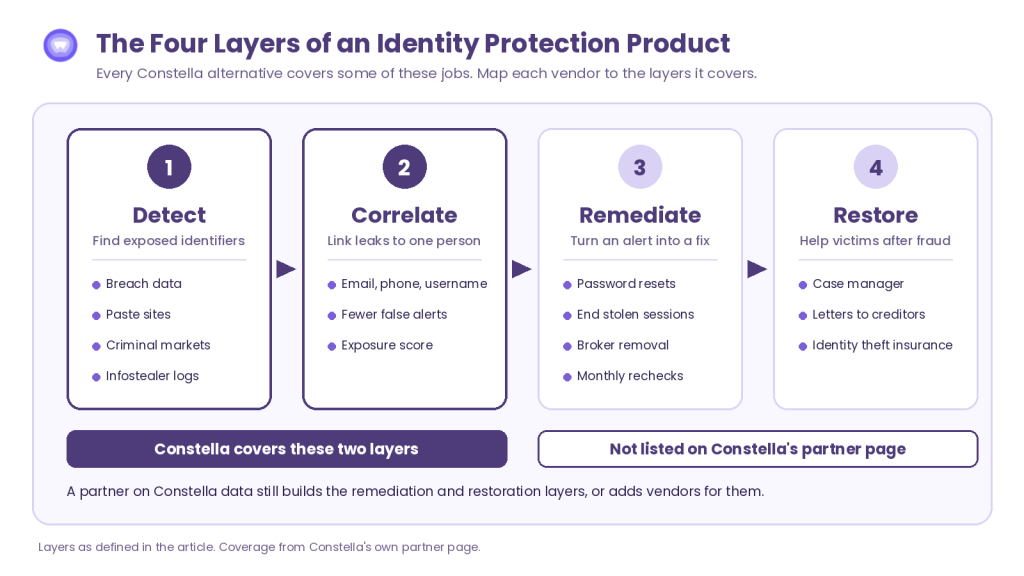
Every Constella alternative covers some of the same four layers. Mapping vendors to layers shows what each contract leaves on your roadmap.
Layer 1: Detect
Detection finds exposed identifiers in breaches, paste sites, and criminal markets. Infostealer data matters most here. Stolen session cookies let attackers skip passwords and MFA, so password-only breach data misses live account risk.
Layer 2: Correlate
Correlation ties an email, phone number, and username to one person. Good linking cuts false alerts and feeds an exposure score. It also splits consumer monitoring from corporate domain monitoring, which watches every address on a company domain.
Layer 3: Remediate
Remediation turns an alert into a fix. That means password resets, steps to end stolen sessions, and broker removal. Removal never ends, because brokers rebuild profiles from new public records. Executive safety programs call for monthly rechecks after every removal for that reason.
Layer 4: Restore
Restoration helps the user after fraud happens. It means a case manager, letters to creditors, and identity theft insurance. Few data vendors offer it. It also brings its own legal and insurance rules.
Constella Intelligence API Alternatives Compared
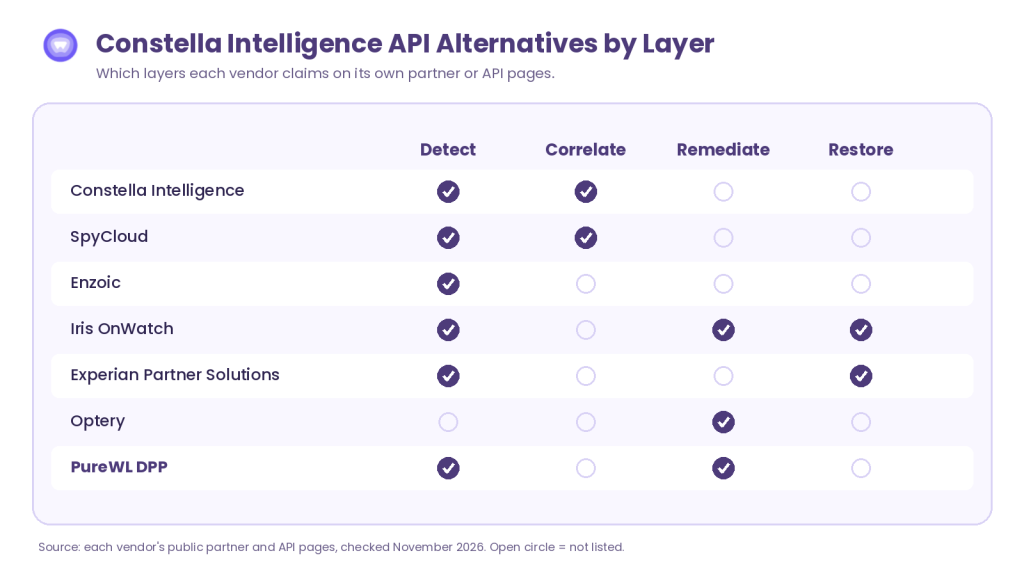
The table below compares Constella with six alternatives on the same six factors. Every cell comes from the vendor’s own public pages. “Not listed” means the vendor’s partner or API page does not claim that capability.
| Vendor | Main Layer | Infostealer Data | Data Broker Removal | Identity Restoration | Delivery Options | Pricing Shape (Public) |
|---|---|---|---|---|---|---|
| Constella Intelligence | Detect, Correlate | Yes | Not listed | Not listed | API, OEM, resale, bulk cloud delivery | Per query or per monitored identity |
| SpyCloud | Detect, Correlate | Yes (malware-infected devices) | Not listed | Not listed | API | Tiered by customer accounts protected |
| Enzoic | Detect | Not stated | Not listed | Not listed | API, SDKs | Startup, Business, Enterprise plans |
| Iris OnWatch | Detect, Remediate, Restore | Not stated | Yes, hundreds of sites | Yes, 24/7/365 plus insurance | API, micro-experiences, hosted portal | Not published |
| Experian Partner Solutions | Detect, Restore | Not stated | Not specified | Yes | API, embedded, hosted | Not published |
| Optery | Remediate | Not listed | Yes, 635+ brokers | Not listed | API | Not published |
| PureWL DPP | Detect, Remediate | Yes, real-time and historic | Yes, 400+ sites, monthly re-checks | Not listed | Full white label, API, SDK, hybrid | Quoted per partner |
Each alternative below gets a short profile. PureWL appears in its own section near the end.
SpyCloud: A Like-for-Like Data Replacement
SpyCloud sells its data to identity theft apps, password managers, and dark web alert services. Its APIs handle data collection, cleanup, and matching. Its Consumer IDLink API, launched in August 2025, links email, phone, username, and IP address in one call.
SpyCloud sets its consumer pricing by the number of customer accounts you protect. It also gives data partners message templates. Fixes and victim help still stay with you, just as with Constella.
Best fit: Teams that want to swap one detection data supplier for another.
Enzoic: Credential and PII Checks for Authentication
Enzoic offers separate APIs for passwords, logins, and exposures. Its Identity Breach Monitoring API lets partners register whole identities and get alerts on new leaks. Enzoic says it does not store or log the passwords or hashes you send it.
A free API key covers initial testing. Paid access comes in Startup, Business, and Enterprise plans. Enzoic positions itself for login flows and password resets more than consumer dashboards.
Best fit: Products that need exposure checks inside sign-up and login, not a full protection suite.
Iris OnWatch: A Full-Service Program With Restoration
Iris used to be called Iris Powered by Generali. It now runs as Iris OnWatch, and its homepage announces a management-led buyout. Partners can plug in its API, add small embedded widgets, or use a branded OnWatch portal.
Iris lists identity alerts, credit alerts, and a data removal service that covers hundreds of broker sites. It adds 24/7/365 help for theft victims and up to $3M in identity theft insurance. A third-party insurer backs that cover, and Iris notes it may not apply everywhere.
Best fit: Banks, insurers, and benefits firms that want victim help and insurance in one package.
Experian Partner Solutions: Credit-Led Identity Protection
Experian Partner Solutions sells identity alerts, help for fraud victims, and digital privacy tools. It also offers credit monitoring, credit scores, and breach response. Partners can use its APIs, pre-built parts, or a portal that Experian hosts.
Experian’s partner page does not state whether its digital privacy tools include data broker removal. Ask for that scope in writing before you compare it with a removal vendor.
Best fit: Fintech and lending brands that want credit data next to identity alerts.
Optery: A Removal Layer, Not a Detection Layer
Optery’s API lets partners embed personal data removal inside their own apps. The API page claims support for 635+ data brokers and SOC 2 Type II attestation. It names security software, VPN software, and reputation management as target use cases.
The API page centers on data broker removal and does not list dark web or infostealer monitoring. Teams pair it with a detection supplier such as Constella.
Best fit: Teams that keep Constella for detection and only need the removal layer.
Illustrative Math: How Pricing Shape Changes Your Bill
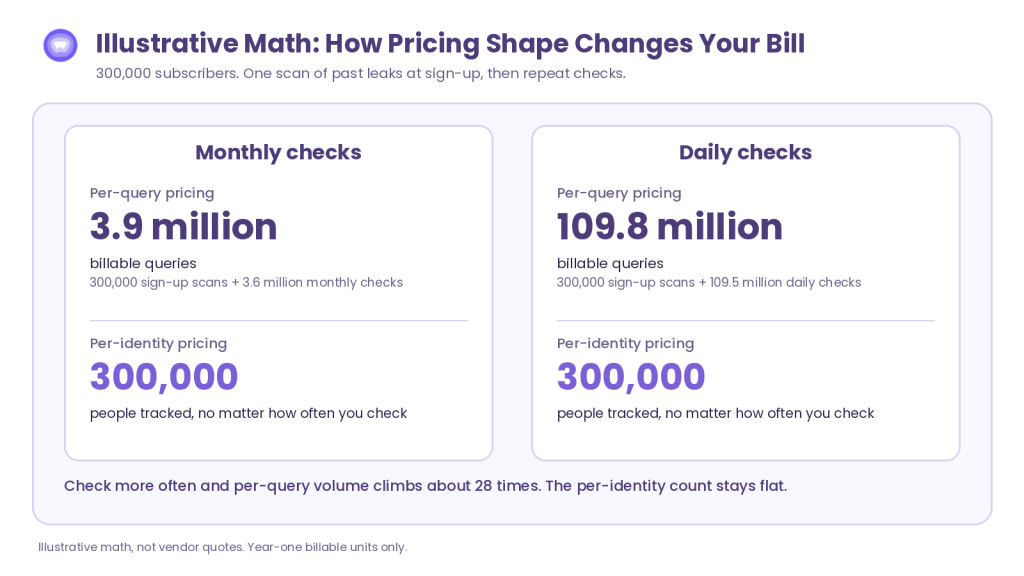
The figures below are illustrative, not vendor quotes. They show how query volume grows under each pricing shape.
Picture a provider with 300,000 subscribers. Each new user gets one scan of past leaks at sign-up. The product then checks each user again once a month.
- Per-query pricing: 300,000 sign-up scans plus 3.6 million monthly re-checks equals 3.9 million billable queries in year one.
- Per-identity pricing: The bill counts 300,000 people, no matter how often you check them.
- Daily re-checks: Per-query volume jumps to about 109.8 million queries a year. The per-identity count stays at 300,000.
Removal adds a second meter. Brokers re-list profiles, so every removal needs a monthly recheck and a re-run when data returns. A removal vendor that bills per request charges again for each re-run. Ask each vendor which events trigger a charge before you model margin.
Combining Vendors Without Doubling Alerts
Most identity protection providers end up with a stack, not one vendor. Constella or SpyCloud finds leaks, a removal vendor fixes them, and a recovery partner helps victims. That setup works, but it brings three build risks.
One Identity Key Across Vendors
Each vendor assigns its own user ID. Map every vendor ID to one internal identity key at enrollment. Without that key, one user can appear as three people in your analytics and billing.
One Alert Queue
Two detection feeds often report the same breach. Deduplicate on breach source and identifier before any alert reaches the user. Otherwise users receive the same warning twice and lose trust in both.
One Status Model for Removal
Each removal vendor uses its own status labels. Map them to one simple set, such as submitted, in progress, done, and re-listed. Support agents then answer every removal question from one screen.
Proof: Built-In Security Keeps Users
Users notice when a product leaves them exposed. In one PureWL case study, over 30% of users who uninstalled a productivity app cited weak security. The app cut uninstalls by 18% within 90 days after adding built-in protection.
That result came from a built-in VPN, not from identity alerts. It is the partner’s own reported data. Still, it shows a pattern identity protection providers share. Users stay when protection lives inside a product they already use.
How PureWL Fits Among Constella Intelligence API Alternatives
PureWL Digital Privacy Protection bundles dark web monitoring and data broker opt-out under your brand. Monitoring covers breaches and infostealer malware, real-time and historic. The removal side scans 400+ people-search and broker sites. It re-checks each listing every month and runs removal again when data comes back. Partners can deploy a full white-label platform, pull single modules through the API and SDK, or mix both.
PureWL holds ISO 27001 and SOC 2 Type II certification and shares full audit reports with partners under NDA. The company reports 150+ partners and two decades in privacy infrastructure, which are its own figures. PureWL does not list identity restoration or insurance. Pair it with a restoration partner if your product needs that layer. Teams already on Constella data can add the PureWL removal service as the remediation layer and keep their detection supplier.
Conclusion
Constella Intelligence API alternatives fall into three groups. Most identity protection providers need at least two of them. Some replace the detection data, some add removal, and some add restoration. Start by naming the layer your product lacks. Then shortlist Constella Intelligence API alternatives that cover that layer. Model pricing against your real check frequency and re-listing rate before you sign.
If your gap is remediation, the fastest path keeps your detection supplier and adds a branded removal layer. If your gap is the whole product, a white-label platform removes most of the build. A PureWL engineer can map your current stack against all four layers in one session.
Request API sandbox access for a 20-minute integration walkthrough.
Frequently Asked Questions
What is the Constella Intelligence API?
It is a RESTful API that returns verified breach, infostealer, and dark web identity data from Constella’s data lake.
What are the best Constella Intelligence API alternatives?
SpyCloud and Enzoic swap the data, Optery adds removal, and Iris OnWatch and Experian add victim help.
Does Constella offer data broker removal?
No, its partner page lists no broker removal, no fixes, no victim recovery help, and no insurance.
How is the Constella Intelligence API priced?
Constella bills per query or per tracked person, and it posts no dollar prices.
Can I use Constella with another identity protection vendor?
Yes, if you map all vendors to one identity key and deduplicate alerts before they reach users.