

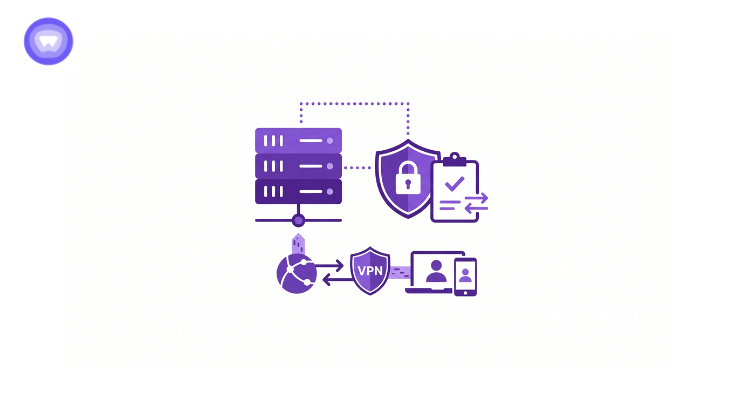
- A VPN’s no-log policy only covers network traffic. Your platform’s own account, billing, and access logs still fall under your own compliance duty, not the vendor’s.
- Legal requests for a white-label app usually go to the reseller brand first, since its name is on the app listing and billing records, not to the underlying VPN infrastructure provider.
- PCI DSS Requirement 10.7 requires audit trail retention for at least one year, with the most recent three months immediately accessible, regardless of the VPN vendor’s own logging policy.
- Server jurisdiction can override a stated no-log claim. Laws like the UK’s Investigatory Powers Act can legally compel data retention despite a provider’s marketing promises.
- A no-log claim without a stated audit scope is a marketing line, not proof. Always confirm exactly which servers and systems an independent audit actually examined.
A fintech platform embeds VPN access into its banking app. It reads the provider’s no-log claim. It assumes that claim covers its own compliance obligations. It does not. White label VPN logging runs across separate layers. Most procurement teams never separate those layers on paper. The gap surfaces only when a regulator or a subpoena asks a direct question.
Getting white label VPN logging wrong is not a theoretical risk. A fintech product moving transaction data over a branded VPN tunnel still owes its own logging duties. PCI DSS and GLBA both apply here. Those duties exist independent of what the VPN infrastructure retains. Confusing the two is the most common mistake in white label VPN logging decisions. It rarely surfaces until an examiner or a legal request forces the question.
Two Logging Domains Fintech Teams Confuse
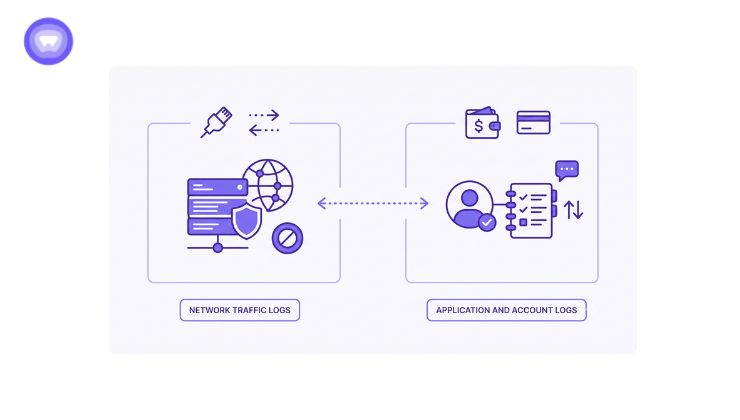
White label VPN logging is not one policy. It is at least two policies. Each runs on different systems. Each answers to a different regulator.
The first domain is network traffic logging. This covers connection timestamps, IP assignment, bandwidth use, and DNS resolution at the infrastructure layer. A no-log policy usually describes this layer only. An independent audit typically examines this layer when a provider claims a strict no-log architecture.
Protocol choice affects what this layer can even produce. WireGuard’s stateless handshake model keeps almost no session state once a connection drops. OpenVPN and IKEv2/IPsec implementations vary more, since some log configurations retain ephemeral session tokens for reconnection handling. The underlying encryption standard also shapes what briefly exists in memory during a handshake. RAM-only server architecture removes persistent disk storage entirely, so nothing survives a reboot regardless of what a config file requests.
The second domain is application and billing logging. This covers account creation, session authentication, payment processing, and support tickets on the reseller’s own platform. A fintech partner white-labeling VPN access still generates this second category on its own servers. No infrastructure provider’s no-log policy was written to cover it.
Network Traffic Logs
These logs sit with the underlying VPN infrastructure. A strict no-log architecture means the provider drops browsing history, DNS queries, and IP-to-session mappings once the connection ends. This is the layer most marketing pages describe.
Application and Account Logs
These logs sit with the fintech platform itself. They form the moment a user authenticates, moves money, or opens a support case. White label VPN logging discussions routinely skip this layer. A compliance officer may treat the vendor’s audit certificate as proof of the platform’s own logging posture. That is the wrong question.
Who Actually Answers a Legal Request
A subpoena naming a branded VPN app does not route to the infrastructure provider automatically. It routes to whichever name sits on the app listing, the terms of service, and the billing statement. In a white-label arrangement, that name belongs to the fintech brand, not the vendor behind it.
The fintech partner is usually the first party contacted. That partner needs its own procedure for forwarding a network-layer request to the infrastructure provider. The partner has no technical ability to produce traffic logs it never held.
Transparency reporting across the VPN industry shows this is routine. One widely tracked industry review found major providers routinely field hundreds of government and law enforcement requests per six-month cycle. A fintech partner should plan for volume at that scale. Build a routing procedure before the first request lands, not after.
The routing gap creates a second risk. Without a documented escalation path, front-line staff may try to answer a legal request directly. Nobody defined who owns it, so nobody stopped them. An unauthorized or incomplete reply can create its own exposure, separate from the request itself.
| Log Type | Who Controls It | What It Typically Contains | Compliance Relevance |
| Network traffic logs | VPN infrastructure provider | Connection times, IP assignment, DNS queries | Covered by no-log audit scope |
| Billing and account logs | Fintech brand (reseller) | Signup data, payment records, session auth | PCI DSS, GLBA vendor oversight |
| Application access logs | Fintech brand’s own platform | Transaction access, support tickets | Internal audit trail requirement |
| Third-party audit records | Independent auditor | Scope, methodology, findings | Proof of infrastructure claims |
Consider a concrete case. A fintech app processes 40,000 monthly active users through a branded VPN tunnel. The VPN vendor’s own logs never touch that traffic once the session closes. But the fintech app itself still logs every login, every transfer request, and every support ticket tied to those accounts. Those application logs are the ones an examiner will ask for first, not the vendor’s network logs. Confusing white label VPN logging with a single vendor-owned obligation leaves that entire application layer unaccounted for. The platform’s own compliance documentation ends up with a gap nobody notices until an audit does.
What PCI DSS and GLBA Still Require
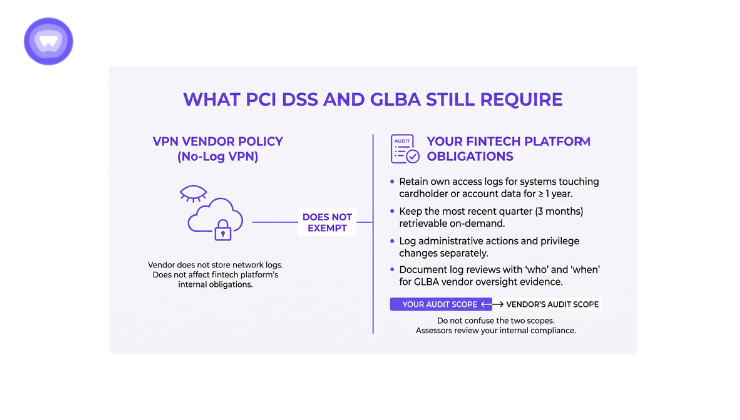
A no-log VPN policy does not exempt a fintech platform from its own audit trail duty. PCI DSS Requirement 10.7 sets a one-year minimum for audit trail retention, with the most recent three months immediately accessible. That clock runs regardless of the VPN vendor’s own network policy.
This requirement covers the cardholder data environment the fintech platform runs, not the VPN tunnel carrying traffic through it. A team that treats a vendor’s no-log certificate as proof of its own PCI compliance has confused two audit scopes. A real assessor keeps them separate.
Obligations a fintech partner owns regardless of VPN vendor policy:
- Retaining access logs for systems touching cardholder or account data for at least one year
- Keeping the most recent quarter of those logs retrievable on demand
- Logging administrative actions and privilege changes separately from routine activity
- Documenting who reviewed those logs, and when, for GLBA vendor-oversight evidence
Treating white label VPN logging as one settled question, closed once a vendor confirms no-log networking, leaves this second obligation unaudited. An examiner reviewing GLBA vendor oversight asks for the platform’s own retention policy, not the vendor’s marketing page. A missing answer counts against the fintech brand.
Jurisdiction Decides What No Logs Means
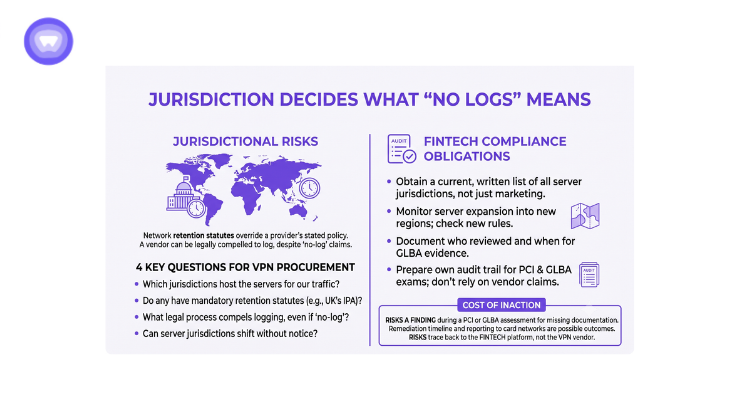
A no-log claim is only as strong as the jurisdiction enforcing it. Some countries impose retention statutes on network operators that override a provider’s stated policy.
The United Kingdom’s Investigatory Powers Act allows authorities to require connection record retention for up to twelve months. A VPN operating servers under an equivalent statute can be legally compelled to retain data its marketing calls uncollected.
Regulators are watching this exact gap. A 2025 coordinated enforcement review by European data protection authorities covered more than 750 controllers across 32 jurisdictions. It found widespread difficulty applying correct retention periods. Fintech risk teams evaluating white label VPN logging need the provider’s actual server jurisdiction list, not a marketing page.
Questions a fintech compliance team should raise before procurement closes:
- Which jurisdictions host the servers this fintech traffic will route through
- Whether any of those jurisdictions carry a mandatory retention statute
- What legal process would compel logging despite a stated no-log architecture
- Whether server jurisdiction can shift without notice as infrastructure scales
A vendor unwilling to answer these four questions in writing is not audit-ready, regardless of how confident its marketing sounds.
Fintech risk teams sometimes assume server jurisdiction is fixed once a contract is signed. It is not. Infrastructure providers add regions to meet demand and reduce latency for partners in new markets. That expansion can quietly move a fintech partner’s traffic into a new jurisdiction. Retention rules there may differ from the ones reviewed at signing. A jurisdiction list requested once during procurement goes stale the moment the vendor’s footprint changes.
Cost of inaction here is not abstract. A fintech platform that cannot produce its own access logs during a PCI assessment risks a finding. That finding can carry a remediation timeline and reporting to card networks. A platform that cannot answer a GLBA examiner’s vendor-oversight question risks the same outcome under a different regulator. Neither risk traces back to the VPN vendor. Both trace back to the fintech partner’s own missing documentation.
Verifying a No-Log Claim Before Signing
A no-log claim without a stated scope is a marketing line, not an audit finding. Third-party audits exist precisely to confirm what a vendor’s marketing only asserts. A fintech partner should ask what an independent audit actually examined. Was it the production traffic servers, a sample of them, or only the account layer above the network? A rigorous scope statement names the exact server pool tested and the testing window. It also states whether the auditor had shell-level access or relied on configuration review alone.
This distinction matters. An audit covering only account systems says nothing about traffic logs elsewhere in the stack. Scope gaps between what got audited and what a partner assumes was audited are common across white label VPN sourcing. A fintech compliance team should request the audit’s stated scope in writing. That request should ask whether the auditor verified server memory state directly, rather than trusting vendor-supplied configuration files.
Building a Logging Review Into Vendor Onboarding
A fintech compliance team should not review white label VPN logging once and move on. Vendor infrastructure changes. Server footprints expand. Audit scopes get renewed on their own schedule, not the fintech partner’s.
A workable review cadence looks like this:
- Request the current audit scope statement at signing, not just the certification badge
- Re-confirm server jurisdiction annually, since expansion into new regions can shift retention exposure
- Log the date of each vendor review internally, as its own compliance artifact
- Flag any vendor policy change that affects data residency to legal before renewal, not after
Annual review matters because a no-log claim can stay technically true while its practical scope shifts underneath a partner who never asked again. A vendor that expanded into a new jurisdiction last quarter may now carry retention exposure. It did not carry that exposure at signing.
This review does not need to be adversarial. A vendor confident in its own architecture should welcome a partner asking for scope detail in writing. A vendor that resists the question is telling a fintech team something worth hearing. Better to hear it before renewal than after an incident.
How PureWL Handles Data Logging Policies
PureWL separates network traffic logging from account and billing logging by design. It documents that separation for partners rather than leaving it implied. The underlying infrastructure runs on a SOC 2 Type II certified, KPMG-verified no-log architecture. PureWL states plainly which layer that certification covers.
Partners keep full ownership of their own account and billing logs. That means a fintech brand’s PCI DSS and GLBA obligations stay inside its own audit trail, not the VPN vendor’s. PureWL’s partner network spans 150 or more organizations across regulated verticals. Server jurisdiction detail is available during procurement, not after a review flags the gap. This partner figure reflects PureWL’s own reporting, kept separate from the independently audited SOC 2 finding above.
Final Thoughts
White label VPN logging is not settled by one no-log marketing claim. It spans network traffic, account records, jurisdiction, and audit scope. Each layer has a different owner and a different regulator watching it. A fintech partner that treats the vendor’s policy as the whole answer finds the real gap only later. That moment usually arrives with a live request already on the clock.
Request a jurisdiction and audit-scope review before the next compliance cycle, not after an examiner asks for one.